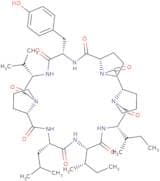
CAS 129536-23-8
:Hymenistatin I
Beschreibung:
Hymenistatin I ist ein Naturprodukt, das als Peptid klassifiziert ist, genauer gesagt als zyklisches Peptid, das aus dem Meereskrebs Hymeniacidon sp. gewonnen wird. Es weist eine einzigartige Struktur auf, die durch eine zyklische Anordnung von Aminosäuren gekennzeichnet ist, was zu seiner biologischen Aktivität beiträgt. Diese Verbindung hat im Bereich der medizinischen Chemie Interesse geweckt, da sie potenzielle antitumorale Eigenschaften aufweist, da sie in vorläufigen Studien gegen verschiedene Krebszelllinien aktiv war. Hymenistatin I wirkt durch Mechanismen, die die Hemmung spezifischer zellulärer Signalwege umfassen können, obwohl der genaue Wirkmechanismus noch untersucht wird. Darüber hinaus können seine strukturellen Merkmale seine Löslichkeit und Stabilität beeinflussen, die entscheidende Faktoren für therapeutische Anwendungen sind. Als eine Verbindung natürlichen Ursprungs stellt Hymenistatin I einen vielversprechenden Ansatz für die Arzneimittelentwicklung dar, insbesondere in der Onkologie, und hebt die Bedeutung der marinen Biodiversität bei der Suche nach neuartigen bioaktiven Substanzen hervor. Weitere Forschungen sind erforderlich, um sein pharmakologisches Potenzial vollständig zu ermitteln und seine Synthese und Modifikation zur Verbesserung der Wirksamkeit zu erkunden.
Formel:C47H72N8O9
Sortieren nach
Reinheit (%)
0
100
|
0
|
50
|
90
|
95
|
100
2 Produkte.
Hymenistatin I
CAS:Hymenistatin I (HS-I) exerts an immunosuppressive effect in the humoral and cellular immune responses comparable with that of cyclosporin A (CsA). Comparison of the influence of HS-I and CsA on cytokine production suggests that the mechanisms of the interaction with the immunological system are substantially different for the two compounds tested.Formel:C47H72N8O9Reinheit:99.3%Farbe und Form:White PowderMolekulargewicht:893.14Hymenistatin I Cyclo(-Pro-Pro-Tyr-Val-Pro-Leu-Ile-Ile)
CAS:Hymenistatin I is a cyclic peptide that is synthesized from the natural amino acid L-proline. It has been shown to inhibit tumor growth and is used in the treatment of bladder cancer. The synthesis of Hymenistatin I begins with the protection of proline as an N-tert-butyloxycarbonyl derivative, followed by a sequence of coupling reactions. This synthetic process involves the use of a linker, such as tetrazole or succinimidyl ester, for example. The final product can then be purified by HPLC analysis. Hymenistatin I inhibits calcineurin inhibitor, which are immunosuppressive agents that are used to treat lymphocytic leukemia and other autoimmune diseases.Formel:C47H72N8O9Reinheit:Min. 95%Molekulargewicht:893.12 g/mol