CAS 129722-34-5
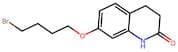
:7-(4-Bromobutoxy)-3,4-dihydro-2(1H)-chinolinon
Beschreibung:
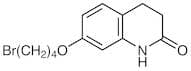
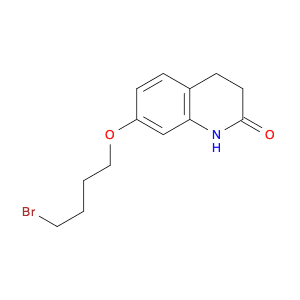
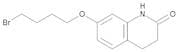
7-(4-Bromobutoxy)-3,4-dihydro-2(1H)-chinolinon ist eine chemische Verbindung, die durch ihre einzigartige Struktur gekennzeichnet ist, die einen modifizierten Quinolinon-Kern mit einer Brombutoxy-Seitenkette umfasst. Diese Verbindung weist eine bicyclische Struktur auf, die zu ihrer potenziellen biologischen Aktivität beiträgt. Die Anwesenheit des Bromatoms erhöht ihre Reaktivität und kann ihre pharmakologischen Eigenschaften beeinflussen. Die Butoxy-Gruppe kann die Löslichkeit und Lipophilie beeinflussen, die für ihre Wechselwirkung mit biologischen Membranen wichtig sind. Diese Verbindung kann verschiedene Eigenschaften aufweisen, einschließlich potenzieller antimikrobieller, entzündungshemmender oder krebsbekämpfender Aktivitäten, was sie in der medizinischen Chemie von Interesse macht. Ihr Molekulargewicht, Schmelzpunkt und Löslichkeitseigenschaften wären relevant für Anwendungen in der Arzneimittel-Formulierung und -Entwicklung. Wie bei vielen organischen Verbindungen sollten Sicherheitsdaten, einschließlich Toxizität und Handhabungshinweisen, vor der Verwendung konsultiert werden. Insgesamt stellt 7-(4-Bromobutoxy)-3,4-dihydro-2(1H)-chinolinon eine Klasse von Verbindungen dar, die aufgrund ihrer strukturellen Merkmale für therapeutische Anwendungen untersucht werden könnten.
Formel:C13H16BrNO2
InChl:InChI=1S/C13H16BrNO2/c14-7-1-2-8-17-11-5-3-10-4-6-13(16)15-12(10)9-11/h3,5,9H,1-2,4,6-8H2,(H,15,16)
InChI Key:InChIKey=URHLNHVYMNBPEO-UHFFFAOYSA-N
SMILES:O(CCCCBr)C=1C=C2C(=CC1)CCC(=O)N2
Synonyme:- 2(1H)-Quinolinone, 7-(4-bromobutoxy)-3,4-dihydro-
- 3,4-Dihydro-7-(4-Bromobutoxy)-2(1H)-Quinolinone
- 3,4-Dihydro-7-(4-bromo butoxy)-2(1H)-quinolinone
- 7-(3-bromopropoxy)-3,4-dihydro-1H-quinolin-2-one
- 7-(4-Bromobutoxy)-1,2,3,4-tetrahydroquinoline-2-one
- 7-(4-Bromobutoxy)-2(1H)-3,4-Dihydroquinolinone
- 7-(4-Bromobutoxy)-3,4-Dihydro-2-Quinolinone
- 7-(4-Bromobutoxy)-3,4-dihydroquinolin-2-one
- 7-(4-Bromobutoxy)-3,4-dihydroquinoline-2(1H)-one
- 7-(4-Bromobutoxy)3,4-dihyrdro-2(H)-Quinolinone
- 7-(4-bromo-butoxy)-3,4-dihydro-1H-quinolin-2-one
- 7-(4-bromobutoxy)-3,4-dihydroquinolin-2(1H)-one
- 7-hydroxy-(4-Bromobutyloxy)-2(1H)-3,4-dihydroquinolinone
- Lanzapine
- Weitere Synonyme anzeigen
Sortieren nach
Reinheit (%)
0
100
|
0
|
50
|
90
|
95
|
100
11 Produkte.
7-(4-Bromobutoxy)-3,4-dihydro-2(1H)-quinolinone
CAS:Formel:C13H16BrNO2Reinheit:>98.0%(HPLC)(N)Farbe und Form:White to Almost white powder to crystalMolekulargewicht:298.183,4-Dihydro-7-(4-bromobutoxy)-2(1h)-quinolinone
CAS:Formel:C13H16BrNO2Reinheit:97%Farbe und Form:SolidMolekulargewicht:298.1756Aripiprazole Impurity 29
CAS:Formel:C13H16BrNO2Farbe und Form:White To Off-White SolidMolekulargewicht:298.187-(4-Bromobutoxy)-3,4-dihydro-2(1H)-quinolinone
CAS:Kontrolliertes ProduktFormel:C13H16BrNO2Farbe und Form:NeatMolekulargewicht:298.187-(4-Bromobutoxy)-3,4-dihydroquinolin-2(1H)-one
CAS:7-(4-Bromobutoxy)-3,4-dihydroquinolin-2(1H)-oneReinheit:98%Farbe und Form:PowderMolekulargewicht:298.18g/mol7-(4-Bromobutoxy)-3,4-dihydroquinolin-2-one
CAS:Kontrolliertes ProduktImpurity Aripiprazole Bromobutoxyquinoline Impurity
Stability Hygroscopic
Applications An impurity in the synthesis of Aripiprazole (A771000). A degradation product in Aripiprazole tablets. Aripiprazole Bromobutoxyquinoline Impurity
References Reddy, G.V.R., et al.: Eur. J. Chem., 1, 20 (2010),Formel:C13H16BrNO2Farbe und Form:White To Off-WhiteMolekulargewicht:298.187-(4-Bromobutoxy)-3,4-dihydroquinolin-2-one
CAS:7-(4-Bromobutoxy)-3,4-dihydroquinolin-2-one is a palladium catalyst that can be used in a Buchwald reaction. This reaction is an industrially scalable process that has been developed to produce high yields of valuable organic compounds from inexpensive starting materials. The catalytic cycle involves the formation of the palladium species Pd(0) followed by its oxidative addition to an alkyl halide. This addition leads to the formation of a palladium(II) species and subsequent reductive elimination of hydrogen halide. 7-(4-Bromobutoxy)-3,4-dihydroquinolin-2-one is used as a catalyst in this process because it selectively reacts with electron rich aromatic substrates to form substituted benzoquinones or phenols. The product distribution is determined by the reactivity of the substrate and the relative rates of competing reactions. Impurities are formed during synthesis due toFormel:C13H16BrNO2Reinheit:Min. 95%Molekulargewicht:298.18 g/mol7-(4-Bromo-butoxy)-3,4-dihydro-1H-quinolin-2-one
CAS:Formel:C13H16BrNO2Reinheit:98%Farbe und Form:SolidMolekulargewicht:298.187-(4-Bromobutoxy)-3,4-dihydroquinolin-2(1H)-one
CAS:7-(4-Bromobutoxy)-3,4-dihydroquinolin-2(1H)-one is a useful organic compound for research related to life sciences. The catalog number is T65919 and the CAS number is 129722-34-5.Formel:C13H16BrNO2Farbe und Form:SolidMolekulargewicht:298.18