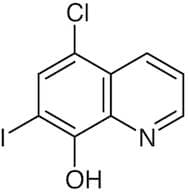
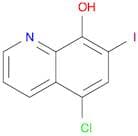
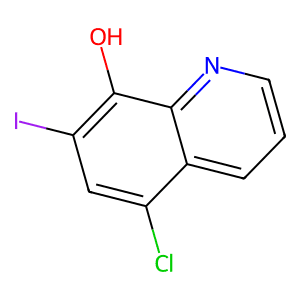
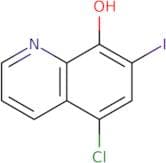
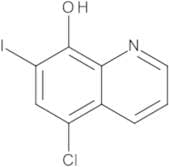
CAS 130-26-7
:Clioquinol
- 5-Chloro-7-iodo-8-hydroxyquinoline
- 5-Chloro-7-iodo-8-oxyquinoline
- 5-Chloro-7-iodo-8-quinolinol
- 5-Chloro-7-iodoquinolin-8-ol
- 7-Iodo-5-chloro-8-hydroxyquinoline
- 7-Iodo-5-chloroxine
- 8-Hydroxy-7-iodo-5-chloroquinoline
- 8-Quinolinol, 5-chloro-7-iodo-
- Alchloquin
- Amebil
- Amoenol
- Bactol
- Barquinol
- Budoform
- Chinoform
- Chloroiodoquin
- Chloroiodoquine
- Chlorojodochin
- Cifoform
- Clioquinol
- Cliquinol
- Cort-Quin
- Dioquinol
- Dizenterol
- Eczecidin
- Emaform
- Entero-Vioform
- Enteroquinol
- Enteroseptol
- Enterozol
- Entrokin
- Hi-Eneterol
- Hi-Enterol
- Iodenterol
- Iodochlorhydroxyquin
- Iodochlorhydroxyquinol
- Iodochlorohydroxyquin
- Iodochlorohydroxyquinoline
- Iodochloroquine
- Iodochloroxine
- Iodochloroxyquinoline
- Iodoenterol
- Iodoxyquinoline
- Lekosept
- NSC 3531
- NSC 74938
- Nioform
- Quin-O-Creme
- Quinambicide
- Quinidochlor
- Quiniodochlor
- Quinoform
- Quinoform (antiseptic)
- Rheaform
- Rheaform Boluses
- Rometin
- Vioform
- Vioformio
- 5-Chlor-7-jod-8-hydroxy-chinolin
- AKOS B020410
- ala-quin
- 5-chloro-7-iodo-8-quinolino
- alchoquin
- chloroiodeoquim
- N-IODO-5-CHLORO-8-HYDROXYQUINOLINE
- Weitere Synonyme anzeigen
5-Chloro-8-hydroxy-7-iodoquinoline
CAS:Formel:C9H5ClINOReinheit:>97.0%(T)Farbe und Form:Light yellow to Brown to Dark green powder to crystalMolekulargewicht:305.50Clioquinol
CAS:ClioquinolFormel:C9H5ClINOReinheit:99.9%Farbe und Form:Off-WhiteMolekulargewicht:304.91044CLIOQUINOL CRS
CAS:CLIOQUINOL CRSFormel:C9H5ClINOFarbe und Form:White. Whitish. Yellow. Dark. Powder.Molekulargewicht:305.4996Clioquinol
CAS:Drugs containing a quinoline or isoquinoline ring-system (whether or not hydrogenated) not further fusedFormel:C9H5ClINOFarbe und Form:PowderMolekulargewicht:304.910445-Chloro-7-Iodoquinolin-8-ol
CAS:Formel:C9H5ClINOReinheit:97%Farbe und Form:SolidMolekulargewicht:305.4996Clioquinol
CAS:Clioquinol: oral, lipophilic copper-binder; halogenated quinoline with antifungal, antiparasitic, and possible antitumor uses.Formel:C9H5ClINOReinheit:97.02%Farbe und Form:Brownish-Yellow Bulky Powder Decomposes At 178-179°C Used As A Topical Anti-InfectiveMolekulargewicht:305.5Clioquinol
CAS:Formel:C9H5ClINOReinheit:≥ 95.0%Farbe und Form:White to light-yellow, yellow or brown powder or crystalsMolekulargewicht:305.495-Chloro-8-hydroxy-7-iodoquinoline
CAS:5-Chloro-8-hydroxy-7-iodoquinolineFormel:C9H5ClINOReinheit:≥95%Farbe und Form: cream powderMolekulargewicht:305.50g/molClioquinol
CAS:Kontrolliertes ProduktApplications Clioquinol is used as an antiparasitic compound, known to induce apoptosis in leukemia and myeloma cells.
References Cao, B. et al.: J. Biol. Chem., 288, 34181 (2013); Chen, Z. et al.: Eur J. Med. Chem., 68, 454 (2013);Formel:C9H5ClINOFarbe und Form:NeatMolekulargewicht:305.5Clioquinol - Bio-X ™
CAS:Clioquinol is an antifungal drug and antiprotozoal drug that has been shown to inhibit the activity of protein kinase-3 and to promote apoptosis. This compound has also been found to improve iron homeostasis, which may be due to its ability to counteract the effects of oxidative stress on the mitochondria. Additionally, it has been shown to have anti-fungal properties against opportunistic fungal pathogens such as Candida albicans. Clioquinol is extracted from a plant called "Clioquinia rosea" and is produced by a chemical reaction with 2-chloroethanol.
Formel:C9H5ClINOReinheit:Min. 95%Farbe und Form:PowderMolekulargewicht:305.5 g/mol5-Chloro-7-iodo-8-hydroxyquinoline
CAS:5-Chloro-7-iodo-8-hydroxyquinoline is a metal chelate that has been shown to have pharmacological effects in experimental animals. It has antioxidative properties and can protect against oxidative injury. 5-Chloro-7-iodo-8-hydroxyquinoline was found to be toxic in various animal models, including the neuronal death and mitochondrial membrane potential. This toxicity may be due to its ability to inhibit the activity of DNA polymerase and protein synthesis. The compound also showed significant cytotoxicity at low concentrations, but had no significant cytotoxicity at higher concentrations. 5-Chloro-7-iodo-8-hydroxyquinoline is similar in structure to clioquinol, which has been shown to have neurotoxic effects in humans.Formel:C9H5ClINOReinheit:Min. 95 Area-%Farbe und Form:PowderMolekulargewicht:305.5 g/mol5-Chloro-7-Iodo-8-Quinolinol (Clioquinol, Iodochlorohydroxyquinoline) ExiPlus, Multi-Compendial, 97-103%
CAS:Formel:C9H5ClINOReinheit:97.0-103.0%Farbe und Form:White to Light Yellow to Light Beige, Powder or Crystals, ClearMolekulargewicht:305.5