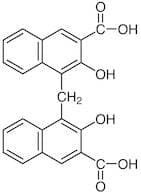
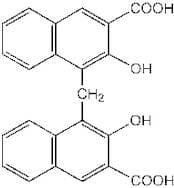
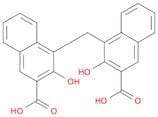
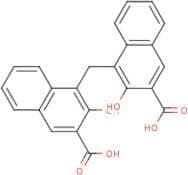
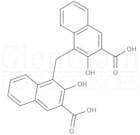
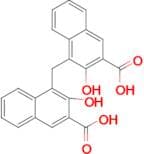
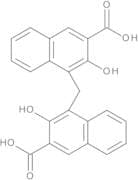
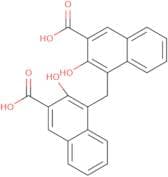
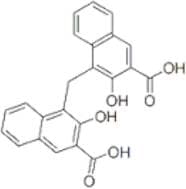
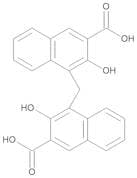
CAS 130-85-8
:Pamoesäure
- 2,2-Dihydroxy-1,1-Dinaphthylmethane-3,3-Dicarboxylic Acid
- 2-Naphthalenecarboxylic acid, 4,4′-methylenebis[3-hydroxy-
- 2-Naphthoic acid, 4,4′-methylenebis[3-hydroxy-
- 3,3-Dihydroxy-4,4-Methylenedi(2-Naphthoic Acid)
- 4,4'-Methanediylbis(3-Hydroxynaphthalene-2-Carboxylate)
- 4,4'-Methanediylbis(3-Hydroxynaphthalene-2-Carboxylic Acid)
- 4,4-Methylenebis[3-hydroxy-2-naphthalenecarboxylic acid]
- 4,4′-Methylenebis[3-hydroxy-2-naphthoic acid]
- 4-[(3-Carboxy-2-hydroxynaphthalen-1-yl)methyl]-3-hydroxynaphthalene-2-carboxylic acid
- Bis(2-hydroxy-3-carboxy-1-naphthyl)methane
- Dilithium 4,4'-Methanediylbis(3-Hydroxynaphthalene-2-Carboxylate)
- Embonic acid
- Embonic acid~4,4-Methylenebis(3-hydroxy-2-naphthoic acid)
- Kg 122
- NSC 30188
- NSC 40132
- 4-4'-METHYLENE-BIS-[2-HYDROXY-3-NAPHTHOIC ACID]
- EMBIONIC ACID
- Pamoic
- PAMOIC ACID
- PamoicAcid98%
- PAMOIC ACID FREE ACID
- 2-Naphthalenecarboxylic acid, 4,4-methylenebis3-hydroxy-
- 4-[(3-CARBOXY-2-HYDROXY-NAPHTHALEN-1-YL)METHYL]-3-HYDROXY-NAPHTHALENE-2-CARBOXYLIC ACID
- 4,4’-methylenebis(3-hydroxy-2-naphthalenecarboxylicaci
- 4,4'-METHYLENE BIS-(3-HYDROXY-2-NAPTHOIC ACID)
- 4,4’-methylenebis[3-hydroxy-2-naphthalenecarboxylicaci
- Weitere Synonyme anzeigen
Pamoic Acid
CAS:Formel:C23H16O6Reinheit:>96.0%(HPLC)Farbe und Form:Light yellow to Amber to Dark green powder to crystalMolekulargewicht:388.38Pamoic acid, 99%
CAS:Pamoic acid is used in preparation of repository derivatives of medicinal agents, used in pharmacology to increase the solubility of a drug in water. This Thermo Scientific Chemicals brand product was originally part of the Alfa Aesar product portfolio. Some documentation and label information may rFormel:C23H16O6Reinheit:99%Farbe und Form:Crystals or powder or crystalline powder, Yellow to yellow-greenMolekulargewicht:388.38Pamoic Acid
CAS:Carboxylic acids with phenol function but without other oxygen function, their anhydrides, halides, peroxides etc nesoiFormel:C23H16O6Farbe und Form:Yellow Crystalline PowderMolekulargewicht:388.094692-Naphthalenecarboxylic acid, 4,4'-methylenebis[3-hydroxy-
CAS:Formel:C23H16O6Reinheit:97%Farbe und Form:SolidMolekulargewicht:388.3695Pamoic acid
CAS:Formel:C23H16O6Reinheit:(Titration) ≥ 97.0%Farbe und Form:Pale yellow to dark yellow-green powder or crystalsMolekulargewicht:388.384,4'-Methylenebis(3-hydroxy-2-naphthoic acid)
CAS:Reinheit:95.0%Farbe und Form:SolidMolekulargewicht:388.375Pamoic Acid
CAS:Applications Agonist of the orphan G protein-coupled receptor GPR35: a potent activator of extracellular signal-regulated kinase and β-arrestin2 with antinociceptive activity. Used as an inhibitor in the real-time fluorescence enzymatic characterization study of specialized human DNA polymerases.
References Zhao, P. et al.: Mol. Pharmacol., 78, 560 (2010); Dorjsujen, D. et al.: Nuc. Acids Res., 37, e128 (2009);Formel:C23H16O6Farbe und Form:NeatMolekulargewicht:388.37Pamoic acid
CAS:Pamoic acid is a natural compound that has been found to exhibit antimicrobial activity against a variety of microorganisms. Pamoic acid is also used in the treatment of infectious diseases, such as leprosy, tuberculosis, and AIDS. The biological properties of pamoic acid are due to its ability to bind with peptide hormones and act as a pharmacological agent. Pamoic acid is able to inhibit the synthesis of peptide hormones by binding to their receptors on the cell surface. This inhibition can lead to immunosuppression (e.g., autoimmune diseases) and mitochondrial membrane depolarization. Pamoic acid is also able to bind with benzalkonium chloride, which may account for some of its antimicrobial activity.
Pamoic acid is synthesized from pantothenic acid (vitamin B5) and caproic acid by means of an enzymatic process called transamination.Formel:C23H16O6Reinheit:Min. 95%Farbe und Form:Yellow PowderMolekulargewicht:388.37 g/molPamoic Acid pure, 98%
CAS:Formel:C23H16O6Reinheit:min. 98%Farbe und Form:White to pale yellow, Crystalline powder, Clear, YellowMolekulargewicht:388.38Pamoic acid
CAS:Pamoic acid is the orphan G protein-coupled receptor GPR35 agonist. Pamoic acid activates ERK and beta-arrestin2 and causes antinociceptive activity.
Formel:C23H16O6Reinheit:99.99%Farbe und Form:Fine Yellow PowderMolekulargewicht:388.37