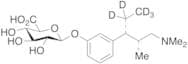
CAS 1300037-86-8
:Sortieren nach
Reinheit (%)
0
100
|
0
|
50
|
90
|
95
|
100
5 Produkte.
Tapentadol O-beta-D-Glucuronide
CAS:Kontrolliertes ProduktApplications A metabolite of Tapentadol (T007200).
References Terlinden, R., et al.: Eur. J. Drug Metab. Pharmacokinet., 32, 163 (2007), Tzschentke, T., et al.: J. Pharmacol. Exp. Ther., 323, 256 (2007), Wade, W., et al.: Clin. Ther., 31, 2804 (2009),Formel:C20H31NO7Farbe und Form:NeatMolekulargewicht:397.46Tapentadol O-b-D-Glucuronide (1 mg/ml in Methanol)
CAS:Kontrolliertes ProduktFormel:C20H31NO7Farbe und Form:ColourlessMolekulargewicht:397.46Tapentadol-d5 O-β-D-Glucuronide
CAS:Kontrolliertes ProduktFormel:C20D5H26NO7Farbe und Form:NeatMolekulargewicht:402.493Tapentadol-²-D-glucuronide solution
CAS:Kontrolliertes ProduktTapentadol is a centrally acting analgesic agent that binds to the µ-opioid receptor. Tapentadol is metabolized in the liver by glucuronidation and sulfation. Tapentadol 2-D-glucuronide is an active metabolite of tapentadol and exhibits a higher affinity for µ-opioid receptors than tapentadol. The clinical relevance of this metabolite has not been studied, but concentrations of tapentadol 2-D-glucuronide in plasma may be useful for monitoring therapeutic effects and for assessing side effects such as respiratory depression. It is believed that tapentadol 2-D-glucuronide binds to opioid receptors in the brain, spinal cord, and peripheral nervous system, which accounts for its analgesic properties. The clinical development of tapentadol was designed to assess its safety and efficacy in pediatric patients (ages 6–17 years). Plasma concentrations were measured using liquid chromatographyFormel:C20H31NO7Reinheit:Min. 95%Molekulargewicht:397.46 g/mol