CAS 130209-90-4
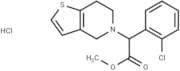
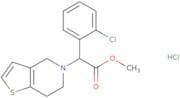
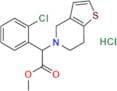
:(±)-Clopidogrelhydrochlorid
Beschreibung:
(±)-Clopidogrelhydrochlorid ist ein Thienopyridin-Derivat, das hauptsächlich als Antiplättchenmedikament zur Verhinderung von Blutgerinnseln bei Patienten mit Herz-Kreislauf-Erkrankungen eingesetzt wird. Es wirkt als Prodrug, die eine metabolische Aktivierung benötigt, um ihre therapeutischen Effekte auszuüben, indem es den P2Y12-Rezeptor auf Thrombozyten irreversibel hemmt und somit die Thrombozytenaggregation verringert. Die Substanz erscheint als weißes bis off-white kristallines Pulver und ist in Wasser und Methanol löslich, mit begrenzter Löslichkeit in organischen Lösungsmitteln. Ihre molekulare Formel spiegelt eine komplexe Struktur wider, die einen Thiophenring umfasst und zu ihrer pharmakologischen Aktivität beiträgt. Die Hydrochlorid-Salzform verbessert ihre Stabilität und Löslichkeit und erleichtert die orale Verabreichung. Clopidogrel wird häufig zusammen mit Aspirin für eine duale Antiplättchen-Therapie verschrieben, insbesondere nach der Platzierung von Stents oder bei Patienten mit akuten Koronarsyndromen. Nebenwirkungen können Blutungskomplikationen, gastrointestinale Störungen und in seltenen Fällen Überempfindlichkeitsreaktionen umfassen. Die Überwachung ist entscheidend, um die Wirksamkeit und Sicherheit zu gewährleisten, insbesondere bei Patienten mit spezifischen genetischen Polymorphismen, die den Arzneimittelstoffwechsel beeinflussen.
Formel:C16H16ClNO2S·ClH
InChl:InChI=1S/C16H16ClNO2S.ClH/c1-20-16(19)15(12-4-2-3-5-13(12)17)18-8-6-14-11(10-18)7-9-21-14;/h2-5,7,9,15H,6,8,10H2,1H3;1H
InChI Key:InChIKey=XIHVAFJSGWDBGA-UHFFFAOYSA-N
SMILES:C(C(OC)=O)(N1CC2=C(CC1)SC=C2)C3=C(Cl)C=CC=C3.Cl
Synonyme:- Thieno[3,2-c]pyridine-5(4H)-acetic acid, α-(2-chlorophenyl)-6,7-dihydro-, methyl ester, hydrochloride
- PCR 4099
- Methyl 2-(2-chlorophenyl)-2-(6,7-dihydro-4H-thieno[3,2-c]pyridin-5-yl)acetate hydrochloride
- Thieno[3,2-c]pyridine-5(4H)-acetic acid, α-(2-chlorophenyl)-6,7-dihydro-, methyl ester, hydrochloride, (±)-
- Thieno[3,2-c]pyridine-5(4H)-acetic acid, α-(2-chlorophenyl)-6,7-dihydro-, methyl ester, hydrochloride (1:1)
Sortieren nach
Reinheit (%)
0
100
|
0
|
50
|
90
|
95
|
100
5 Produkte.
(R,S)-Methyl-2-(2-chlorophenyl)-2-(4,5,6,7-tetrahydrothino[3.2-c]pyridin-5-yl)acetatehydrochloride
CAS:Formel:C16H17Cl2NO2SReinheit:98%Farbe und Form:SolidMolekulargewicht:358.2827Methyl 2-(2-chlorophenyl)-2-(6,7-dihydrothieno[3,2-c]pyridin-5(4H)-yl)acetate hydrochloride
CAS:Methyl 2-(2-chlorophenyl)-2-(6,7-dihydrothieno[3,2-c]pyridin-5(4H)-yl)acetate hydrochlorideReinheit:98%Molekulargewicht:358.29g/mol(±)-Clopidogrel (hydrochloride)
CAS:Clopidogrel is an antithrombic compound whose active metabolite is a selective, irreversible antagonist of the platelet purinergic P2Y12 receptor (IC50 = 100 nMFormel:C16H17Cl2NO2SFarbe und Form:SolidMolekulargewicht:358.28(±)-Clopidogrel hydrochloride
CAS:Clopidogrel is a prodrug that must be activated by the enzyme CYP2C19 to become its active form, clopidogrel. It is a platelet inhibitor used as an anti-platelet agent and diagnostic tool. Clopidogrel inhibits the action of adenosine diphosphate (ADP) on the P2Y12 receptor and is also a potent pump inhibitor. The major route of metabolism of clopidogrel is through CYP2C19, although other routes such as enteric are present. Inhibitors of this enzyme can affect clopidogrel's effectiveness. Clopidogrel has been shown to be effective in preventing cancer and tumours in rodents, but not humans. It has been found to inhibit cell proliferation in human epithelial cancers when applied orally or topically.
Formel:C16H17Cl2NO2SReinheit:Min. 95%Molekulargewicht:358.3 g/mol
![(R,S)-Methyl-2-(2-chlorophenyl)-2-(4,5,6,7-tetrahydrothino[3.2-c]pyridin-5-yl)acetatehydrochloride](/_next/image/?url=https%3A%2Fstatic.cymitquimica.com%2Fproducts%2FIN%2Fthumb%2FDA00A7RT.jpg&w=3840&q=75)

![Methyl 2-(2-chlorophenyl)-2-(6,7-dihydrothieno[3,2-c]pyridin-5(4H)-yl)acetate hydrochloride](/_next/image/?url=https%3A%2Fstatic.cymitquimica.com%2Fproducts%2F54%2Fthumb%2FOR1063179.jpg&w=3840&q=75)