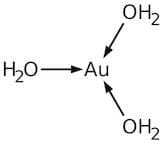
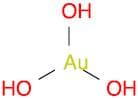
CAS 1303-52-2
:Goldhydroxid (Au(OH)3)
- Auric hydroxide
- Gold Hydroxide
- Gold Trihydrate
- Gold hydroxide (Au(OH)<sub>3</sub>)
- Gold trihydroxide
- Gold(1+) Hydroxide
- Gold hydroxide (Au(OH)3)
- Gold(III) hydroxide
- goldhydroxide(au(oh)3)
- Gold(III) hydroxide, Au 79% min
- Gold(III) hydroxide, 99.9%
- Weitere Synonyme anzeigen
Gold(III) hydroxide, Au 79% min
CAS:Gold plating solutions, porcelain decorationFormel:Au(OH)3Reinheit:79%Molekulargewicht:247.99Gold(III) hydroxide
CAS:Gold(III) hydroxide is a yellow solid that is soluble in acidic and alkaline solutions. It can be prepared by the reaction of gold(III) nitrate with sodium hydroxide, or by the reaction of hydrochloric acid with sodium chloride and ferrous sulfate. Gold hydroxide can be used in a number of techniques such as nature, hydrolysis, synthons, and high yield. Gold hydroxide has been shown to have luminescent properties when mixed with nitrate. The synthesis of gold nanoparticles is also possible using gold hydroxide at temperatures below 100°C. The yields for this process are variable depending on the conditions used, but it has been shown to produce approximately 10% of the theoretical yield. Gold hydroxide will react with deionized water to form a gel-like substance, which is due to its interaction with water molecules. This compound also has nucleation properties that allow it to act as an initiator for
Formel:AuH3O3Reinheit:Min. 95%Molekulargewicht:247.99 g/molRef: 3D-FG55110
Ausgelaufenes produkt