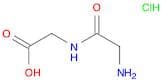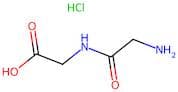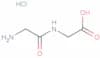
CAS 13059-60-4
:Glycylglycin-Hydrochlorid
Beschreibung:
Glycylglycin-Hydrochlorid ist ein Dipeptid und ein Derivat von Glycin, das aus zwei Glycin-Molekülen besteht, die durch eine Peptidbindung verbunden sind, in Form eines Hydrochloridsalzes. Es handelt sich um ein weißes bis off-white kristallines Pulver, das in Wasser löslich ist, was es für verschiedene biochemische Anwendungen geeignet macht. Diese Verbindung wird häufig in der Peptidsynthese, als Puffer in biochemischen Tests und in der Untersuchung von Proteininteraktionen aufgrund seiner zwitterionischen Natur verwendet, die es ihm ermöglicht, je nach pH-Wert in kationischen und anionischen Formen zu existieren. Glycylglycin-Hydrochlorid ist unter Standardlaborbedingungen im Allgemeinen stabil, sollte jedoch an einem kühlen, trockenen Ort gelagert werden, um eine Zersetzung zu verhindern. Sein niedriges Molekulargewicht und die einfache Struktur machen es zu einem wichtigen Baustein in der Synthese komplexerer Peptide und Proteine. Darüber hinaus hat es Anwendungen in der Pharmazie und Forschung, insbesondere in Studien zum Aminosäurestoffwechsel und zur Protein-Faltung.
Formel:C4H8N2O3·ClH
InChl:InChI=1S/C4H8N2O3.ClH/c5-1-3(7)6-2-4(8)9;/h1-2,5H2,(H,6,7)(H,8,9);1H
InChI Key:InChIKey=YHBAZQDEMYQPJL-UHFFFAOYSA-N
SMILES:C(NCC(O)=O)(CN)=O.Cl
Synonyme:- 2-(2-Aminoacetamido)acetic acid hydrochloride
- Glycine, N-glycyl-, monohydrochloride
- Glycine, glycyl-, hydrochloride (1:1)
- Glycine, glycyl-, monohydrochloride
- Glycyl-glycine hydrochloride
- Glycylglycine Hydrochloride (1:1)
- Glycylglycine hydrochloride
- Glycylglycine monohydrochloride
Sortieren nach
Reinheit (%)
0
100
|
0
|
50
|
90
|
95
|
100
5 Produkte gefunden.
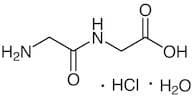
Glycylglycine Hydrochloride Monohydrate
CAS:Formel:C4H8N2O3·HCl·H2OReinheit:>98.0%(N)Farbe und Form:White to Almost white powder to crystalMolekulargewicht:186.60Glycylglycine Hydrochloride Monohydrate
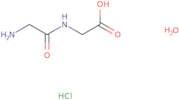
CAS:Glycylglycine hydrochloride monohydrate is a glycine salt that can be used as a metal chelator. It has been shown to be an experimental model for the study of metal-binding proteins, and it can also be used as a model system for the study of benzalkonium chloride. Glycylglycine hydrochloride monohydrate has been shown to have thermodynamic data and biological studies. In vitro assays have been used to show its transfer reactions with other molecules, such as intermolecular hydrogen bonding and coordination geometry. Synchronous fluorescence has also been used to investigate the energy metabolism of glycylglycine hydrochloride monohydrate in solution.Formel:C4H8N2O3·HCl·H2OReinheit:Min. 95%Molekulargewicht:186.6 g/mol