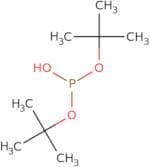
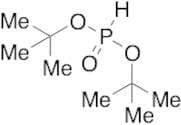
CAS 13086-84-5
:Di-tert-butylphosphit
Beschreibung:
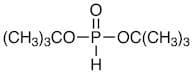
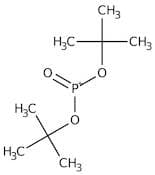
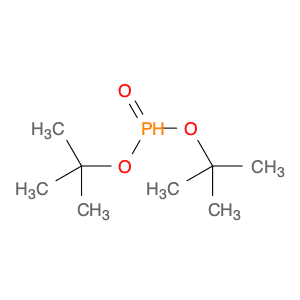
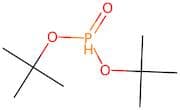
Di-tert-butylphosphit ist eine organophosphorverbindung, die durch ihre Phosphit-Funktionalgruppe gekennzeichnet ist, an die zwei tert-Butylgruppen an ein Phosphoratome gebunden sind. Es handelt sich typischerweise um eine farblose bis blassgelbe Flüssigkeit mit einem milden Geruch. Diese Verbindung ist bekannt für ihre Rolle als Stabilisator und Antioxidans in verschiedenen chemischen Prozessen, insbesondere bei der Herstellung von Polymeren und Kunststoffen. Di-tert-butylphosphit zeigt eine gute thermische Stabilität und kann als Reduktionsmittel wirken. Seine chemische Struktur trägt zu seiner relativ geringen Flüchtigkeit und moderaten Löslichkeit in organischen Lösungsmitteln bei. Darüber hinaus ist es empfindlich gegenüber Feuchtigkeit und kann in Gegenwart von Wasser hydrolysieren, was zur Bildung von Phosphonsäuren führt. Sicherheitsüberlegungen umfassen das Potenzial, bei Kontakt mit Haut oder Augen Reizungen zu verursachen, und es sollte mit den entsprechenden Vorsichtsmaßnahmen in einem gut belüfteten Bereich gehandhabt werden. Insgesamt wird Di-tert-butylphosphit in industriellen Anwendungen wegen seiner schützenden Eigenschaften gegen oxidative Zersetzung geschätzt.
Formel:C8H19O3P
InChl:InChI=1/C8H19O3P/c1-7(2,3)10-12(9)11-8(4,5)6/h12H,1-6H3
InChI Key:InChIKey=HLMXUWAUCZMWOG-UHFFFAOYSA-N
SMILES:O(C(C)(C)C)P(OC(C)(C)C)=O
Synonyme:- 2-Methyl-2-[(2-methylpropan-2-yl)oxyphosphonoyloxy]propane
- Di-Tert-Butoxy(Oxo)Phosphonium
- Di-Tert-Butyl Hydrogen Phosphite
- Di-Tert-Butyl Phosphonate
- Phosphonic acid, bis(1,1-dimethylethyl) ester
- Phosphonic acid, di-tert-butyl ester
- Phosphorous acid di-tert-butyl ester
- tert-Butyl phosphite ((C<sub>4</sub>H<sub>9</sub>O)<sub>2</sub>P(OH))
- tert-Butyl phosphonate ((C<sub>4</sub>H<sub>9</sub>O)<sub>2</sub>PH(O))
- Di-tert-butyl phosphite
- tert-Butyl phosphonate ((C4H9O)2PH(O))
- Di-tert-butyl phosphite 95%
- Einecs 235-996-8
- Ditertiarybutyl phosphite
- bis(1,1-dimethylethyl) phosphonate
- Di-tert-butyl phosphite ,97.5%
- Bis(2-methyl-2-propanyl) phosphonate
- Weitere Synonyme anzeigen
Sortieren nach
Reinheit (%)
0
100
|
0
|
50
|
90
|
95
|
100
7 Produkte.
Di-tert-butyl Phosphonate
CAS:Formel:C8H19O3PReinheit:>98.0%(T)Farbe und Form:Colorless to Almost colorless clear liquidMolekulargewicht:194.21Di-tert-butyl phosphite, 95%
CAS:As a solvent, as an antioxidant, and as an intermediateFormel:C8H18O3PReinheit:95%Farbe und Form:Clear colorless to yellow, LiquidMolekulargewicht:193.20Phosphonic acid, bis(1,1-dimethylethyl) ester
CAS:Formel:C8H19O3PReinheit:95%Farbe und Form:LiquidMolekulargewicht:194.2084Di-tert-butyl phosphonate
CAS:Di-tert-butyl phosphonateFormel:C8H19O3PReinheit:99%Farbe und Form: clear. almost colourless liquidMolekulargewicht:194.21g/molDi-tert-butylphosphite
CAS:Di-tert-butylphosphite is a phosphatase inhibitor that is used as a synthetic target in drug discovery. Di-tert-butylphosphite binds to the active site of phosphatases and prevents them from hydrolyzing the phosphate group from their substrates. This leads to an accumulation of the substrate and a decrease in enzymes, which inhibits protein synthesis. The sequence specificity of di-tert-butylphosphite has been shown by its affinity for tripeptides with hydrophobic amino acids at position P1 and P3. Di-tert-butylphosphite has been shown to inhibit cancer cell growth in vitro by binding to DNA and inhibiting RNA synthesis. It also inhibits farnesyl diphosphate synthase, which synthesizes the precursor for cholesterol biosynthesis, leading to decreased levels of cholesterol and reduced cell proliferation.Formel:C8H19O3PReinheit:Min. 95 Area-%Farbe und Form:Clear LiquidMolekulargewicht:194.21 g/molDi-tert-butyl Phosphite
CAS:Kontrolliertes ProduktApplications Di-tert-butyl Phosphite is used as a reagent in the synthesis of chloromethyl di-tert-butyl phosphate, a key component in the formation of many phosphonoxymethyl pro-drugs. Also used as a reagent in the synthesis of L-phosphonophenylalanine (Ppa) derivatives suitable for solid phase peptide synthesis.
Not a dangerous good if item is equal to or less than 1g/ml and there is less than 100g/ml in the package
References Zheng, B., et al.: Org. Process Res. Dev., 18, 636 (2014); Chauhan, S.S., et al.: Tetrahedron Lett., 48, 4051 (2007)Formel:C8H19O3PFarbe und Form:NeatMolekulargewicht:194.21