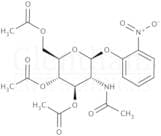
CAS 13089-26-4
:β-D-Glucopyranosid, 2-nitrophenyl 2-(acetylamino)-2-desoxy-, 3,4,6-triacetat
Beschreibung:
β-D-Glucopyranosid, 2-nitrophenyl 2-(acetylamino)-2-desoxy-, 3,4,6-triacetat, allgemein als Glykosid bezeichnet, ist eine chemische Verbindung, die durch ihre Struktur gekennzeichnet ist, die ein Glucopyranosid-Moiety enthält, das an eine 2-Nitrophenylgruppe und mehrere Acetylgruppen gebunden ist. Diese Verbindung wird typischerweise in der biochemischen Forschung und der synthetischen organischen Chemie verwendet, da sie als Substrat für verschiedene enzymatische Reaktionen dienen kann, insbesondere in Studien, die Glykosidasen betreffen. Die Anwesenheit der Acetylgruppen verbessert ihre Löslichkeit und Stabilität, während die Nitrophenylgruppe als Chromophor wirken kann, was eine spektroskopische Analyse ermöglicht. Ihre molekulare Struktur trägt zu ihrer Reaktivität und Interaktion mit biologischen Systemen bei, was sie zu einem wertvollen Werkzeug im Studium der Kohlenhydratchemie und der Enzymkinetik macht. Darüber hinaus können die Eigenschaften der Verbindung, wie Schmelzpunkt, Löslichkeit und Reaktivität, je nach den spezifischen Bedingungen, unter denen sie gehandhabt wird, variieren. Sicherheitsdaten sollten konsultiert werden, um eine ordnungsgemäße Handhabung und Verwendung in Laborumgebungen sicherzustellen.
Formel:C20H24N2O11
InChl:InChI=1S/C20H24N2O11/c1-10(23)21-17-19(31-13(4)26)18(30-12(3)25)16(9-29-11(2)24)33-20(17)32-15-8-6-5-7-14(15)22(27)28/h5-8,16-20H,9H2,1-4H3,(H,21,23)/t16-,17-,18-,19-,20-/m1/s1
InChI Key:InChIKey=HANQNSOXWBEEGZ-LASHMREHSA-N
SMILES:O(C(C)=O)[C@@H]1[C@@H](NC(C)=O)[C@H](OC2=C(N(=O)=O)C=CC=C2)O[C@H](COC(C)=O)[C@H]1OC(C)=O
Synonyme:- (2'-Nitro)Phenyl-2-Acetamido-3,4,6-Tri-O-Acetyl-2-Deoxy-Ss-D-Glucopyranoside
- 2-Nitrophenyl2-acetamido-3,4,6-tri-O-acetyl-2-deoxy-b-D-glucopyranoside
- Glucopyranoside, o-nitrophenyl 2-acetamido-2-deoxy-, triacetate
- Glucopyranoside, o-nitrophenyl 2-acetamido-2-deoxy-, triacetate (ester), β-<span class="text-smallcaps">D</span>-
- β-<span class="text-smallcaps">D</span>-Glucopyranoside, 2-nitrophenyl 2-(acetylamino)-2-deoxy-, 3,4,6-triacetate
- β-<span class="text-smallcaps">D</span>-Glucoside, o-nitrophenyl 2-acetamido-2-deoxy-, triacetate
- Glucopyranoside, o-nitrophenyl 2-acetamido-2-deoxy-, triacetate (ester), β-D-
- β-D-Glucoside, o-nitrophenyl 2-acetamido-2-deoxy-, triacetate
- β-D-Glucopyranoside, 2-nitrophenyl 2-(acetylamino)-2-deoxy-, 3,4,6-triacetate
- o-Nitrophenyl 2-Acetamido-2-deoxy-3,4,6-tri-O-acetyl-β-D-galactopyranoside
- 2-Nitrophenyl 2-(acetylaMino)-2-deoxy-β-D-glucopyranoside 3,4,6-Triacetate
- Weitere Synonyme anzeigen
Sortieren nach
Reinheit (%)
0
100
|
0
|
50
|
90
|
95
|
100
2 Produkte.
2-Nitrophenyl 2-acetamido-3,4,6-tri-O-acetyl-2-deoxy-b-D-glucopyranoside
CAS:2-Nitrophenyl 2-acetamido-3,4,6-tri-O-acetyl-2-deoxy-b-D-glucopyranoside is a chromogenic substrate used to detect and measure the activity of glycosidase enzymes. Glycosidases are enzymes that hydrolyze glycosidic bonds in carbohydrates, and are produced by many organisms. The substrate is cleaved by glycosidase to release a chromophore, which can be quantified via spectrophotometry analysis. 2-Nitrophenyl 2-acetamido-3,4,6-tri-O-acetyl-2-deoxy-b-D-glucopyranoside is widely used in various applications, including enzyme kinetics studies, inhibitor screening, and the detection of NAGase activity in biological samples, such as serum, urine, and cell lysates. It is also used for the identification and characterization of glycosidases in microorganisms and the study of glycosylation-related processes in cells and tissues.Reinheit:Min. 95%Molekulargewicht:468.41 g/mol