CAS 1309-33-7
:Eisen(III)-hydroxid
Beschreibung:
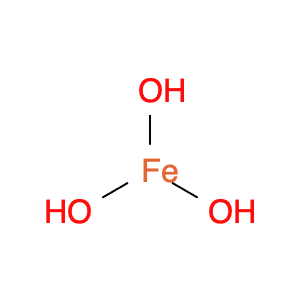
Eisen(III)-hydroxid, mit der chemischen Formel Fe(OH)₃ und der CAS-Nummer 1309-33-7, ist eine anorganische Verbindung, die als rötlich-brauner Feststoff erscheint. Sie entsteht hauptsächlich durch die Hydrolyse von Eisen(III)-salzen in wässrigen Lösungen. Eisen(III)-hydroxid ist in Wasser unlöslich, was sie in verschiedenen Anwendungen nützlich macht, einschließlich Wasseraufbereitungsprozessen, in denen sie als Flockungsmittel zur Entfernung von Verunreinigungen wirkt. Sie hat ein relativ niedriges Löslichkeitsprodukt, was zu ihrer Ausfällung unter alkalischen Bedingungen führt. Die Verbindung ist amphoter, was bedeutet, dass sie sowohl mit Säuren als auch mit Basen reagieren kann und lösliche Komplexe oder Salze bildet. Eisen(III)-hydroxid ist auch ein Vorläufer anderer Eisenverbindungen, wie Eisenoxiden, und wird in der Pigmentproduktion sowie als Katalysator in bestimmten chemischen Reaktionen verwendet. Darüber hinaus spielt sie eine Rolle in biologischen Systemen, insbesondere im Eisenstoffwechsel. Sicherheitsüberlegungen umfassen ihr Potenzial, bei Kontakt mit Haut oder Augen Reizungen zu verursachen, und es sollten geeignete Handhabungsmaßnahmen beachtet werden.
Formel:FeH3O3
InChl:InChI=1S/Fe.3H2O/h;3*1H2/q+3;;;/p-3
InChI Key:InChIKey=MSNWSDPPULHLDL-UHFFFAOYSA-K
SMILES:[Fe](O)(O)O
Synonyme:- Dieisentrioxidhydrat
- Diiron Trioxide Hydrate
- Ferric hydroxide
- Ferric hydroxide gel
- Ferric trihydroxide
- Hydrated iron sesquioxide
- Hydrous iron (III) oxide
- Iron (Iii) Hydroxide
- Iron hydroxide
- Iron hydroxide (Fe(OH)<sub>3</sub>)
- Iron trihydroxide
- Iron(3+) hydroxide
- Iron(3+) trihydroxide
- Trioxido De Dihierro, Hidrato
- Trioxyde de difer, hydrate
- Weitere Synonyme anzeigen
Sortieren nach
Reinheit (%)
0
100
|
0
|
50
|
90
|
95
|
100
3 Produkte.
Iron hydroxide
CAS:Iron hydroxide is a type of iron oxide, which is a chemical compound that is composed of iron and oxygen. Iron hydroxide has been shown to inhibit the growth of bacteria by binding to pyrite and other minerals in the soil. The inhibition caused by iron hydroxide is due to its ability to increase the concentration of free calcium ions in the environment and thus disrupt bacterial metabolism. Iron hydroxide can be found in dry soils, especially those with high amounts of pyrite. Iron hydroxide binds to pyrite because it has a higher affinity for it than for Ca2+. This occurs because pyrite has more surface area than Ca2+ and so more molecules are able to bind to it. Iron hydroxide can also be found in women’s urine where it inhibits the growth of bacteria such as Escherichia coli, Enterococcus faecalis, Klebsiella pneumoniae, Proteus mirabilis, PseudFormel:Fe(OH)3Farbe und Form:PowderMolekulargewicht:106.87 g/mol