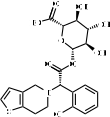
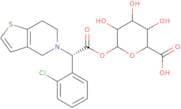
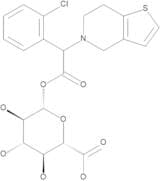
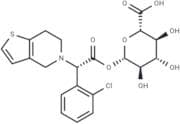
CAS 1314116-53-4
:Clopidogrel-β-D-Glucuronid
Beschreibung:
Clopidogrel-β-D-Glucuronid ist ein Metabolit des antiplättchenmedikaments Clopidogrel, das häufig zur Vorbeugung von Blutgerinnseln bei Patienten mit Herz-Kreislauf-Erkrankungen eingesetzt wird. Diese Verbindung entsteht durch den Glucuronidierungsprozess, bei dem eine Glucuronsäureeinheit mit Clopidogrel konjugiert wird, wodurch dessen Löslichkeit erhöht und die Ausscheidung erleichtert wird. Die chemische Struktur von Clopidogrel-β-D-Glucuronid weist eine Glucuronidgruppe auf, die mit dem Clopidogrel-Molekül verbunden ist, das durch seine Thienopyridinstruktur gekennzeichnet ist. Dieser Metabolit behält eine gewisse pharmakologische Aktivität bei, die zu den insgesamt therapeutischen Effekten von Clopidogrel beiträgt. Er wird typischerweise in pharmakokinetischen Studien analysiert, um den Stoffwechsel und die Wirksamkeit des Medikaments zu verstehen. Die Verbindung ist aufgrund der Anwesenheit von Glucuronsäure in Wasser löslich, was auch ihre Verteilung und Eliminierung im Körper beeinflusst. Das Verständnis der Eigenschaften von Clopidogrel-β-D-Glucuronid ist entscheidend für die Optimierung der Clopidogrel-Therapie und das Management potenzieller Arzneimittelwechselwirkungen oder Nebenwirkungen.
Formel:C21H22ClNO8S
InChl:InChI=1S/C21H22ClNO8S/c22-12-4-2-1-3-11(12)14(23-7-5-13-10(9-23)6-8-32-13)20(29)31-21-17(26)15(24)16(25)18(30-21)19(27)28/h1-4,6,8,14-18,21,24-26H,5,7,9H2,(H,27,28)/t14-,15-,16-,17+,18-,21-/m0/s1
InChI Key:InChIKey=TUBQAJBXTWIXFX-CLCCAKIRSA-N
SMILES:[C@H](C(O[C@@H]1O[C@H](C(O)=O)[C@@H](O)[C@H](O)[C@H]1O)=O)(N2CC3=C(CC2)SC=C3)C4=C(Cl)C=CC=C4
Synonyme:- Clopidogrel-β-D-glucuronide
- β-D-Glucopyranuronic acid, 1-[(αS)-α-(2-chlorophenyl)-6,7-dihydrothieno[3,2-c]pyridine-5(4H)-acetate]
- Clopidogrel acyl-O-β-D- Glucuronide
- 1-[α-(2-Chlorophenyl)-6,7-dihydrothieno[3,2-c]pyridine-5(4H)-acetate] β-D-Glucopyranuronic Acid
- Clopidogrel Acyl-beta-D-Glucuronide
- Clopidogrel Acyl--D-glucuronide
Sortieren nach
Reinheit (%)
0
100
|
0
|
50
|
90
|
95
|
100
7 Produkte.
Clopidogrel-β-D-glucuronide ((2S,3S,4S,5R,6S)-6-((S)-2-(2-chlorophenyl)-2-(6,7-dihydrothieno[3,2-c]pyridin-5(4H)-yl)acetoxy)-3,4,5-trihydroxytetrahydro-2H-pyran-2-carboxylic acid)
CAS:Nucleic acids and their salts, whether or not chemically defined; other heterocyclic compounds, nesoiFormel:C21H22ClNO8SFarbe und Form:White Off-White SolidMolekulargewicht:483.07547Clopidogrel Acyl-β-D-Glucuronide
CAS:Formel:C21H22ClNO8SFarbe und Form:White To Off-White SolidMolekulargewicht:483.92Clopidogrel acyl glucuronide
CAS:Clopidogrel is a prodrug that is metabolized to the active form, clopidogrel acyl glucuronide (CPG). The glucuronide conjugate of CPG is excreted in urine and can be used as a potential biomarker for drug interactions. Clopidogrel acyl glucuronide is an inhibitor of CYP2C19, CYP1A2, and CYP3A4 which may lead to drug-drug interactions. Clopidogrel also inhibits uptake by P-glycoprotein and efflux by MRPs. The uptake of CPG in the liver cells from the blood stream is low due to its high affinity for proteins such as albumin. This makes it difficult to measure plasma concentrations of CPG and its metabolites. However, CPG can be detected in human liver microsomes using liquid chromatography with tandem mass spectrometry (LC-MS/MS) analysis. The metaboliteFormel:C21H22ClNO8SReinheit:Min. 95%Molekulargewicht:483.92 g/molClopidogrel Acyl-beta-D-glucuronide
CAS:Kontrolliertes ProduktApplications A metabolite of Clopidogrel.
Formel:C21H22ClNO8SFarbe und Form:NeatMolekulargewicht:483.92Clopidogrel Acyl-β-D-glucuronide
CAS:Kontrolliertes ProduktFormel:C21H18ClD4NO8SFarbe und Form:NeatMolekulargewicht:483.92Clopidogrel-β-D-glucuronide
CAS:Clopidogrel-β-D-glucuronide is a metabolite of Clopidogrel. It directly interacts with the CYP2C8 enzyme and strongly inhibits the hepatic enzyme CYP2C8.Formel:C21H22ClNO8SFarbe und Form:SolidMolekulargewicht:483.919