CAS 131580-10-4
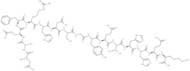
:H-Asp-Ala-Glu-Phe-Arg-His-Asp-Ser-Gly-Tyr-Glu-Val-His-His-Gln-Lys-OH
Beschreibung:
Die chemische Substanz mit dem Namen "H-Asp-Ala-Glu-Phe-Arg-His-Asp-Ser-Gly-Tyr-Glu-Val-His-His-Gln-Lys-OH" ist ein Peptid, das aus einer Sequenz von Aminosäuren besteht, insbesondere Asparaginsäure (Asp), Alanin (Ala), Glutaminsäure (Glu), Phenylalanin (Phe), Arginin (Arg), Histidin (His), Serin (Ser), Glycin (Gly), Tyrosin (Tyr), Valin (Val), Glutamin (Gln) und Lysin (Lys). Dieses Peptid zeichnet sich durch seine vielfältigen funktionellen Gruppen aus, die zu seiner Löslichkeit, Reaktivität und biologischen Aktivität beitragen. Das Vorhandensein von basischen Aminosäuren wie Arg, His und Lys deutet auf potenzielle Wechselwirkungen mit negativ geladenen Molekülen hin, während die aromatischen Reste (Phe, Tyr) an hydrophoben Wechselwirkungen teilnehmen können. Die Struktur des Peptids kann seine Konformation und Stabilität beeinflussen, was sich auf seine biologischen Funktionen wie Enzymaktivität oder Rezeptorbindung auswirken kann. Die CAS-Nummer 131580-10-4 identifiziert dieses spezifische Peptid eindeutig und erleichtert dessen Erkennung in chemischen Datenbanken und der Literatur. Insgesamt kann dieses Peptid Anwendungen in der Biochemie, Pharmakologie und therapeutischen Entwicklung haben.
Formel:C84H119N27O28
Synonyme:- Beta-Amyloid (1-16)
- Daefrhdsgyevhhqk
- Amyloid Beta-Protein (1-16)
Sortieren nach
Reinheit (%)
0
100
|
0
|
50
|
90
|
95
|
100
5 Produkte.
Amyloid β-Protein (1-16)
CAS:The Cu²⁺ complex of this soluble amyloid β-protein fragment showed significant oxidative activities toward the catechol-like substrate 1,2,3-trihydroxylbenzene (pyrogallol) and plasmid DNA cleavage. The N-terminal Aβ fragments Aβ1-14, Aβ1-15, and Aβ1-16 are elevated in cell media and in CSF in response to γ-secretase inhibitor treatment. The fragments can serve as biomarkers in clinical studies of the effect of such inhibitors.Formel:C84H119N27O28Reinheit:> 98%Farbe und Form:White PowderMolekulargewicht:1955.03β-Amyloid (1-16)
CAS:β-Amyloid (1-16) is an amyloidogenic protein fragment with a sequence derived from β-amyloid.Formel:C84H119N27O28Reinheit:98%Farbe und Form:SolidMolekulargewicht:1955.04Amyloid β-Protein (1-16)
CAS:Custom research peptide; min purity 95%. For different specs please use the Peptide Quote ToolFormel:C84H119N27O28Molekulargewicht:1,955 g/molAmyloid Beta-Protein (Human, 1-16)
CAS:Amyloid beta-protein (Aβ) is a peptide that is associated with Alzheimer's disease. It is a research tool for understanding the biology of Aβ. The Aβ peptide has been shown to activate a number of receptors and ion channels, including the nicotinic acetylcholine receptor, which may be due to its ability to bind to these proteins with high affinity. Amyloid beta-protein has also been shown to bind antibodies, which may be due to its ability to act as an antigen. Amyloid beta-protein inhibits the function of ion channels and can be used in pharmacological studies as a tool for understanding how this protein interacts with other proteins.Formel:C84H119N27O28Reinheit:Min. 95%Molekulargewicht:1,955 g/molAmyloid beta-Protein (1-16) trifluoroacetate salt
CAS:Amyloid beta-Protein (1-16) trifluoroacetate salt is a modified form of amyloid beta protein. It is synthesized by the modification of amino acids with trifluoroacetic acid and can be used to study the pathogenesis of Alzheimer's disease. Amyloid beta-Protein (1-16) trifluoroacetate salt has been shown to bind to β-amyloid, which is thought to be the main component of plaques in Alzheimer's disease. This binding inhibits the formation of β-amyloid aggregates, which are associated with neurotoxicity and neuronal cell death.Formel:C84H119N27O28Reinheit:Min. 95%Molekulargewicht:1,955.01 g/mol