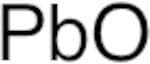
CAS 1317-36-8
:Bleioxid (PbO)
Beschreibung:
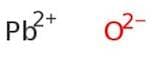
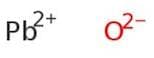
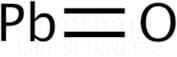
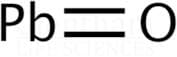
Bleioxid (PbO), mit der CAS-Nummer 1317-36-8, ist eine anorganische Verbindung, die hauptsächlich in zwei Formen existiert: Lithargyr (α-PbO) und Massicot (β-PbO). Lithargyr ist ein gelb-rotes Pulver, während Massicot typischerweise gelb ist und eine kristallinere Struktur aufweist. PbO ist in Wasser unlöslich, aber in Säuren löslich, was es in verschiedenen chemischen Umgebungen reaktiv macht. Es hat einen hohen Schmelzpunkt und zeigt halbleitende Eigenschaften, was es in elektronischen Anwendungen nützlich macht. Bleioxid wird hauptsächlich in der Herstellung von Glas, Keramiken und Blei-Säure-Batterien sowie in Pigmenten und als Stabilisator in Kunststoffen verwendet. Aufgrund der Toxizität von Blei erfordert der Umgang mit PbO jedoch strenge Sicherheitsvorkehrungen, um eine Exposition zu verhindern, da dies erhebliche Gesundheitsrisiken, einschließlich Blei-Vergiftung, darstellen kann. Umweltvorschriften regeln ebenfalls seine Verwendung und Entsorgung und betonen die Bedeutung einer verantwortungsvollen Handhabung von bleihaltigen Substanzen.
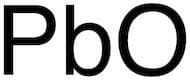
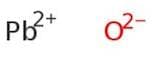
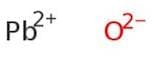
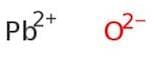
Formel:OPb
InChl:InChI=1S/O.Pb
InChI Key:InChIKey=YEXPOXQUZXUXJW-UHFFFAOYSA-N
SMILES:O=[Pb]
Synonyme:- Blei(II)-oxid
- Bleimonoxid
- Lead Mono Oxide
- Lead Oxide Regular
- Lead monooxide
- Lead monoxide
- Lead oxide
- Lead oxide (PbO)
- Lead oxide yellow
- Lead oxide yellow granular
- Lead protoxide
- Lead(2+) oxide
- Lead(II) oxide yellow
- Leadoxide
- Leadoxideyellowpowder
- Litharge
- Litharge Granular
- Litharge Irregular
- Litharge Regular
- Litharge S
- Litharge Yellow L 28
- Monoxido De Plomo
- Monoxyde de plomb
- Oxo-Lambda~2~-Plumbane
- Oxyde de plomb(II)
- PbO
- Pigment Yellow 46
- Plumbous Oxygen(-2) Anion
- Plumbous oxide
- Red Lead Oxide
- Rhenogran P60-80
- Yellow Lead Monoxide
- Yellow Lead Oxide Granular
- Yellow lead ocher
- lead (II) oxide, litharge, lead oxide
- C.I. Pigment Yellow 46
- Lead(II)oxide
- C.I. 77577
- Weitere Synonyme anzeigen
Sortieren nach
Reinheit (%)
0
100
|
0
|
50
|
90
|
95
|
100
13 Produkte gefunden.
Lead(II) Oxide
CAS:Formel:PbOReinheit:>98.0%(T)Farbe und Form:Light yellow to Yellow to Orange powder to crystalMolekulargewicht:223.20Lead(II) oxide, 99.9%
CAS:It is employed mostly in lead-based industrial glass and industrial ceramics, including computer components. Lead monoxide is used as an intermediate/precursor in the manufacture of several products, for example water proof cements, lubricants, lubricating oils, inorganic pigments, lead soaps, petrFormel:OPbReinheit:99.9%Farbe und Form:Pale yellow to yellow or pale orange, Powder or crystalline powder or crystalsMolekulargewicht:223.20Lead(II) oxide, Puratronic™, 99.999% (metals basis)
CAS:Used in producing iridescent colors on brass and bronze, coloring sulfur-containing substances and used as pigment for rubber. It is also used in oil refining, varnishes, paints, enamels and in assays for precious metal ores. This Thermo Scientific Chemicals brand product was originally part of theFormel:OPbReinheit:99.999%Molekulargewicht:223.20Lead(II) oxide, 99.99% (metals basis)
CAS:Lead(II) oxide is employed mostly in lead-based industrial glass and industrial ceramics, including computer components. It is used as an intermediate/precursor in the manufacture of several products, for example water proof cements, lubricants, lubricating oils, inorganic pigments, lead soaps, petFormel:OPbReinheit:99.99%Molekulargewicht:223.20Lead(II) oxide, low silver
CAS:Lead(II) oxide is used in storage batteries, ceramic cements and fluxes, pottery and glazes, in chromium pigments, in oil refining, in paints, and in the assay of precious metal ores. This Thermo Scientific Chemicals brand product was originally part of the Alfa Aesar product portfolio. Some documeFormel:OPbFarbe und Form:Powder, Yellow to yellow-orange to redMolekulargewicht:223.20Lead(II) oxide, Puratronic™, 99.9995% (metals basis)
CAS:It is used in the manufacture of glass, ceramics and computer components. Addition of lead oxide increases the refractive index, electrical resistivity, Curie temperature, and the ability of the glass to absorb X-rays. It is also added to decrease the viscosity of glass. It is employed in the vulFormel:OPbReinheit:99.9995%Molekulargewicht:223.20Lead(II) oxide (99.999+%-Pb) PURATREM
CAS:Lead(II) oxide (99.999+%-Pb) PURATREM
Formel:PbOReinheit:(99.999+%-Pb)Farbe und Form:yellow pwdr.Molekulargewicht:223.19Lead(II) oxide (Litharge), 99+%
CAS:Lead(II) oxide (Litharge), 99+%
Formel:PbOReinheit:99+%Farbe und Form:yellow pwdr.Molekulargewicht:223.19Lead(II) oxide, 99%
CAS:Formel:PbOReinheit:≥ 99.0%Farbe und Form:Yellow or yellow-orange powderMolekulargewicht:223.19Lead(II) Oxide
CAS:Applications Lead(II) Oxide is used as the starting material in the synthesis of Dibasic Lead Phthalate Hydrate (D417070); a compound that is used in vinyl wire insulation as a flame retardant.
Not a dangerous good if item is equal to or less than 1g/ml and there is less than 100g/ml in the package
References Grossman, R. et al.: J. Vinyl Addt. Tech., 9, 65 (2003); Grossman, R. et al.: Vinyl Addt. Tech., 6, 138 (2000)Formel:PbOFarbe und Form:NeatMolekulargewicht:223.97157Lead (II) Oxide (Lead Monoxide, Litharge) ACS, 99%
CAS:Formel:PbOReinheit:min.99%Farbe und Form:Yellow to orange, PowderMolekulargewicht:223.20Lead (II) Oxide (Lead Monoxide, Litharge) pure, 99%
CAS:Formel:PbOReinheit:min.99%Farbe und Form:Yellow to orange, PowderMolekulargewicht:223.20