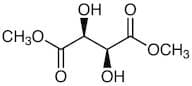
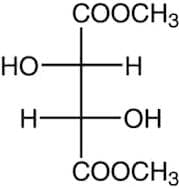
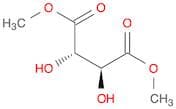
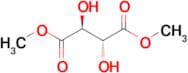
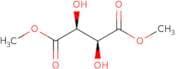
CAS 13171-64-7
:Dimethyl (2S,3S)-2,3-dihydroxybutandioat
- (-)-Dimethyl <span class="text-smallcaps">D</span>-tartarate
- (S,S)-Dimethyl tartrate
- <span class="text-smallcaps">D</span>-(-)-Tartaric acid dimethyl ester
- Butanedioic acid, 2,3-dihydroxy-, dimethyl ester, (2S,3S)-
- Butanedioic acid, 2,3-dihydroxy-, dimethyl ester, (R*,S*)-
- Butanedioic acid, 2,3-dihydroxy-, dimethyl ester, [S-(R*,R*)]-
- D-(-)-Tartaric acid dimethyl ester
- Dimethyl (-)-<span class="text-smallcaps">D</span>-tartrate
- Dimethyl (-)-tartrate
- Dimethyl (2S,3S)-2,3-Dihydroxybutanedioate
- Dimethyl 2,3-Dihydroxybutanedioate
- Dimethyl D-Tartrate
- Dimethyl D-Tartrate 99% (99+% Ee/Glc)
- Meso-tartaric acid, dimethyl ester
- Tartaric acid, dimethyl ester, <span class="text-smallcaps">D</span>-(-)-
- dimethyl (2R,3R)-2,3-dihydroxybutanedioate
- dimethyl (2R,3S)-2,3-dihydroxybutanedioate
- Weitere Synonyme anzeigen
Dimethyl D-(-)-Tartrate
CAS:Formel:C6H10O6Reinheit:>98.0%(GC)Farbe und Form:White to Almost white powder to crystalMolekulargewicht:178.14Dimethyl D-tartrate, 99%
CAS:This Thermo Scientific Chemicals brand product was originally part of the Alfa Aesar product portfolio. Some documentation and label information may refer to the legacy brand. The original Alfa Aesar product / item code or SKU reference has not changed as a part of the brand transition to Thermo Sci
Formel:C6H10O6Reinheit:99%Farbe und Form:White, Crystals or powder or crystalline powder or lumps or fused solidMolekulargewicht:178.14Butanedioic acid, 2,3-dihydroxy-, dimethyl ester, (2S,3S)-
CAS:Formel:C6H10O6Reinheit:98%Farbe und Form:SolidMolekulargewicht:178.1400(2R,3S)-Dimethyl 2,3-dihydroxysuccinate
CAS:Reinheit:98.0%Farbe und Form:SolidMolekulargewicht:178.13999938964844Dimethyl-D-tartrate
CAS:Dimethyl-D-tartrate is an enolate that has been synthesized using a stereoselective and l-tartaric acid. It has been shown to be pharmacologically active in micelles, which may be due to its ability to inhibit the accumulation of D-serine in the brain. Dimethyl-D-tartrate’s pharmacokinetic profile is characterized by a rapid elimination half-life and high clearance rate, which may be due to its metabolism by carbon tetrachloride. Dimethyl-D-tartrate has also been shown to have a strong affinity for l-phenylalanine and micelles, suggesting that it may act as an inhibitor of the enzyme phenylalanine hydroxylase.
Formel:C6H10O6Reinheit:Min. 95%Farbe und Form:PowderMolekulargewicht:178.14 g/mol