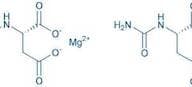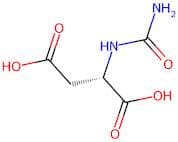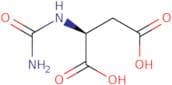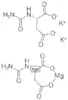
CAS 13184-27-5
:Carbamoylaspartinsäure
Beschreibung:
Carbamoylaspartinsäure, mit der CAS-Nummer 13184-27-5, ist ein Aminosäurederivat, das durch das Vorhandensein sowohl einer Carbamoylgruppe als auch eines Aspartat-Rückgrats gekennzeichnet ist. Diese Verbindung weist eine Carbonsäurefunktionalität, eine Aminogruppe und eine Carbamoylgruppe auf, die zu ihren einzigartigen Eigenschaften beiträgt. Sie wird typischerweise als nicht-proteinogene Aminosäure klassifiziert, was bedeutet, dass sie während der Translation nicht in Proteine eingebaut wird. Carbamoylaspartinsäure ist bekannt für seine potenzielle biologische Bedeutung, insbesondere in Stoffwechselwegen und als Vorläufer bei der Synthese anderer Biomoleküle. Ihre Löslichkeit in Wasser ist bemerkenswert, was ihre Interaktion in biologischen Systemen erleichtert. Die Verbindung kann verschiedene physiologische Effekte zeigen, obwohl spezifische biologische Aktivitäten je nach Konzentration und Umweltbedingungen variieren können. Wie viele Aminosäuren und deren Derivate kann sie an verschiedenen biochemischen Reaktionen teilnehmen, was sie sowohl für die Forschung als auch für potenzielle therapeutische Anwendungen von Interesse macht.
Formel:C5H8N2O5
InChl:InChI=1S/C5H8N2O5/c6-5(12)7-2(4(10)11)1-3(8)9/h2H,1H2,(H,8,9)(H,10,11)(H3,6,7,12)/t2-/m0/s1
InChI Key:InChIKey=HLKXYZVTANABHZ-REOHCLBHSA-N
SMILES:[C@@H](CC(O)=O)(NC(N)=O)C(O)=O
Synonyme:- (2S)-2-(Carbamoylamino)butanedioic acid
- <span class="text-smallcaps">L</span>-Aspartic acid, N-(aminocarbonyl)-
- <span class="text-smallcaps">L</span>-Ureidosuccinic acid
- Aspartic acid, N-carbamoyl-, <span class="text-smallcaps">L</span>-
- Carbamoyl-L-Aspartic Acid Magnesium Salt
- Carbamoylaspartic acid
- Carbamoylasparticacid
- Carbamylaspartic acid
- Carbamylasparticacid
- L-Asparticaci
- L-Ureidosuccinicacid
- N-(Aminocarbonyl)-<span class="text-smallcaps">L</span>-aspartic acid
- N-(Aminocarbonyl)-L-Asparticaci
- N-Carbamoyl-(S)-aspartic acid
- N-Carbamoyl-<span class="text-smallcaps">L</span>-aspartic acid
- N-Carbamylaspartic acid
- N-carbamoyl-L-aspartic acid
- N-carbamoylaspartic acid
- NSC 14983
- Aspartic acid, N-carbamoyl-, L-
- L-Aspartic acid, N-(aminocarbonyl)-
- N-(Aminocarbonyl)-L-aspartic acid
- Weitere Synonyme anzeigen
Sortieren nach
Reinheit (%)
0
100
|
0
|
50
|
90
|
95
|
100
4 Produkte.
Carbamoyl-Asp-OH · magnesium salt/Carbamoyl-Asp-OH · dipotassium salt (1:1)
CAS:Substrate for the determination of E.coli dihydroorotase (EC 3.5.2.3.), which catalyzes the cyclization of carbamoyl-Asp-OH into L-5,6-dihydroorotate. This enzyme being in the biosynthetic pathway of pyrimidine nucleotides, is an important therapeutic target for the design of new antineoplastic agents. Its activity was assayed spectrophotometrically measuring the increase of absorbance at 230 nm (ε₂₃₀ = 1170 M⁻¹cm⁻¹, Km = 0.47 mM, kcat = 143 s⁻¹).Formel:C10H12K2MgN4O10Reinheit:> 90%Farbe und Form:White PowderMolekulargewicht:450.73Carbamoyl-Asp-OH·magnesium salt/Carbamoyl-Asp-OH·dipotassium salt (1:1)
CAS:Carbamoyl-Asp-OH·magnesium salt/Carbamoyl-Asp-OH·dipotassium salt (1:1) is a derivate of p-hydroxybenzoic acid that has been shown to inhibit leukotriene receptor antagonists and basic proteins. It has been found in urine samples, but its function is not yet known. The uptake of this molecule may be a potential biomarker for the diagnosis of orotic aciduria and HIV infection. Carbamoyl-Asp-OH·magnesium salt/Carbamoyl-Asp-OH·dipotassium salt (1:1) has also been shown to be an inhibitor of intramolecular hydrogen transfer reactions in model systems.Formel:C10H12K2MgN4O10Reinheit:Min. 95%Molekulargewicht:450.72 g/mol