CAS 13204-98-3
:Lysin, 5-hydroxy-, Hydrochlorid (1:1)
Beschreibung:
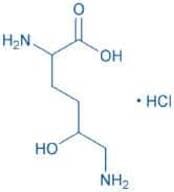
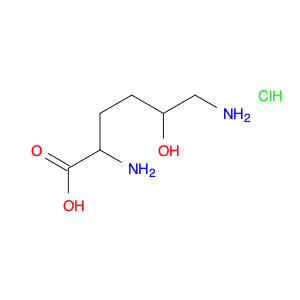
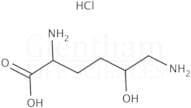
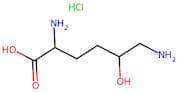
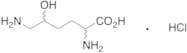
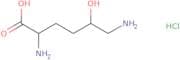
Lysin, 5-hydroxy-, Hydrochlorid (1:1), mit der CAS-Nummer 13204-98-3, ist ein Derivat der Aminosäure Lysin, das durch das Vorhandensein einer Hydroxylgruppe an der fünften Kohlenstoffposition der Lysin-Seitenkette gekennzeichnet ist. Diese Verbindung erscheint typischerweise als weißes bis off-white kristallines Pulver und ist in Wasser löslich, was eine häufige Eigenschaft vieler Aminosäurederivate ist. Die Hydrochloridform zeigt an, dass es sich um ein Salz handelt, das mit Salzsäure gebildet wurde, was seine Stabilität und Löslichkeit erhöht. Lysin selbst ist essentiell für die Proteinsynthese und spielt eine entscheidende Rolle in verschiedenen biologischen Prozessen, einschließlich der Kollagenbildung und der Immunfunktion. Die Hydroxylierung an der fünften Position kann einzigartige biochemische Eigenschaften verleihen, die potenziell seine Wechselwirkung mit Enzymen und Rezeptoren beeinflussen. Wie viele Aminosäuren und deren Derivate kann Lysin, 5-Hydroxy-, Hydrochlorid in Nahrungsergänzungsmitteln, pharmazeutischen Produkten und Forschungsanwendungen verwendet werden, insbesondere in Studien, die sich mit dem Stoffwechsel und der Proteinstruktur befassen.
Formel:C6H14N2O3·ClH
InChl:InChI=1S/C6H14N2O3.ClH/c7-3-4(9)1-2-5(8)6(10)11;/h4-5,9H,1-3,7-8H2,(H,10,11);1H
InChI Key:InChIKey=MJXVOTKVFFAZQJ-UHFFFAOYSA-N
SMILES:C(CC(CN)O)C(C(O)=O)N.Cl
Synonyme:- Lysine, 5-hydroxy-, hydrochloride (1:1)
- Lysine, 5-hydroxy-, monohydrochloride, DL-
- DL-Lysine, 5-hydroxy-, monohydrochloride
- Lysine, 5-hydroxy-, monohydrochloride
- 5-Hydroxy-DL-lysine hydrochloride
Sortieren nach
Reinheit (%)
0
100
|
0
|
50
|
90
|
95
|
100
12 Produkte.
H-DL-δ-Hydroxy-DL-Lys-OH · HCl
CAS:Inhibitor of homoserine kinase.Formel:C6H14N2O3·HClReinheit:> 99%Farbe und Form:White PowderMolekulargewicht:198.655-Hydroxy-dl-lysine, HCl
CAS:Formel:C6H15ClN2O3Reinheit:97%Farbe und Form:SolidMolekulargewicht:198.6479DL-5-Hydroxylysine hydrochloride
CAS:Formel:C6H14N2O3·HClReinheit:≥ 98%Farbe und Form:White to almost white powderMolekulargewicht:198.65DL-5-Hydroxylysine HCl
CAS:Formel:C6H14N2O3·HClFarbe und Form:White To Off-White SolidMolekulargewicht:162.19 36.46DL-5-Hydroxylysine hydrochloride
CAS:DL-5-Hydroxylysine hydrochlorideReinheit:≥98%Molekulargewicht:198.65g/molDL-5-Hydroxylysine hydrochloride
CAS:DL-5-Hydroxylysine hydrochloride is a racemic mix of 5-hydroxylysine enantiomers, used as markers for protein oxidation.Formel:C6H15ClN2O3Reinheit:99.62% - 99.67%Farbe und Form:White Crystalline PowderMolekulargewicht:198.65DL-5-Hydroxy-DL-lysine Hydrochloride
CAS:Applications Amino acid substitute tumor growth.
References Villiers, C.L., et al.: Eur. J. Biochem., 140, 421 (1984);Formel:C6H14N2O3·ClHFarbe und Form:Beige PowderMolekulargewicht:198.655-Hydroxy-DL-lysine hydrochloride
CAS:5-Hydroxy-DL-Lysine Hydrochloride is a chemical compound that is used in the study of collagen. The 5-hydroxy group on lysine makes it an acidic amino acid. It is a building block for proteins that are important in connective tissue, such as collagen and elastin. Collagen is a fibrous protein that provides support to structures like skin, bones, and tendons. Agmatine has been shown to inhibit the degradation of collagen by preventing the breakdown of polyamines, which are required for the production of collagen and other proteins. Fluorescent labelling techniques have been used to detect 5-hydroxy-DL-Lysine Hydrochloride in biological samples using fluorescent proteins or tritiated lysine as surrogates for this compound. The fluorescent technique can be used to measure how much 5-hydroxy-DL-Lysine Hydrochloride is present in a sample at a given time and also how fast it deFormel:C6H14N2O3•HClReinheit:Min. 98%Farbe und Form:PowderMolekulargewicht:198.65 g/mol