CAS 1321-74-0
:Divinylbenzol
Beschreibung:
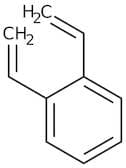
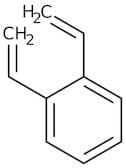
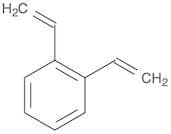
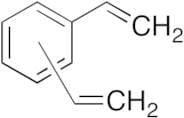
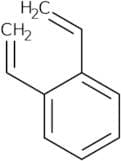
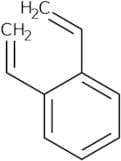
Divinylbenzol (DVB) ist eine organische Verbindung, die durch ihre Struktur gekennzeichnet ist, die zwei Vinylgruppen enthält, die an einen Benzolring gebunden sind. Es handelt sich um eine farblose bis blassgelbe Flüssigkeit mit einem charakteristischen aromatischen Geruch. DVB ist bekannt für seine hohe Reaktivität aufgrund der Anwesenheit der Vinylgruppen, was es zu einem wertvollen Monomer in der Herstellung von vernetzten Polymeren und Harzen macht. Es wird häufig in der Synthese von Ionenaustauschharzen sowie in der Herstellung verschiedener Kunststoffe und Beschichtungen verwendet. Die Verbindung ist in organischen Lösungsmitteln löslich, hat jedoch eine begrenzte Löslichkeit in Wasser. DVB kann polymerisieren, was zur Bildung von vernetzten Strukturen führt, die die mechanischen und thermischen Eigenschaften der resultierenden Materialien verbessern. Sicherheitsüberlegungen sind wichtig beim Umgang mit DVB, da es ein Reizstoff für Haut und Augen sein kann, und es sollten geeignete Vorsichtsmaßnahmen getroffen werden, um die Exposition zu minimieren. Insgesamt ist Divinylbenzol eine vielseitige Verbindung mit bedeutenden Anwendungen in der chemischen Industrie.
Formel:C10H10
InChl:InChI=1/2C10H10/c1-3-9-5-7-10(4-2)8-6-9;1-3-9-6-5-7-10(4-2)8-9/h2*3-8H,1-2H2
SMILES:C=Cc1ccc(C=C)cc1.C=Cc1cccc(C=C)c1
Synonyme:- Benzene, Divinyl
- Benzene, diethenyl-
- Diethenylbenzene
- Divinilbenceno
- Divinilbenceno, Puro
- Divinilbenzene
- Divinylbenzen
- Divinylbenzene
- Divinylbenzene Mixed Isomers
- Divinylbenzene, Mixture Of Isomers
- Divinylbenzenetechmixedisomers
- Divinylbenzol
- Dvb 810
- Dvb 96
- Dvb 960
- Dvb Hp
- Dvb-H
- Dvr 960
- Ethylvinyl Benzene
- Vinilestireno
- Vinilstirene
- Vinyl styrène
- Vinyl-Styrol
- Vinylethylbenzene
- Vinylstyren
- Vinylstyrene
- ジビニルベンゼン
- Weitere Synonyme anzeigen
Sortieren nach
Reinheit (%)
0
100
|
0
|
50
|
90
|
95
|
100
10 Produkte.
Divinylbenzene (m- and p- mixture) (contains Ethylvinylbenzene, Diethylbenzene) (stabilized with TBC)
CAS:Formel:C10H10Reinheit:>50.0%(GC)Farbe und Form:Colorless to Light orange to Yellow clear liquidMolekulargewicht:130.19Divinylbenzene, 80%, mixture of isomers, stab. with 1000ppm 4-tert-butylcatechol
CAS:Divinylbenzene is used as a reactive monomer in polyester resins and for the synthesis of highly crosslinked macroporous styrene as well as a crosslinking agent. It acts as an intermediate in the production of ion exchange resin. Further, it is used in making rubber, petroleum production and polymerFormel:C10H10Reinheit:80%Farbe und Form:Colorless to yellow, LiquidMolekulargewicht:130.19Divinylbenzene, 55%, mixture of isomers, stab. with 1000ppm 4-tert-butylcatechol
CAS:Crosslinking monomerFormel:C10H10Farbe und Form:LiquidMolekulargewicht:130.19Divinylbenzene (ortho-, meta-, or para- substituted) (~80%)
CAS:Kontrolliertes ProduktApplications Divinylbenzene;m-(or p-)Divinylbenzene (cas# 1321-74-0) is a useful research chemical.
Formel:C10H10Reinheit:~80%Farbe und Form:ColourlessMolekulargewicht:130.19Divinylbenzene (m- and p- mixture) (contains Ethylvinylbenzene, Diethylbenzene) - 80%
CAS:Divinylbenzene is a glycol ester that undergoes a palladium-catalyzed coupling reaction with an alkyne to produce a model system. The resulting polymer has high values of optical sensor, kinetic data, and thermal expansion. Divinylbenzene's chemical stability and particle size make it an appropriate sample preparation for various types of analytical techniques such as optical sensor, which can measure the concentration of divinylbenzene in polymers. Divinylbenzene contains nitrogen atoms that can react with fatty acids to form liver lesions in rats.Formel:C10H10Reinheit:Min. 80 Area-%Farbe und Form:Clear LiquidMolekulargewicht:130.19 g/molDivinylbenzene (m- and p- mixture) (contains Ethylvinylbenzene, Diethylbenzene) - 55%
CAS:Divinylbenzene is a glycol ether that is used as a solvent and an intermediate in the production of polyvinyl chloride. It has been shown to be harmful to the liver in animal studies, causing lesions. It also causes an increase in the levels of water vapor in the air and high values for thermal expansion. Divinylbenzene undergoes a reaction with phosphorus pentoxide, yielding polyvinyl chloride and hydrogen gas. The mechanism of this reaction is catalyzed by palladium.Formel:C10H10Reinheit:Min. 55 Area-%Molekulargewicht:130.19 g/mol