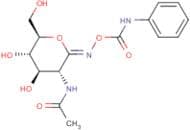
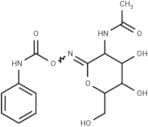
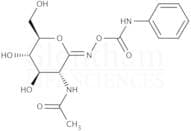
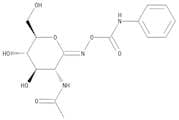
![D-Gluconimidic acid, 2-(acetylamino)-2-deoxy-N-[[(phenylamino)carbonyl]oxy]-, δ-lactone, (1Z)-](/_next/image/?url=https%3A%2Fstatic.cymitquimica.com%2Fcas-image%2Fthumb-webp%2F42589-d-gluconimidic-acid-2-acetylamino-2-deoxy-n-phenylamino-carbonyl-oxy-d-lactone-1z.webp&w=3840&q=75)
CAS 132489-69-1
:D-Gluconimidinsäure, 2-(acetylamino)-2-desoxy-N-[[(phenylamino)carbonyl]oxy]-, δ-lacton, (1Z)-
Beschreibung:
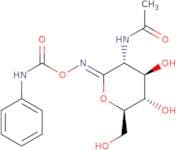
D-Gluconimidensäure, 2-(Acetylamino)-2-deoxy-N-[[(Phenylamino)carbonyl]oxy]-, δ-Lacton, mit der CAS-Nummer 132489-69-1, ist eine komplexe organische Verbindung, die durch ihre Lactonstruktur gekennzeichnet ist, die ein zyklischer Ester ist, der aus der Reaktion einer Hydroxylgruppe und einer Carbonsäure entsteht. Diese Verbindung weist eine Acetylamino-Gruppe auf, was auf das Vorhandensein einer Acetylgruppe hinweist, die an eine Aminogruppe gebunden ist, was zu ihrer Reaktivität und potenziellen biologischen Aktivität beiträgt. Die Phenylamino-Gruppe deutet darauf hin, dass sie aromatische Eigenschaften aufweisen könnte, was möglicherweise ihre Löslichkeit und Wechselwirkung mit biologischen Systemen beeinflusst. Das Vorhandensein der Gluconimidensäure-Einheit deutet darauf hin, dass sie möglicherweise an biochemischen Prozessen beteiligt ist, die möglicherweise mit dem Kohlenhydratstoffwechsel zusammenhängen. Ihre δ-Lacton-Konfiguration impliziert, dass sie einzigartige Eigenschaften in Bezug auf Stabilität und Reaktivität haben könnte, was sie in der medizinischen Chemie und der Arzneimittelentwicklung von Interesse macht. Insgesamt deuten die strukturellen Merkmale dieser Verbindung auf potenzielle Anwendungen in der Pharmazie hin, insbesondere bei der Entwicklung von glykosilierten Verbindungen oder Enzyminhibitoren.
Formel:C15H19N3O7
InChl:InChI=1S/C15H19N3O7/c1-8(20)16-11-13(22)12(21)10(7-19)24-14(11)18-25-15(23)17-9-5-3-2-4-6-9/h2-6,10-13,19,21-22H,7H2,1H3,(H,16,20)(H,17,23)/b18-14-/t10-,11-,12-,13-/m1/s1
InChI Key:InChIKey=PBLNJFVQMUMOJY-JXZOILRNSA-N
SMILES:N(\OC(NC1=CC=CC=C1)=O)=C\2/[C@H](NC(C)=O)[C@@H](O)[C@H](O)[C@@H](CO)O2
Synonyme:- <span class="text-smallcaps">D</span>-Gluconimidic acid, 2-(acetylamino)-2-deoxy-N-[[(phenylamino)carbonyl]oxy]-, δ-lactone, (1Z)-
- N-Acetylglucosaminono-1,5-Lactoneo-(Phenylcarbamoyl)Oxime
- N-[(2Z,3R,4R,5S,6R)-4,5-dihydroxy-6-(hydroxymethyl)-2-{[(phenylcarbamoyl)oxy]imino}tetrahydro-2H-pyran-3-yl]acetamide (non-preferred name)
- O-(2-Acetamido-2-deoxy-D-glucopyranosylidenamino) N-phenylcarbamate
- acetamidodeoxy-D-glucopyranosylideneamino phenylcarbamate
- D-Gluconimidic acid, 2-(acetylamino)-2-deoxy-N-[[(phenylamino)carbonyl]oxy]-, δ-lactone, (1Z)-
Sortieren nach
Reinheit (%)
0
100
|
0
|
50
|
90
|
95
|
100
8 Produkte.
D-Gluconimidic acid, 2-(acetylamino)-2-deoxy-N-[[(phenylamino)carbonyl]oxy]-, δ-lactone, (1Z)-
CAS:Formel:C15H17N3O9Reinheit:98%Farbe und Form:SolidMolekulargewicht:383.3102(Z)-PUGNAc
CAS:(Z)-PUGNAc is a potent O-GlcNAcase inhibitor that is more active than (E)-PUGNAc, removes O-GlcNAc from proteins (peptide O-GlcNAc-β-N-acetylaminoglucosidase),Formel:C15H19N3O7Reinheit:98.72%Farbe und Form:SolidMolekulargewicht:353.33O-(2-Acetamido-2-deoxy-D-glucopyranosylidene)amino N-Phenylcarbamate
CAS:Kontrolliertes ProduktStability Moisture and Temperature Sensitive
Applications An inhibitor of O-GlcNAcase, hexosaminidase A, and hexosaminidase B.
References Baji, H., et al,: Eur. J. Med. Chem., 30, 617 (1995), Vaaje-Kolstad, G., et al.: J. Biol. Chem., 279, 3612 (2004), Perreira, M., et al.: Bioorg. Med. Chem., 14, 837 (2006).Formel:C15H19N3O7Farbe und Form:White To Off-WhiteMolekulargewicht:353.33(Z)-PugNAc
CAS:PUGNAc (O-(2-acetamido-2-deoxy-D-glucopyranosylidene)amino N-phenylcarbamate) is a potent inhibitor of O-GlcNAcase, the enzyme that removes O-linked N-acetylglucosamine from intracellular proteins. It increases global O-GlcNAcylation levels by blocking O-GlcNAcase and is widely used to study the biological effects of altered O-linked protein glycosylation. PUGNAc also inhibits the related lysosomal enzyme β-hexosaminidase, which is mainly of interest in research to understand lysosomal function, glycoconjugate metabolism, or the role of hexosaminidases in pathogens, such as bacteria and parasites that use similar enzymes to process sugars.Formel:C15H19N3O7Reinheit:Min. 97 Area-%Farbe und Form:White PowderMolekulargewicht:353.33 g/mol
![D-Gluconimidic acid, 2-(acetylamino)-2-deoxy-N-[[(phenylamino)carbonyl]oxy]-, δ-lactone, (1Z)-](/_next/image/?url=https%3A%2Fstatic.cymitquimica.com%2Fproducts%2FIN%2Fthumb%2FDA0010QF.jpg&w=3840&q=75)