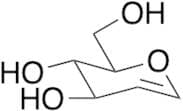
CAS 13265-84-4
:D-glucal
Beschreibung:
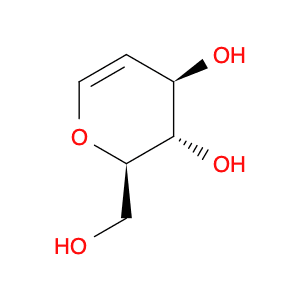
D-glucal, mit der CAS-Nummer 13265-84-4, ist eine organische Verbindung, die als Aldohexose klassifiziert ist und ein Derivat von Glukose darstellt. Sie zeichnet sich durch ihre offenkettige Struktur aus, die an einem Ende eine Carbonylgruppe (Aldehyd) und mehrere Hydroxylgruppen entlang der Kohlenstoffkette aufweist. D-glucal ist typischerweise ein weißer bis schmutzig-weißer Feststoff und ist aufgrund seiner polaren funktionellen Gruppen in Wasser löslich. Diese Verbindung ist bekannt für ihre Reaktivität, insbesondere in Glykosylierungsreaktionen, was sie in der organischen Synthese und der Kohlenhydratchemie wertvoll macht. D-glucal kann verschiedenen Umwandlungen unterzogen werden, einschließlich Oxidation und Reduktion, und kann an Zyklisierungsreaktionen teilnehmen, um Glykoside zu bilden. Ihre strukturellen Merkmale tragen zu ihrer biologischen Bedeutung bei, da sie als Vorläufer für komplexere Kohlenhydrate dienen kann. Darüber hinaus machen die Eigenschaften von D-glucal sie zu einem interessanten Thema in der Forschung zu Glykoproteinen und anderen Biomolekülen.
Formel:C6H10O4
InChl:InChI=1/C6H10O4/c7-3-5-6(9)4(8)1-2-10-5/h1-2,4-9H,3H2/t4-,5-,6+/m1/s1
InChI Key:InChIKey=YVECGMZCTULTIS-PBXRRBTRSA-N
SMILES:C(O)[C@@H]1[C@@H](O)[C@H](O)C=CO1
Synonyme:- (4xi)-1,5-anhydro-2-deoxy-D-threo-hex-1-enitol
- 1,5-Anhydro-2-deoxy-<span class="text-smallcaps">D</span>-arabino-hex-1-enitol
- 1,5-Anhydro-2-deoxy-D-arabino-hex-1-enitol
- <span class="text-smallcaps">D</span>-(+)-Glucal
- <span class="text-smallcaps">D</span>-arabino-Hex-1-enitol, 1,5-anhydro-2-deoxy-
- <span class="text-smallcaps">D</span>-arabino-Hex-1-enopyranose, 1,2-dideoxy-
- D-arabino-Hex-1-enitol, 1,5-anhydro-2-deoxy-
- Glucal
- D-Glucal
- D-arabino-Hex-1-enopyranose, 1,2-dideoxy-
- (2R,3S,4R)-2-(hydroxymethyl)-3,4-dihydro-2H-pyran-3,4-diol
- (2R)-3β,4α-Dihydroxy-3,4-dihydro-2H-pyran-2α-methanol
- (2R)-3,4-Dihydro-2α-(hydroxymethyl)-2H-pyran-3β,4α-diol
- 1,2-Didehydro-1,2-dideoxy-D-glucopyranose
- P-GLUCAL
- 1,5-Anhydro-2-deoxy-D-arabino-hexa-1-enitol
- 1,5-anhydro-2-deoxy-d-arabino-hex-1-enito
- Weitere Synonyme anzeigen
Sortieren nach
Reinheit (%)
0
100
|
0
|
50
|
90
|
95
|
100
8 Produkte.
D-Glucal
CAS:Formel:C6H10O4Reinheit:>97.0%(GC)Farbe und Form:White to Almost white powder to crystalMolekulargewicht:146.14D-arabino-Hex-1-enitol, 1,5-anhydro-2-deoxy-
CAS:Formel:C6H10O4Reinheit:98%Farbe und Form:SolidMolekulargewicht:146.1412D-Glucal
CAS:Formel:C6H10O4Reinheit:≥ 98.0%Farbe und Form:White to off-white or beige powderMolekulargewicht:146.14D-Glucal
CAS:D-Glucal is a protonated d-glucal, which is a simple sugar. It reacts with the electron acceptor oxygen to form an oxidized product. This product can be reduced back to the original molecule by using a reducing agent, such as sodium borohydride or sodium dithionite. D-Glucal has been shown to inhibit the growth of tumor cells in mice that are resistant to other anticancer drugs. D-Glucal inhibits transcription and replication of DNA by binding to the DNA-dependent RNA polymerase and blocking its ability to transcribe messenger RNA (mRNA). The enzyme is also inhibited by glycosidic bond architectures that prevent it from binding to the DNA template strand. D-Glucal also has an effect on protein synthesis because it binds to proteins and prevents them from performing their normal functions. D-Glucal has been used as a model system for studying cellular processes in mammalian cells, such as oxidationFormel:C6H10O4Reinheit:Min. 98 Area-%Farbe und Form:White Off-White PowderMolekulargewicht:146.14 g/mol(2R,3S,4R)-2-(Hydroxymethyl)-3,4-dihydro-2H-pyran-3,4-diol
CAS:Formel:C6H10O4Reinheit:98%Farbe und Form:SolidMolekulargewicht:146.142D-Glucal
CAS:Kontrolliertes ProduktApplications D-Glucal is an important building block for both solution- and solid-phase synthesis of oligosaccharides.
References Gilkes, N., et al.: J. Biol. Chem., 259, 10455 (1984), Street, I., et al.: Biochemistry, 31, 9970 (1992), Crout, D., et al.: Curr. Opin. Chem. Biol., 2, 98 (1998),Formel:C6H10O4Farbe und Form:NeatMolekulargewicht:146.14