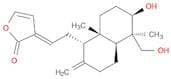
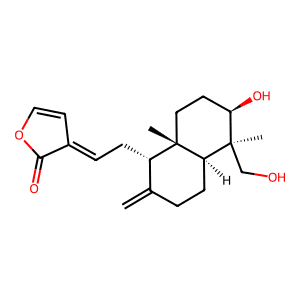
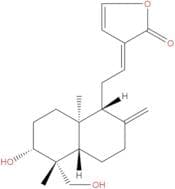
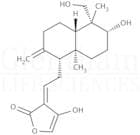
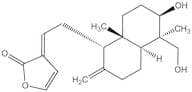
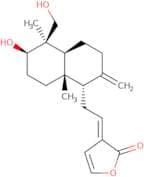
CAS 134418-28-3
:Dehydroandrographolid
Beschreibung:
Dehydroandrographolid ist eine natürliche Verbindung, die aus der Pflanze Andrographis paniculata gewonnen wird, die allgemein für ihre medizinischen Eigenschaften bekannt ist. Es handelt sich um eine bicyclische Diterpenoidlacton, die durch ihre komplexe Struktur gekennzeichnet ist, die mehrere Ringe und funktionelle Gruppen umfasst. Diese Verbindung zeigt eine Reihe biologischer Aktivitäten, einschließlich entzündungshemmender, antioxidativer und antimikrobieller Eigenschaften, was sie für die pharmakologische Forschung von Interesse macht. Dehydroandrographolid wurde auf seine potenziellen therapeutischen Wirkungen bei verschiedenen Erkrankungen, einschließlich Infektionen und entzündlichen Erkrankungen, untersucht. Sein Wirkmechanismus umfasst oft die Modulation von Signalwegen und die Hemmung von pro-inflammatorischen Zytokinen. Darüber hinaus ist bekannt, dass es mit verschiedenen biologischen Zielen interagiert, was zu seinen vielfältigen pharmakologischen Wirkungen beiträgt. Die Verbindung wird typischerweise mit Techniken wie Chromatographie und Spektroskopie analysiert, um ihre Reinheit und Konzentration in Forschungseinrichtungen zu bestimmen. Insgesamt stellt Dehydroandrographolid ein bedeutendes Forschungsfeld in der Chemie natürlicher Produkte und der Arzneimittelentwicklung dar, was die Bedeutung pflanzenbasierter Verbindungen in der modernen Medizin hervorhebt.
Formel:C20H28O5
InChl:InChI=1/C20H28O4/c1-13-4-7-16-19(2,10-8-17(22)20(16,3)12-21)15(13)6-5-14-9-11-24-18(14)23/h5-6,9,15-17,21-22H,1,4,7-8,10-12H2,2-3H3/b6-5+/t15-,16?,17-,19+,20+/m1/s1
InChI Key:InChIKey=YIIRVUDGRKEWBV-CZUXAOBFSA-N
SMILES:C[C@]12[C@@]([C@@](CO)(C)[C@H](O)CC1)(CCC(=C)[C@@H]2C/C=C\3/C(=O)OC=C3)[H]
Synonyme:- (2R,5R,10R)-2,17-dihydroxy-20-oxo-9,19-didehydro-5,6,7,8,9,10,15-octahydro-20:5,10-dicycloretinal
- (3E)-3-[2-[(1S,4aS,5R,6R,8aS)-Decahydro-6-hydroxy-5-(hydroxymethyl)-5,8a-dimethyl-2-methylene-1-naphthalenyl]ethylidene]-2(3H)-furanone
- 14-(P)
- 14-Deoxy-11-dehydroandrographolide
- 2(3H)-Furanone, 3-[2-[(1S,4aS,5R,6R,8aS)-decahydro-6-hydroxy-5-(hydroxymethyl)-5,8a-dimethyl-2-methylene-1-naphthalenyl]ethylidene]-, (3E)-
- 2(3H)-Furanone, 3-[2-[decahydro-6-hydroxy-5-(hydroxymethyl)-5,8a-dimethyl-2-methylene-1-naphthalenyl]ethylidene]-, [1R-[1α,2α,4aα,5β(E),8aβ]]-
- DEOXY-11,12-DiDehydroandrographolide
- Dehydroanddrographolide
- Dehydroandrographoline
- andrographolide, Dehydro-
- Dehydroandrographolide
- Dehydrographkide
- 2(3H)-Furanone,3-[2-[(1S,4aS,5R,6R,8aS)-decahydro-
- Weitere Synonyme anzeigen
Sortieren nach
Reinheit (%)
0
100
|
0
|
50
|
90
|
95
|
100
7 Produkte.
(3E)-3-[2-[(1S,4aS,5R,6R,8aS)-Decahydro-6-hydroxy-5-(hydroxymethyl)-5,8a-dimethyl-2-methylene-1-naphthalenyl]ethylidene]-2(3H)-furanone
CAS:Formel:C20H28O4Reinheit:98%Farbe und Form:SolidMolekulargewicht:332.4339Dehydroandrographolide
CAS:Dehydroandrographolide is a natural compound extracted from herbal medicine Andrographis paniculata (Burm f) Nees.Formel:C20H28O4Reinheit:99.98%Farbe und Form:SolidMolekulargewicht:332.43Dehydroandrographolide
CAS:Dehydroandrographolide is a novel TMEM16A inhibitor and possesses multiple pharmacological activities, including anti-inflammation, anti-cancer, anti-bacterial, anti-virus and anti-hepatitis activity. It possesses activity against HBV DNA replication with IC50 values of 22.58 uM and low SI values of 8.7 ; it can alleviate oxidative stress in LPS-induced acute lung injury possibly by inactivating iNOS.Formel:C20H28O4Reinheit:95%~99%Molekulargewicht:332.44Dehydroandrographolide
CAS:Formel:C20H28O4Reinheit:≥ 98.0%Farbe und Form:White to off-white powderMolekulargewicht:332.43Dehydroandrographolide
CAS:LactoneFormel:C20H28O4Reinheit:≥ 95.0 % (HPLC)Farbe und Form:PowderMolekulargewicht:332.44Dehydroandrographoline
CAS:Dehydroandrographolide is a natural product that has been used in traditional medicine to treat bowel disease, diabetes, and cancer. This compound is found in the plant Andrographis paniculata and has been shown to inhibit P-glycoprotein (P-gp) efflux transporter activity. Dehydroandrographolide also induces autophagy, which is the process by which cells degrade their own components under conditions of nutrient starvation or other stress. In addition, dehydroandrographolide succinate inhibits potassium channel activity and may be a potential anticancer agent. The analytical method for dehydroandrographolide succinate is based on an acid hydrolysis followed by high performance liquid chromatography with UV detection at λ max 218 nm.Formel:C20H28O5Reinheit:Min. 95%Farbe und Form:White PowderMolekulargewicht:348.43 g/mol