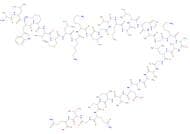
CAS 136212-91-4
:Dermaseptin Phyllomedusa sauvagii
Beschreibung:
Dermaseptin Phyllomedusa sauvagii ist ein Peptid, das aus den Hautsekreten des Frosches Phyllomedusa sauvagii gewonnen wird und für seine antimikrobiellen Eigenschaften bekannt ist. Diese Substanz gehört zu einer Klasse von Verbindungen, die als Dermaseptine bezeichnet werden und sich durch ihre Fähigkeit auszeichnen, mikrobielle Membranen zu stören, was sie gegen eine Vielzahl von Bakterien, Pilzen und einigen Viren wirksam macht. Dermaseptin Phyllomedusa sauvagii weist typischerweise eine kationische Natur auf, die zu seiner Wechselwirkung mit negativ geladenen mikrobiellen Membranen beiträgt. Das Peptid besteht aus einer Sequenz von Aminosäuren, die sowohl hydrophobe als auch hydrophile Bereiche umfasst, was ihm ermöglicht, in Lipid-Doppelschichten einzudringen. Seine potenziellen Anwendungen erstrecken sich auf die Pharmazie, insbesondere bei der Entwicklung neuer antimikrobieller Mittel, sowie bei der Wundheilung und in Hautpflegeprodukten. Darüber hinaus hebt die Forschung zu Dermaseptinen ihre Rolle in der Immunabwehr von Amphibien hervor und zeigt die evolutionäre Bedeutung dieser Peptide zum Schutz vor Krankheitserregern in ihren natürlichen Lebensräumen.
Formel:C152H257N43O44S2
Synonyme:- Dermaseptin
- Dermaseptin s
Sortieren nach
Reinheit (%)
0
100
|
0
|
50
|
90
|
95
|
100
3 Produkte.
Dermaseptin
CAS:Dermaseptin is a peptide expressed by the frog skin glands with a potent antimicrobial activity against bacteria, fungi and protozoa.Formel:C152H257N43O44S2Reinheit:98%Farbe und Form:SolidMolekulargewicht:3455.1Dermaseptin
CAS:Dermaseptin is a type of antimicrobial peptide, which is sourced predominantly from the skin secretions of frogs, specifically from the Phyllomedusinae subfamily. These peptides function by disrupting the microbial cell membranes through their amphipathic and cationic nature, leading to cell lysis and death. Dermaseptins exhibit a broad spectrum of antimicrobial activity, including action against bacteria, fungi, protozoa, and certain viruses, making them of significant interest in biomedical research.
Formel:C152H257N43O44S2Reinheit:Min. 95%Molekulargewicht:3,455.1 g/mol