CAS 136461-80-8
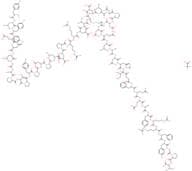
:H-TYR-LEU-TYR-GLN-TRP-LEU-GLY-ALA-PRO-VAL-PRO-TYR-PRO-ASP-PRO-LEU-GLA-PRO-ARG-ARG-GLA-VAL-CYS-GLA-LEU-ASN-PRO-ASP-CYS-ASP-GLU-LEU-ALA-ASP-HIS-ILE-GLY-PHE-GLN-GLU-ALA-TYR-ARG-ARG-PHE-TYR-GLY-PRO-VAL-OH
Beschreibung:
Die chemische Substanz mit dem Namen "H-TYR-LEU-TYR-GLN-TRP-LEU-GLY-ALA-PRO-VAL-PRO-TYR-PRO-ASP-PRO-LEU-GLA-PRO-ARG-ARG-GLA-VAL-CYS-GLA-LEU-ASN-PRO-ASP-CYS-ASP-GLU-LEU-ALA-ASP-HIS-ILE-GLY-PHE-GLN-GLU-ALA-TYR-ARG-ARG-PHE-TYR-GLY-PRO-VAL-OH" und der CAS-Nummer "136461-80-8" ist ein Peptid, das aus einer Sequenz von Aminosäuren besteht. Dieses Peptid weist typische Merkmale von Polypeptiden auf, einschließlich einer spezifischen Sequenz, die seine biologische Funktion und Aktivität bestimmt. Das Vorhandensein verschiedener Aminosäuren wie Tyrosin (Tyr), Leucin (Leu) und Arginin (Arg) deutet auf potenzielle Rollen in der Signalübertragung, struktureller Unterstützung oder enzymatischer Aktivität hin. Die Struktur des Peptids kann seine Löslichkeit, Stabilität und Interaktion mit biologischen Zielen wie Rezeptoren oder Enzymen beeinflussen. Darüber hinaus deutet die terminale Hydroxylgruppe darauf hin, dass es spezifische Eigenschaften in Bezug auf seine Reaktivität und Interaktion mit anderen Molekülen haben könnte. Insgesamt werden die Eigenschaften dieses Peptids durch seine Aminosäurenzusammensetzung, Sequenz und strukturelle Konformation definiert, die zusammen zu seiner biologischen Bedeutung beitragen.
Formel:C269H381N67O82S2
Synonyme:- Osteocalcin (Human, Gla17,21,24)
- Osteocalcin (1-49) (Human)
- Tyr-Leu-Tyr-Gln-Trp-Leu-Gly-Ala-Pro-Val-Pro-Tyr-Pro-Asp-Pro-Leu-Gla-Pro-Arg-Arg-Gla-Val-Cys-Gla-Leu-Asn-Pro-Asp-Cys-Asp-Glu-Leu-Ala-Asp-His-Ile-Gly-Phe-Gln-Glu-Ala-Tyr-Arg-Arg-Phe-Tyr-Gly-Pro-Val
- Ylyqwlgapvpypdpl-Gla-Prr-Gla-Vc-Gla-Lnpdcdeladhigfqeayrrfygpv
- [Gla17,21,24]-Osteocalcin (1-49)
- Gla17,21,24-Osteocalcin (Human)
- Bone Gla Protein (Human)
Sortieren nach
Reinheit (%)
0
100
|
0
|
50
|
90
|
95
|
100
4 Produkte.
Osteocalcin (1-49) (human)
CAS:Bachem ID: 4034491.
Formel:C269H381N67O82S2Reinheit:93.2%Farbe und Form:WhiteMolekulargewicht:5929.52Gla17,21,24-Osteocalcin (Human)
CAS:Gla17,21,24-Osteocalcin is a peptide that belongs to the family of proteins that have bone-building properties. Osteocalcin is produced by osteoblasts and its production increases in response to activation by parathyroid hormone. It is also an activator of ion channels and has been found to be involved in regulating calcium homeostasis. Gla17,21,24-Osteocalcin has been shown to inhibit protein interactions with the receptor and ligand. This peptide also binds to receptor sites on cells and inhibits the activity of G protein-coupled receptors (GPCRs).
Formel:C269H381N67O82S2Reinheit:Min. 95%Molekulargewicht:5,929.4 g/molOsteocalcin (1-49) (human) acetate salt
CAS:Osteocalcin is a protein that is synthesized by osteoblasts and released into the extracellular matrix. It is involved in the regulation of bone metabolism, including the synthesis and mineralization of bone matrix. Osteocalcin has been shown to be a marker for osteoarthritis, which may be due to its role in cartilage degradation. This protein has also been implicated in prognosis and diagnosis of this condition. Osteocalcin can be used as a marker for monitoring disease-modifying therapies such as chondroitin sulfate or cross-linking agents.Formel:C269H381N67O82S2Reinheit:Min. 95%Molekulargewicht:5,929.44 g/mol