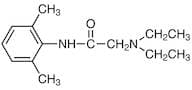
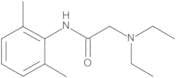
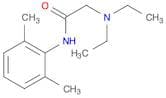
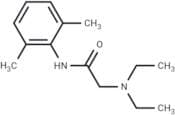
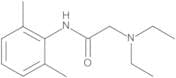
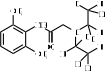
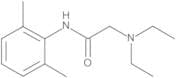
CAS 137-58-6
:Lidocain
Beschreibung:
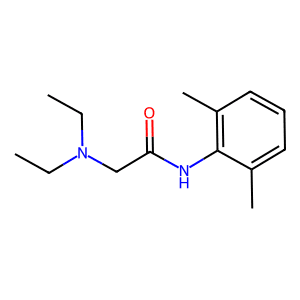
Lidocain, mit der CAS-Nummer 137-58-6, ist ein Lokalanästhetikum und antiarrhythmisches Mittel, das häufig in medizinischen Einrichtungen verwendet wird. Es wird als Amide-Anästhetikum klassifiziert, das sich durch seine Fähigkeit auszeichnet, die Nervenleitung zu blockieren, indem es den Natriumionenfluss durch spannungsabhängige Natriumkanäle hemmt. Lidocain wird typischerweise als weißes kristallines Pulver präsentiert, das in Wasser und Alkohol löslich ist, und hat einen pKa-Wert, der es ihm ermöglicht, sowohl in ionisierter als auch in nicht-ionisierter Form zu existieren, was für seine Wirksamkeit in verschiedenen pH-Umgebungen entscheidend ist. Seine chemische Formel ist C14H22N2O, und es hat ein relativ niedriges Molekulargewicht. Lidocain wird häufig in verschiedenen Formulierungen verwendet, einschließlich topischer Gele, injizierbarer Lösungen und Pflastern, was es vielseitig für Verfahren von zahnärztlichen Arbeiten bis hin zu kleineren chirurgischen Eingriffen macht. Darüber hinaus hat es einen schnellen Wirkungseintritt und eine relativ kurze Wirkungsdauer, was in klinischen Anwendungen von Vorteil sein kann. Es muss jedoch darauf geachtet werden, mögliche Nebenwirkungen, einschließlich allergischer Reaktionen oder systemischer Toxizität, insbesondere bei höheren Dosen, zu überwachen.
Formel:C14H14O3S
InChl:InChI=1/C14H22N2O/c1-5-16(6-2)10-13(17)15-14-11(3)8-7-9-12(14)4/h7-9H,5-6,10H2,1-4H3,(H,15,17)/p+1
InChI Key:InChIKey=NNJVILVZKWQKPM-UHFFFAOYSA-N
SMILES:N(C(CN(CC)CC)=O)C1=C(C)C=CC=C1C
Synonyme:- 2',6'-Acetoxylidide, 2-(diethylamino)-
- 2-(Diethylamino)-2',6'-acetoxylidide
- 2-(Diethylamino)-N-(2,6-dimethylphenyl)acetamide
- 2-Diethylamino-2,6'-acetoxylidide
- 2′,6′-Acetoxylidide, 2-(diethylamino)-
- Anbesol
- Anestacon
- Aritmal
- Cuivasil
- Dalcaine
- Duncaine
- ELA-Max
- Esracaine
- Isicaina
- Isicaine
- Jetocaine
- LMX
- Leostesin
- Lida-Mantle
- LidoPosterine
- Lidocadren
- Lidocain
- Lidocaina
- Lidocaine
- Lidoderm
- Lignocaine
- Linisol
- Maricaine
- Medicaine
- Nsc 40030
- Penles
- Remicaine
- Rucaina
- Solarcaine
- Solcain
- Trachisan
- Versatis
- Xilina
- Xybrex
- Xycaine
- Xylestesin
- Xyline
- Xylocain
- Xylocaine
- Xylocitin
- Xylovet
- α-Diethylamino-2,6-acetoxylidide
- Lidocaine base
- 2-diethylaminoacet-2,6-xylidide
- Acetamide, 2-(diethylamino)-N-(2,6-dimethylphenyl)-
- N-(2,6-dimethylphenyl)-N~2~,N~2~-diethylglycinamide
- 2-[(2,6-dimethylphenyl)amino]-N,N-diethyl-2-oxoethanaminium
- 6’-acetoxylidide,2-(diethylamino)-2
- alpha-Diethylamino-2,6-dimethylacetanilide
- LIDOCAINE-D6
- 4,4'-DIMETHOXY DIPHENYL SULFOXIDE
- alpha-Diethylaminoaceto-2,6-xylidide
- alpha-diethylamino-2,6-acetoxylidide
- Broncaine
- Cappicaine
- Cito optadren
- 2-(diethylamino)-n-(2,6-dimethylphenyl)-acetamid
- alfa-Dietilamino-2,6-dimetilacetanilide
- Weitere Synonyme anzeigen
Sortieren nach
Reinheit (%)
0
100
|
0
|
50
|
90
|
95
|
100
Lidocaine
CAS:Formel:C14H22N2OReinheit:>99.0%(T)(HPLC)Farbe und Form:White to Almost white powder to crystalMolekulargewicht:234.34Lidocaine
CAS:LidocaineFormel:C14H22N2OReinheit:100.0%Farbe und Form:White To Off-WhiteMolekulargewicht:234.17321LIDOCAINE CRS
CAS:LIDOCAINE CRSFormel:C14H22N2OFarbe und Form:Crystalline Powder. White. Powder.Molekulargewicht:234.3373Lidocaine
CAS:Aromatic cyclic amides (including cyclic carbamates) and their derivatives; salts thereofFormel:C14H22N2OFarbe und Form:White Off-White Crystalline PowderMolekulargewicht:234.342-(Diethylamino)-N-(2,6-dimethylphenyl)acetamide
CAS:Formel:C14H22N2OReinheit:98%Farbe und Form:SolidMolekulargewicht:234.3373Lidocaine
CAS:Lidocaine, an amide local anesthetic, reduces pain and inflammation by dampening ICAM-1, cytokines, and neutrophil influx.Formel:C14H22N2OReinheit:99.95% - >99.99%Farbe und Form:Needles From Benzene Or Alcohol SolidMolekulargewicht:234.34Lidocaine
CAS:Formel:C14H22N2OReinheit:≤ 0.1%Farbe und Form:White crystalline powderMolekulargewicht:234.34