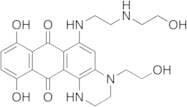
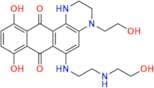
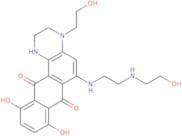
CAS 137132-70-8
:8,11-dihydroxy-4-(2-hydroxyethyl)-6-((2-((2-hydroxyethyl)amino)ethyl)amino)-1,2,3,4,7,12-hexahydronaphtho(2,3-f)chinoxalin-7,12-dion
Beschreibung:
8,11-dihydroxy-4-(2-hydroxyethyl)-6-((2-((2-hydroxyethyl)amino)ethyl)amino)-1,2,3,4,7,12-hexahydronaphtho(2,3-f)chinoxalin-7,12-dion, mit der CAS-Nummer 137132-70-8, ist eine komplexe organische Verbindung, die durch ihre multifunktionalen Gruppen gekennzeichnet ist, einschließlich Hydroxylgruppen (-OH) und Aminogruppen (-NH2), die zu ihrer Löslichkeit und Reaktivität beitragen. Diese Verbindung weist ein Naphthoquinoxalin-Rückgrat auf, das für seine potenzielle biologische Aktivität, insbesondere in der medizinischen Chemie, bekannt ist. Das Vorhandensein von Hydroxyethylsubstituenten deutet auf eine erhöhte Hydrophilie hin, die möglicherweise ihre pharmakokinetischen Eigenschaften beeinflusst. Die strukturelle Komplexität deutet darauf hin, dass sie mit verschiedenen biologischen Zielen interagieren kann, was sie für die Arzneimittelentwicklung von Interesse macht. Ihre spezifische Stereochemie und funktionalen Gruppen können ebenfalls eine entscheidende Rolle in ihrer biologischen Aktivität spielen, einschließlich potenzieller antioxidativer oder entzündungshemmender Wirkungen. Insgesamt veranschaulicht diese Verbindung die komplexe Beziehung zwischen molekularer Struktur und biologischer Funktion, was eine weitere Untersuchung für therapeutische Anwendungen rechtfertigt.
Formel:C22H26N4O6
InChl:InChI=1/C22H26N4O6/c27-9-6-23-3-4-24-12-11-13-20(25-5-7-26(13)8-10-28)19-16(12)21(31)17-14(29)1-2-15(30)18(17)22(19)32/h1-2,11,23-25,27-30H,3-10H2
SMILES:c1cc(c2c(c1O)C(=O)c1c(cc3c(c1C2=O)NCCN3CCO)NCCNCCO)O
Synonyme:- Dhhnqd
- Naphtho(2,3-f)quinoxaline-7,12-dione, 8,11-dihydroxy-1,2,3,4-tetrahydro-4-(2-hydroxyethyl)-6-((2-((2-hydroxyethyl)amino)ethyl)amino)-
- 8,11-Dihydroxy-4-(2-Hydroxyethyl)-6-({2-[(2-Hydroxyethyl)Amino]Ethyl}Amino)-1,2,3,4-Tetrahydronaphtho[2,3-F]Quinoxaline-7,12-Dione
Sortieren nach
Reinheit (%)
0
100
|
0
|
50
|
90
|
95
|
100
3 Produkte.
Mitoxantrone (2-Hydroxyethyl)piperazine Impurity(Mitoxantrone Impurity D)
CAS:Kontrolliertes ProduktApplications A metabolite of the anticancer agent Mitoxantrone (M373425)
References Feafanov, A. et al.: Anticcancer Res., 19, 5341 (1999); Ponousis, C. et al.: Biochem. Pharmacol., 48, 2223 (1994);Formel:C22H26N4O6Farbe und Form:NeatMolekulargewicht:442.46Mitoxantrone (2-hydroxyethyl)piperazine impurity
CAS:Mitoxantrone is an anticancer drug that is used to treat various types of cancer. Mitoxantrone is a prodrug, which means it needs to be metabolized by the body to become active. The main metabolic pathway for mitoxantrone involves hydrolysis of the 2-hydroxyethyl piperazine impurity and formation of N-desmethylmitoxantrone, which is a metabolite that has been found to be more potent than the parent compound in inhibiting DNA synthesis. This impurity standard is used as a reference substance for quality control purposes during drug development. Mitoxantrone can also be synthesized with high purity and custom synthesis services are available upon request.Formel:C22H26N4O6Reinheit:Min. 95%Farbe und Form:Brown PowderMolekulargewicht:442.47 g/mol