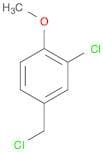
CAS 13719-57-8
:3-chlor-4-methoxybenzylchlorid
Beschreibung:
3-chlor-4-methoxybenzylchlorid ist eine organische Verbindung, die durch ihre aromatische Struktur gekennzeichnet ist, die einen Benzolring umfasst, der mit einem Chloratom und einer Methoxygruppe substituiert ist. Das Vorhandensein der Chlor- und Methoxysubstituenten beeinflusst ihre Reaktivität und Löslichkeit. Diese Verbindung erscheint typischerweise als farblose bis blassgelbe Flüssigkeit und ist bekannt für ihre Rolle als Zwischenprodukt in der organischen Synthese, insbesondere in der Herstellung von Arzneimitteln und Agrochemikalien. Ihre Reaktivität wird weitgehend der elektrophilen Natur der Benzylchlorid-Gruppe zugeschrieben, was sie für nucleophile Substitutionsreaktionen geeignet macht. Darüber hinaus kann die Methoxygruppe an verschiedenen chemischen Umwandlungen teilnehmen, was ihre Nützlichkeit in der synthetischen Chemie erhöht. Sicherheitsvorkehrungen sind beim Umgang mit dieser Verbindung erforderlich, da sie Gesundheitsrisiken durch Inhalation oder Hautkontakt darstellen kann. Es sollten geeignete Lagerungs- und Entsorgungsmethoden befolgt werden, um die Umweltauswirkungen zu mindern. Insgesamt ist 3-chlor-4-methoxybenzylchlorid eine wertvolle Verbindung im Bereich der organischen Synthese aufgrund ihrer vielseitigen Reaktivität.
Sortieren nach
Reinheit (%)
0
100
|
0
|
50
|
90
|
95
|
100
2 Produkte.
2-Chloro-4-(chloromethyl)-1-methoxybenzene
CAS:2-Chloro-4-(chloromethyl)-1-methoxybenzene is a fibrinolytic drug that has been shown to be effective in the treatment of deep vein thrombosis. It reversibly binds to albumin, which prevents the formation of clots by inhibiting fibrin polymerization and stabilizing existing clots. Fibrinolysis also results in the release of plasminogen activator, which converts plasminogen to plasmin. This conversion leads to the dissolution of blood clots. 2-Chloro-4-(chloromethyl)-1-methoxybenzene has also been shown to have a carboxylic acid group on its structure, which increases lipophilicity and decreases water solubility, making it more suitable for use as a fibrinolytic agent. The optimum substituents for this drug are an aromatic ring or substituted aromatic ring withFormel:C8H8Cl2OReinheit:Min. 95%Molekulargewicht:191.05 g/mol