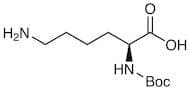
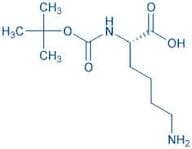
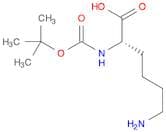
CAS 13734-28-6
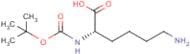
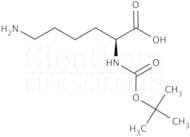
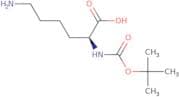
:α-tert-Butoxycarbonyl-L-Lysin
Beschreibung:
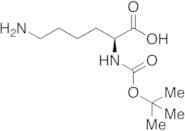
α-tert-Butoxycarbonyl-L-Lysin, allgemein bekannt als Boc-L-Lysin, ist ein Derivat der Aminosäure Lysin, das durch das Vorhandensein einer tert-Butoxycarbonyl (Boc) Schutzgruppe gekennzeichnet ist. Diese Verbindung wird typischerweise in der Peptidsynthese und der organischen Chemie als Schutzgruppe für die Aminogruppe von Lysin verwendet, was selektive Reaktionen ohne Beeinträchtigung durch die Aminofunktionalität ermöglicht. Boc-L-Lysin ist ein weißes bis off-white kristallines Feststoff, das in organischen Lösungsmitteln wie Dichlormethan und Dimethylsulfoxid löslich ist, aber weniger löslich in Wasser. Seine molekulare Struktur umfasst ein Lysin-Rückgrat, das zu seinen basischen Eigenschaften beiträgt, und die Boc-Gruppe, die Stabilität und Reaktivität unter bestimmten Bedingungen erhöht. Die Verbindung ist empfindlich gegenüber Feuchtigkeit und sollte an einem kühlen, trockenen Ort gelagert werden, um ihre Integrität zu bewahren. Neben seiner Rolle in der synthetischen Chemie kann Boc-L-Lysin auch in der Untersuchung der Struktur und Funktion von Proteinen verwendet werden, da es in Peptide integriert wird.
Formel:C11H22N2O4
InChl:InChI=1S/C11H22N2O4/c1-11(2,3)17-10(16)13-8(9(14)15)6-4-5-7-12/h8H,4-7,12H2,1-3H3,(H,13,16)(H,14,15)/t8-/m0/s1
InChI Key:InChIKey=DQUHYEDEGRNAFO-QMMMGPOBSA-N
SMILES:[C@H](NC(OC(C)(C)C)=O)(CCCCN)C(O)=O
Synonyme:- (2S)-6-Amino-2-[[(tert-butoxy)carbonyl]amino]hexanoic acid
- (2S)-6-Azaniumyl-2-[(2-methylpropan-2-yl)oxycarbonylamino]hexanoate
- (S)-6-Amino-2-(tert-butoxycarbonylamino)hexanoic acid
- <span class="text-smallcaps">L</span>-Lysine, N<sup>2</sup>-[(1,1-dimethylethoxy)carbonyl]-
- BOC-<span class="text-smallcaps">L</span>-Lys-OH
- Boc-L-lysine
- Boc-Lys-OH
- Lysine, N<sup>2</sup>-carboxy-, N<sup>2</sup>-tert-butyl ester, <span class="text-smallcaps">L</span>-
- N-Boc-L-Lysine
- N-tert-Butoxycarbonyllysine
- N-α-(tert-Butoxycarbonyl)-<span class="text-smallcaps">L</span>-lysine
- N<sub>α</sub>-Boc-<span class="text-smallcaps">L</span>-lysine
- N<sup>2</sup>-[(1,1-Dimethylethoxy)carbonyl]-<span class="text-smallcaps">L</span>-lysine
- N<sup>2</sup>-tert-Butoxycarbonyl-<span class="text-smallcaps">L</span>-lysine
- N<sup>α</sup>-BOC-<span class="text-smallcaps">L</span>-lysine
- NSC 343721
- N~2~-(tert-butoxycarbonyl)lysine
- N~6~-(tert-butoxycarbonyl)-L-lysine
- α-N-Boc-lysine
- α-N-tert-Butoxycarbonyl-<span class="text-smallcaps">L</span>-lysine
- α-tert-Butoxycarbonyl-<span class="text-smallcaps">L</span>-lysine
- N2-tert-Butoxycarbonyl-L-lysine
- Lysine, N2-carboxy-, N2-tert-butyl ester, L-
- N2-[(1,1-Dimethylethoxy)carbonyl]-L-lysine
- Weitere Synonyme anzeigen
Sortieren nach
Reinheit (%)
0
100
|
0
|
50
|
90
|
95
|
100
12 Produkte.
Nα-(tert-Butoxycarbonyl)-L-lysine
CAS:Formel:C11H22N2O4Reinheit:>98.0%(T)Farbe und Form:White to Light yellow powder to lumpMolekulargewicht:246.31Nα-Boc-L-lysine, 97%
CAS:N-Boc-L-lysine is a protected analogue of a major amino acid participating in the binding of AcH to proteins. N-Boc-L-lysine as well as other t-butoxycarbonyl (Boc) amino acids can be converted to their respective amino acids via cleavage of the urethane bond. This Thermo Scientific Chemicals brandFormel:C11H22N2O4Reinheit:97%Molekulargewicht:246.31Boc-Lys-OH
CAS:Educt for the synthesis of Boc- and Fmoc-ε-azido-norleucine.Formel:C11H22N2O4Farbe und Form:WhiteMolekulargewicht:246.31Ref: IN-DA0038XW
1kgNachfragen1g21,00€5g23,00€10g28,00€25g49,00€50g89,00€100g117,00€250g228,00€500g541,00€Boc-Lys-OH
CAS:Boc-Lys-OHFormel:C11H22N2O4Reinheit:98%Farbe und Form: white solidMolekulargewicht:246.30g/molN-Boc-L-Lysine
CAS:N-Boc-L-Lysine is a model of the amino acid lysine. This compound has been shown to inhibit the growth of cancer cells in vitro and in vivo. N-Boc-L-Lysine inhibits protein synthesis by blocking the formation of peptide bonds between amino acids, thus stopping the production of proteins vital for cell division. The inhibition of fatty acid synthesis by this compound may be due to its ability to inhibit the activity of fatty acid synthase, which catalyzes the conversion of acetyl coenzyme A into fatty acids. This product can also be synthesized from caproic acid and an ester hydrochloride or from a fatty acid and an ester hydrochloride.
Formel:C11H22N2O4Reinheit:Min. 95%Farbe und Form:White Off-White PowderMolekulargewicht:246.3 g/molBoc-Lys-OH
CAS:M03297 - Boc-Lys-OH
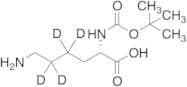
Formel:C11H22N2O4Reinheit:95%Farbe und Form:SolidMolekulargewicht:246.307N-Boc-L-lysine-d4
CAS:Kontrolliertes ProduktFormel:C11D4H18N2O4Farbe und Form:NeatMolekulargewicht:250.328N-Boc-L-lysine
CAS:Kontrolliertes ProduktFormel:C11H22N2O4Farbe und Form:White To Light YellowMolekulargewicht:246.3