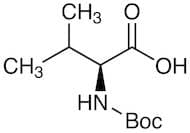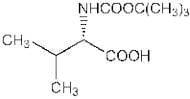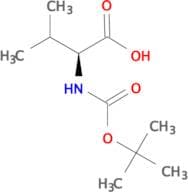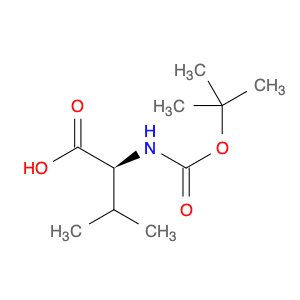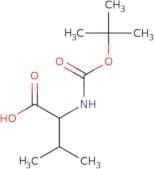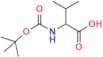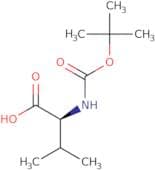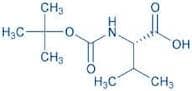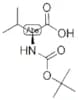
CAS 13734-41-3
:Boc-L-Valin
Beschreibung:
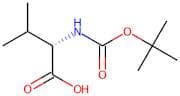
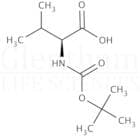
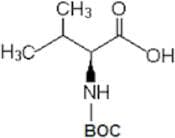
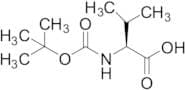
Boc-L-Valin, oder tert-Butoxycarbonyl-L-Valin, ist eine geschützte Form der Aminosäure Valin, die häufig in der Peptidsynthese und der organischen Chemie verwendet wird. Es weist eine tert-Butoxycarbonyl (Boc)-Gruppe auf, die als Schutzgruppe für die Aminofunktionalität dient und selektive Reaktionen ermöglicht, ohne mit der Aminogruppe zu interferieren. Die Verbindung ist typischerweise ein weißer bis off-white kristalliner Feststoff und in organischen Lösungsmitteln wie Dichlormethan und Dimethylformamid löslich, aber weniger löslich in Wasser. Boc-L-Valin zeichnet sich durch seine Chiralität aus, da es ein chirales Zentrum am alpha-Kohlenstoff enthält, was es zu einem L-Enantiomer macht. Diese Eigenschaft ist entscheidend in biologischen Systemen und pharmazeutischen Anwendungen, wo die spezifische Stereochemie die Aktivität und Wirksamkeit erheblich beeinflussen kann. Die Verbindung ist unter Standardlaborbedingungen stabil, kann jedoch unter sauren oder basischen Bedingungen hydrolysiert werden, wobei die freie Aminosäure Valin freigesetzt wird. Ihre Anwendungen erstrecken sich auf die Synthese von Peptiden, bei denen die Boc-Gruppe unter milden sauren Bedingungen entfernt werden kann, um weitere Reaktionen zu erleichtern.
Formel:C10H19NO4
InChl:InChI=1S/C10H19NO4/c1-6(2)7(8(12)13)11-9(14)15-10(3,4)5/h6-7H,1-5H3,(H,11,14)(H,12,13)/t7-/m0/s1
InChI Key:InChIKey=SZXBQTSZISFIAO-ZETCQYMHSA-N
SMILES:[C@H](NC(OC(C)(C)C)=O)(C(C)C)C(O)=O
Synonyme:- (2S)-2-(tert-Butoxycarbonylamino)-3-methylbutanoic acid
- (2S)-2-[(tert-butoxycarbonyl)amino]-3-methylbutanoate
- (2S)-2-[[(1,1-Dimethylethoxy)carbonyl]amino]-3-methylbutanoic acid
- (2S)-2-[[(tert-Butoxy)carbonyl]amino]-3-methylbutanoic acid
- (2S)-3-Methyl-2-[(2-methylpropan-2-yl)oxycarbonylamino]butanoic acid
- (S)-2-(Boc-Amino)-3-Methylbutyric Acid
- (S)-2-(tert-Butoxycarbonylamino)-3-methylbutanoic acid
- (S)-Boc-Valine
- (S)-N-tert-Butoxycarbonylvaline
- <span class="text-smallcaps">L</span>-Valine, N-[(1,1-dimethylethoxy)carbonyl]-
- BOC-valine
- Boc-<span class="text-smallcaps">L</span>-Val
- Boc-<span class="text-smallcaps">L</span>-valine
- Boc-L-Valine
- Boc-Val-OH
- Boc-l-Val-OH
- L-Valine, N-[(1,1-dimethylethoxy)carbonyl]-
- N-(tert-butoxycarbonyl)-D-valine
- N-(tert-butoxycarbonyl)-L-valine
- N-(tert-butoxycarbonyl)valine
- N-BOC-<span class="text-smallcaps">L</span>-valine
- N-BOC-valine
- N-Boc-L-Valine
- N-[(1,1-Dimethylethoxy)carbonyl]-<span class="text-smallcaps">L</span>-valine
- N-[(1,1-Dimethylethoxy)carbonyl]-L-valine
- N-[(terc-butoxi)carbonil]-L-valina
- N-[(tert-Butoxy)carbonyl]-L-valin
- N-tert-Butoxycarbonyl-<span class="text-smallcaps">L</span>-valine
- N-tert-Butoxycarbonyl-<span class="text-smallcaps">L</span>-valine vinyl ester
- N-tert-Butoxycarbonylvaline
- N-tert-Butyloxycarbonyl-<span class="text-smallcaps">L</span>-valine
- N-tert-Butyloxycarbonyl-L-valine
- N-tert-Butyloxycarbonylvaline
- N-α-tert-Butoxycarbonyl-<span class="text-smallcaps">L</span>-valine
- N-α-tert-Butoxycarbonyl-L-valine
- Nsc 197197
- Valine, N-carboxy-, N-tert-butyl ester, <span class="text-smallcaps">L</span>-
- Valine, N-carboxy-, N-tert-butyl ester, L-
- t-Butoxycarbonyl-<span class="text-smallcaps">L</span>-valine
- t-Butoxycarbonyl-L-valine
- tert-Butoxycarbonyl-<span class="text-smallcaps">L</span>-valine
- Weitere Synonyme anzeigen
Sortieren nach
Reinheit (%)
0
100
|
0
|
50
|
90
|
95
|
100
13 Produkte.
N-(tert-Butoxycarbonyl)-L-valine
CAS:Formel:C10H19NO4Reinheit:>99.0%(T)Farbe und Form:White to Almost white powder to crystalMolekulargewicht:217.27N-Boc-L-valine, 98+%
CAS:N-Boc-L-valine is used in the multi-peptide synthesis and serves as the amino acid protection monomer. This Thermo Scientific Chemicals brand product was originally part of the Alfa Aesar product portfolio. Some documentation and label information may refer to the legacy brand. The original Alfa AesFormel:C10H19NO4Reinheit:98+%Farbe und Form:White, PowderMolekulargewicht:217.27Boc-Val-OH
CAS:M03340 - Boc-Val-OH
Formel:C10H19NO4Reinheit:98%Farbe und Form:Solid, Powder or Crystalline Powder or SolidMolekulargewicht:217.265N-t-butyloxycarbonyl-N-methyl-L-valine
CAS:Formel:C10H19NO4Reinheit:97%Farbe und Form:SolidMolekulargewicht:217.2622N-(tert-Butoxycarbonyl)-L-valine
CAS:N-(tert-Butoxycarbonyl)-L-valineFormel:C10H19NO4Reinheit:99%Farbe und Form: white to off-white solidMolekulargewicht:217.26g/molBOC-L-Valine extrapure, 99%
CAS:Formel:C10H19NO4Reinheit:min. 99%Farbe und Form:White to off-white, Crystalline powderMolekulargewicht:217.30Boc-L-Valine
CAS:Kontrolliertes ProduktApplications Boc-L-Valine is used in amino acid conjugates as proteasome inhibitors.
References Wan, S. et al.: Int. J. Mol. Med., 26, 447 (2010);Formel:C10H19NO4Farbe und Form:NeatMolekulargewicht:217.26Boc-Val-OH
CAS:Boc-Val-OH is a natural compound that belongs to the class of ferrocene fatty acid. It has been shown to have antimicrobial properties in cell culture and pharmacokinetic properties in rats. Boc-Val-OH is able to inhibit the activity of serine proteases, which are enzymes that break down proteins and amino acids within cells, as well as cyclopropavir, a virus inhibitor. This compound also has potent inhibitory activity against various microbial strains, including methicillin-resistant Staphylococcus aureus (MRSA) and Helicobacter pylori. Boc-Val-OH has been shown to have hepatoprotective effects in rats with liver damage.Formel:C10H19NO4Reinheit:Min. 95%Molekulargewicht:217.26 g/molBoc-L-valine
CAS:Boc-L-Valine is a model system for the synthesis of peptides. This compound is synthesized in a liquid phase and then purified by column chromatography. It has an antimicrobial activity against Gram-positive bacteria such as Staphylococcus aureus and Escherichia coli, but not against Gram-negative bacteria such as Proteus vulgaris or Pseudomonas aeruginosa. Boc-L-Valine is also used to study the binding of inhibitors and ferrocenes.Formel:C10H19NO4Reinheit:Min. 95%Farbe und Form:White PowderMolekulargewicht:217.3 g/molBoc-Val-OH
CAS:Bachem ID: 4000426.
Formel:C10H19NO4Reinheit:100.0%Farbe und Form:WhiteMolekulargewicht:217.27