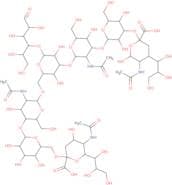
CAS 137636-98-7
:O-(N-Acetyl-α-neuraminosyl)-(2→3)-O-β-D-galactopyranosyl-(1→3)-O-2-(acetylamino)-2-desoxy-β-D-glucopyranosyl-(1→3)-O-[O-(N-acetyl-α-neuraminosyl)-(2→6)-O-β-D-galactopyranosyl-(1→4)-2-(acetylamino)-2-desoxy-β-D-glucopyranosyl-(1→6)]-O-β-D-galactopyranosyl-(1→4)-D-Glucose
Beschreibung:
Die chemische Substanz, die als O-(N-Acetyl-α-neuraminosyl)-(2→3)-O-β-D-galactopyranosyl-(1→3)-O-2-(acetylamino)-2-desoxy-β-D-glucopyranosyl-(1→3)-O-[O-(N-acetyl-α-neuraminosyl)-(2→6)-O-β-D-galactopyranosyl-(1→4)-2-(acetylamino)-2-desoxy-β-D-glucopyranosyl-(1→6)]-O-β-D-galactopyranosyl-(1→4)-D-Glucose bekannt ist, mit der CAS-Nummer 137636-98-7, ist eine komplexe glykosylierte Verbindung, die durch mehrere Zuckermoleküle gekennzeichnet ist, die durch spezifische glykosidische Bindungen verbunden sind. Dieses Molekül enthält N-Acetylneuraminsäure, die ein Derivat der Sialinsäure ist und zu ihrer biologischen Bedeutung beiträgt, insbesondere in den Prozessen der Zellenerkennung und Signalübertragung. Das Vorhandensein verschiedener Zuckereinheiten, einschließlich Derivaten von Galactose und Glucosamin, weist auf ihre potenzielle Rolle in Glycoprotein- oder Glycolipidstrukturen hin. Solche Verbindungen sind oft an zellulären Interaktionen, Immunantworten und der Erkennung von Krankheitserregern beteiligt. Die komplexe Struktur deutet darauf hin, dass sie spezifische Bindungseigenschaften aufweisen könnte, was sie in der biochemischen Forschung und in potenziellen therapeutischen Anwendungen relevant macht. Ihre Stabilität und Löslichkeit in biologischen Systemen würden von der Anordnung ihrer glykosidischen Bindungen und der Anwesenheit funktioneller Gruppen abhängen.
Formel:C62H102N4O47
InChl:InChI=1S/C62H102N4O47/c1-16(74)63-31-20(78)5-61(59(96)97,111-50(31)36(85)23(81)8-68)101-15-30-38(87)43(92)44(93)56(106-30)108-48-28(13-73)104-54(33(42(48)91)65-18(3)76)100-14-29-41(90)52(45(94)57(105-29)107-47(25(83)10-70)35(84)22(80)7-67)110-55-34(66-19(4)77)49(39(88)26(11-71)102-55)109-58-46(95)53(40(89)27(12-72)103-58)113-62(60(98)99)6-21(79)32(64-17(2)75)51(112-62)37(86)24(82)9-69/h7,20-58,68-73,78-95H,5-6,8-15H2,1-4H3,(H,63,74)(H,64,75)(H,65,76)(H,66,77)(H,96,97)(H,98,99)/t20-,21-,22-,23+,24+,25+,26+,27+,28+,29+,30+,31+,32+,33+,34+,35+,36+,37+,38-,39+,40-,41-,42+,43-,44+,45+,46+,47+,48+,49+,50+,51+,52-,53-,54+,55-,56-,57-,58-,61+,62-/m0/s1
InChI Key:InChIKey=KRJQBUMEJQLMJO-IYWOAXAFSA-N
SMILES:O([C@@]1(C(O)=O)O[C@@]([C@@H]([C@@H](CO)O)O)([C@H](NC(C)=O)[C@@H](O)C1)[H])[C@@H]2[C@@H](O)[C@H](O[C@@H]3[C@@H](NC(C)=O)[C@H](O[C@@H]4[C@@H](O)[C@H](O[C@@H]([C@@H]([C@H](C=O)O)O)[C@@H](CO)O)O[C@H](CO[C@H]5[C@H](NC(C)=O)[C@@H](O)[C@H](O[C@@H]6O[C@H](CO[C@@]7(C(O)=O)O[C@@]([C@@H]([C@@H](CO)O)O)([C@H](NC(C)=O)[C@@H](O)C7)[H])[C@H](O)[C@H](O)[C@H]6O)[C@@H](CO)O5)[C@@H]4O)O[C@H](CO)[C@H]3O)O[C@H](CO)[C@@H]2O
Synonyme:- 5-(acetylamino)-2-[(6-{[5-(acetylamino)-6-[(4-{[3-(acetylamino)-4-{[4-{[5-(acetylamino)-2-carboxy-6-hydroxy-4-(1,2,3-trihydroxypropyl)tetrahydro-2H-pyran-2-yl]oxy}-3,5-dihydroxy-6-(hydroxymethyl)tetrahydro-2H-pyran-2-yl]oxy}-5-hydroxy-6-(hydroxymethyl)tetrahydro-2H-pyran-2-yl]oxy}-6-[1-(1,2-dihydroxyethyl)-2,3-dihydroxy-4-oxobutoxy]-3,5-dihydroxytetrahydro-2H-pyran-2-yl)methoxy]-4-hydroxy-2-(hydroxymethyl)tetrahydro-2H-pyran-3-yl]oxy}-3,4,5-trihydroxytetrahydro-2H-pyran-2-yl)methoxy]-4-hydroxy-6-(1,2,3-trihydroxypropyl)tetrahydro-2H-pyran-2-carboxylic acid (non-preferred name)
- 5-Acetamido-2-[2-[3-Acetamido-2-[2-[[3-Acetamido-5-[6-[[5-Acetamido-2-Carboxy-4-Hydroxy-6-(1,2,3-Trihydroxypropyl)Oxan-2-Yl]Oxymethyl]-3,4,5-Trihydroxyoxan-2-Yl]Oxy-4-Hydroxy-6-(Hydroxymethyl)Oxan-2-Yl]Oxymethyl]-3,5-Dihydroxy-6-(1,2,4,5-Tetrahydroxy-6-Oxohexan-3-Yl)Oxyoxan-4-Yl]Oxy-5-Hydroxy-6-(Hydroxymethyl)Oxan-4-Yl]Oxy-3,5-Dihydroxy-6-(Hydroxymethyl)Oxan-4-Yl]Oxy-6-Hydroxy-4-(1,2,3-Trihydroxypropyl)Oxane-2-Carboxylic Acid
- <span class="text-smallcaps">D</smallcap>-Glucose, O-(N-acetyl-α-neuraminosyl)-(2→3)-O-β-<smallcap>D</smallcap>-galactopyranosyl-(1→3)-O-2-(acetylamino)-2-deoxy-β-<smallcap>D</smallcap>-glucopyranosyl-(1→3)-O-[O-(N-acetyl-α-neuraminosyl)-(2→6)-O-β-<smallcap>D</smallcap>-galactopyranosyl-(1→4)-2-(acetylamino)-2-deoxy-β-<smallcap>D</smallcap>-glucopyranosyl-(1→6)]-O-β-<smallcap>D</span>-galactopyranosyl-(1→4)-
- Disialyllacto-N-hexaose I
- Dslnh-I
- O-(N-Acetyl-α-neuraminosyl)-(2→3)-O-β-<span class="text-smallcaps">D</smallcap>-galactopyranosyl-(1→3)-O-2-(acetylamino)-2-deoxy-β-<smallcap>D</smallcap>-glucopyranosyl-(1→3)-O-[O-(N-acetyl-α-neuraminosyl)-(2→6)-O-β-<smallcap>D</smallcap>-galactopyranosyl-(1→4)-2-(acetylamino)-2-deoxy-β-<smallcap>D</smallcap>-glucopyranosyl-(1→6)]-O-β-<smallcap>D</smallcap>-galactopyranosyl-(1→4)-<smallcap>D</span>-glucose
- D-Glucose, O-(N-acetyl-α-neuraminosyl)-(2→3)-O-β-D-galactopyranosyl-(1→3)-O-2-(acetylamino)-2-deoxy-β-D-glucopyranosyl-(1→3)-O-[O-(N-acetyl-α-neuraminosyl)-(2→6)-O-β-D-galactopyranosyl-(1→4)-2-(acetylamino)-2-deoxy-β-D-glucopyranosyl-(1→6)]-O-β-D-galactopyranosyl-(1→4)-
- O-(N-Acetyl-α-neuraminosyl)-(2→3)-O-β-D-galactopyranosyl-(1→3)-O-2-(acetylamino)-2-deoxy-β-D-glucopyranosyl-(1→3)-O-[O-(N-acetyl-α-neuraminosyl)-(2→6)-O-β-D-galactopyranosyl-(1→4)-2-(acetylamino)-2-deoxy-β-D-glucopyranosyl-(1→6)]-O-β-D-galactopyranosyl-(1→4)-D-glucose
Sortieren nach
Reinheit (%)
0
100
|
0
|
50
|
90
|
95
|
100
1 Produkte.
Disialyllacto-N-hexaose I
CAS:Disialyllacto-N-hexaose I is a complex carbohydrate that belongs to a class of saccharides called polysaccharides. Disialyllacto-N-hexaose I is synthesized through the methylation and glycosylation of sucrose. It has been modified by Click chemistry with a maleimide group to create an amide bond between the terminal alpha position on the glucose residue and the terminal alpha position on the N-acetylglucosamine residue. This modification can be used for Polysaccharide analysis, such as MALDI TOF MS. Disialyllacto-N-hexaose I has a CAS number of 137636-98-7 and has been shown to have high purity without any impurities or contaminants.
Formel:C62H102N4O47Reinheit:Min. 95%Molekulargewicht:1,655.47 g/molRef: 3D-OD64737
Ausgelaufenes produkt