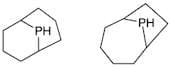
![9-Phosphabicyclo[3.3.1]nonane](/_next/image/?url=https%3A%2Fstatic.cymitquimica.com%2Fcas-image%2Fthumb-webp%2F298301-9-phosphabicyclo-3-3-1-nonane.webp&w=3840&q=75)
CAS 13887-02-0
:9-Phosphabicyclo[3.3.1]nonan
Beschreibung:
9-Phosphabicyclo[3.3.1]nonan ist eine bicyclische Verbindung, die ein in ihre Struktur integriertes Phosphoratome aufweist, was für phosphabicyclische Verbindungen charakteristisch ist. Diese Substanz ist bemerkenswert für ihr einzigartiges bicyclisches Gerüst, das aus zwei verschmolzenen Cyclopropanringen und einem Phosphoratom an der Brückenposition besteht. Die Anwesenheit von Phosphor führt zu ausgeprägten chemischen Eigenschaften, wie potenzieller Reaktivität in nucleophilen und elektrophilen Reaktionen. Sie wird häufig wegen ihrer Anwendungen in der organischen Synthese und als Ligand in der Koordinationschemie untersucht. Die Verbindung kann aufgrund ihrer starren Struktur interessante stereochemische Eigenschaften aufweisen, die ihre Reaktivität und Wechselwirkung mit anderen chemischen Spezies beeinflussen. Darüber hinaus können ihre physikalischen Eigenschaften, wie Löslichkeit und Siedepunkt, je nach spezifischen Bedingungen und der Anwesenheit von Substituenten variieren. Insgesamt stellt 9-Phosphabicyclo[3.3.1]nonan ein faszinierendes Forschungsfeld innerhalb der Organophosphorchemie dar, mit Implikationen sowohl für die theoretische Forschung als auch für praktische Anwendungen.
Formel:C8H15P
InChl:InChI=1S/C8H15P/c1-3-7-5-2-6-8(4-1)9-7/h7-9H,1-6H2
InChI Key:InChIKey=QJCMAJXWIAFFED-UHFFFAOYSA-N
SMILES:C12PC(CCC1)CCC2
Synonyme:- 9-Phosphabicyclo(3.3.1)nonane
- Phoban
- 9-Phosphabicyclo[3.3.1]nonane
Sortieren nach
Reinheit (%)
0
100
|
0
|
50
|
90
|
95
|
100
2 Produkte.
9-Phosphabicyclononanes in toluene, mixture of isomers, CYTOP® 282T
CAS:Formel:C8H15PFarbe und Form:Colorless to pale yellow liq.Molekulargewicht:142.179-Phosphabicyclononanes (mixture of isomers) in toluene
CAS:9-Phosphabicyclo[3.3.1]nonane (9-PBN) is the simplest member of a class of phosphorus compounds that can be used as an efficient and economical reagent for cross-coupling reactions in organic synthesis. 9-PBN is a stable, white solid that is soluble in hydrocarbon solvents and reacts with nucleophiles such as amines, alcohols, and thiols to form phosphine oxides (PR 3 ). 9-PBN undergoes rapid isomerization between the cis and trans configurations at room temperature. When heated, it converts to the cis configuration at a rate that depends on the activation energy of the reaction. It has been proposed that this conversion may be catalyzed by acid or base catalysis because of its acidic nature or polydentate ligand properties. 9-PBN has been shown to react with primary alcohols to form amides via nucleophilic attack onFormel:C8H15PReinheit:Min. 95%Farbe und Form:PowderMolekulargewicht:142.18 g/mol