CAS 13983-13-6
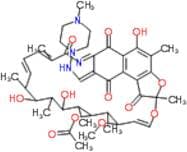
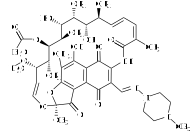
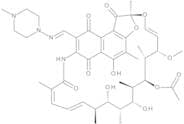
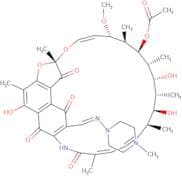
:(8E,24E)-5,17,19-trihydroxy-23-methoxy-2,4,12,16,18,20,22-heptamethyl-8-{[(4-methylpiperazin-1-yl)amino]methyliden}-1,6,9,11-tetraoxo-1,2,8,9-tetrahydro-6H-2,7-(epoxypentadeca[1,11,13]trienoazeno)naphtho[2,1-b]furan-21-yl acetat
Beschreibung:
Die chemische Substanz mit dem Namen "(8E,24E)-5,17,19-trihydroxy-23-methoxy-2,4,12,16,18,20,22-heptamethyl-8-{[(4-methylpiperazin-1-yl)amino]methyliden}-1,6,9,11-tetraoxo-1,2,8,9-tetrahydro-6H-2,7-(epoxypentadeca[1,11,13]trienoazeno)naphtho[2,1-b]furan-21-yl acetat" und der CAS-Nummer "13983-13-6" ist eine komplexe organische Verbindung, die durch mehrere funktionelle Gruppen gekennzeichnet ist, darunter Hydroxyl-, Methoxy- und Aminfunktionen. Ihre Struktur deutet auf eine signifikante molekulare Komplexität hin, die eine Reihe von Methylgruppen und ein einzigartiges Naphtho-Furan-Rückgrat aufweist, was zu ihrer biologischen Aktivität beitragen könnte. Das Vorhandensein von Tetraoxo-Gruppen weist auf eine potenzielle Reaktivität hin, während die Epoxidgruppe die Möglichkeit von Ringöffnungsreaktionen andeutet. Diese Verbindung könnte aufgrund ihrer strukturellen Merkmale interessante pharmakologische Eigenschaften aufweisen, einschließlich potenzieller Wechselwirkungen mit biologischen Zielen. Die spezifische Stereochemie, die durch die Konfiguration (8E,24E) angezeigt wird, deutet darauf hin, dass sie unterschiedliche isomere Formen haben könnte, die ihre biologische Aktivität und Löslichkeit beeinflussen könnten. Insgesamt stellt diese Substanz eine Klasse von Verbindungen dar, die in der medizinischen Chemie und der Arzneimittelentwicklung von Interesse sein könnten.
Formel:C43H56N4O12
InChl:InChI=1/C43H56N4O12/c1-21-12-11-13-22(2)42(55)45-33-28(20-44-47-17-15-46(9)16-18-47)37(52)30-31(38(33)53)36(51)26(6)40-32(30)41(54)43(8,59-40)57-19-14-29(56-10)23(3)39(58-27(7)48)25(5)35(50)24(4)34(21)49/h11-14,19-21,23-25,29,34-35,39,44,49-51H,15-18H2,1-10H3/b12-11+,19-14+,22-13+,28-20+,45-33-
InChI Key:InChIKey=IHHAOHNZEKYBLG-WLSIYKJHSA-N
SMILES:O=C1C=2C3=C4O[C@@](C)(C3=O)O/C=C/[C@H](OC)[C@@H](C)[C@@H](OC(C)=O)[C@H](C)[C@H](O)[C@H](C)[C@@H](O)[C@@H](C)\C=C\C=C(\C)/C(=O)NC(C(=O)C2C(O)=C4C)=C1/C=N/N5CCN(C)CC5
Synonyme:- Rifaldazinequinone
- 2,7-(Epoxypentadeca[1,11,13]trienimino)naphtho[2,1-b]furan, rifamycin deriv.
- 1,4-Dideoxy-1,4-dihydro-3-[(E)-[(4-methyl-1-piperazinyl)imino]methyl]-1,4-dioxorifamycin
- Rifamycin, 1,4-dideoxy-1,4-dihydro-3-[(E)-[(4-methyl-1-piperazinyl)imino]methyl]-1,4-dioxo-
- 2,7-(Epoxypentadeca[1,11,13]trienimino)naphtho[2,1-b]furan-1,6,9,11(2H)-tetrone, 5,17,19,21-tetrahydroxy-23-methoxy-2,4,12,16,18,20,22-heptamethyl-8-[N-(4-methyl-1-piperazinyl)formimidoyl]-, 21-acetate
Sortieren nach
Reinheit (%)
0
100
|
0
|
50
|
90
|
95
|
100
6 Produkte.
Rifampin Quinone (1,4-dideoxy-1,4-dihydro-3-[[[4-methyl-1-piperazinyl]imino]methyl]-1,4-dioxo-rifamycin)
CAS:Nucleic acids and their salts, whether or not chemically defined; other heterocyclic compounds, nesoiFormel:C43H56N4O12Farbe und Form:Black PowderMolekulargewicht:820.38947Rifampicin EP Impurity A (Rifampicin Quinone)
CAS:Formel:C43H56N4O12Farbe und Form:Dark Purple SolidMolekulargewicht:820.94Rifampicin Quinone
CAS:Kontrolliertes ProduktStability Light Sensitive
Applications Rifampicin Quinone is a metabolite of Rifampicin (R508000). Rifampicin Quinone acts as an immunosuppressant unlike Rifampicin.
References Gidoh, M. et al.: Nip. Rai Gak. Zas., 47, 110 (1978); Konrad, P. et al.: Clin. Immunol. Immunopathol., 46,162 (1988); Prasad, B. et al.: J. Pharmac. Biomed. Anal., 50, 475 (2009);Formel:C43H56N4O12Farbe und Form:NeatMolekulargewicht:820.92Rifampicin quinone
CAS:Rifampicin is a quinone that is used as an antibiotic. It is the most active of the rifamycins for the treatment of tuberculosis. Rifampicin has been shown to have a redox cycle and may be involved in transfer reactions with other biomolecules, such as tenofovir alafenamide hemifumarate (TAF), which is used in HIV therapy. Rifampicin binds to DNA-dependent RNA polymerase, thereby preventing transcription and replication. The high frequency of human activity has been shown using a patch-clamp technique on human erythrocytes. This active form is metabolized through a number of metabolic transformations, including hydrolysis by esterases or glucuronidases, oxidation by cytochrome P450 enzymes, reduction by glutathione reductase, or conjugation with glucuronic acid. Rifampicin also specifically binds to markers expressed at high levelsFormel:C43H56N4O12Reinheit:Min. 95%Farbe und Form:PowderMolekulargewicht:820.93 g/mol