CAS 140-31-8
:1-Piperazinethanamin
Beschreibung:
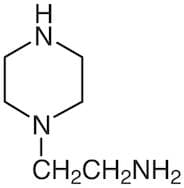
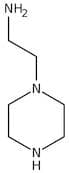
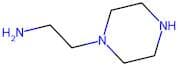
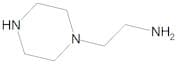
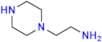
1-Piperazinethanamin, auch bekannt als N-(2-Aminoethyl)piperazin, ist eine organische Verbindung, die durch ihre Piperazinringstruktur mit einer Ethylamin-Seitenkette gekennzeichnet ist. Es handelt sich um eine farblose bis blassgelbe Flüssigkeit bei Raumtemperatur und es ist in Wasser und verschiedenen organischen Lösungsmitteln löslich, was seine Nützlichkeit in der chemischen Synthese und in Formulierungen erhöht. Die Verbindung weist basische Eigenschaften auf, die auf das Vorhandensein der Piperazinnitrogenatome und der Aminogruppe zurückzuführen sind, was es ihr ermöglicht, an verschiedenen chemischen Reaktionen teilzunehmen, einschließlich nucleophiler Substitutionen und Komplexierung mit Metallionen. Es wird häufig als Baustein in der Synthese von Arzneimitteln, Agrochemikalien und Tensiden verwendet. Darüber hinaus kann 1-Piperazinethanamin als Ligand in der Koordinationschemie fungieren. Sicherheitsdaten zeigen, dass es bei Kontakt mit Haut oder Augen Reizungen verursachen kann, und es sollten geeignete Handhabungsvorkehrungen getroffen werden. Insgesamt machen seine einzigartige Struktur und Reaktivität es zu einer wertvollen Verbindung sowohl in industriellen als auch in Forschungsanwendungen.
Formel:C6H15N3
InChl:InChI=1S/C6H15N3/c7-1-4-9-5-2-8-3-6-9/h8H,1-7H2
InChI Key:InChIKey=IMUDHTPIFIBORV-UHFFFAOYSA-N
SMILES:C(CN)N1CCNCC1
Synonyme:- 1-(2-Aminomethyl)piperazine
- 1-(2-Ammonioethyl)Piperazinediium
- 1-(Piperazin-1-Yl)Ethanamine
- 1-(β-Aminoethyl)piperazine
- 1-Aminoethylpiperazine
- 1-Piperazineethanamine
- 1-Piperazineethylamine
- 2-(1-Piperazino)ethylamine
- 2-(1-Piperazinyl)ethanamine
- 2-(1-Piperazinyl)ethylamine
- 2-(Piperazin-1-Yl)Ethanamine
- 2-(Piperazin-1-Yl)Ethanamine Acetate (1:1)
- 2-(Piperazin-1-yl)ethan-1-amine
- 2-(Piperazin-1-yl)ethaneamine
- 2-(Piperazinyl-1-yl)ethanamine
- 2-Piperazin-1-Iletilamina
- 2-Piperazin-1-Ylethylamine
- 2-Piperazin-1-ylethylamin
- 2-Piperazine-1-Ylethylamine
- 2-Piperazinoethylamine
- 2-Piperazinylethylamine
- 4-(2-Aminoethyl)piperazine
- AEP
- Ancamine AEP
- Epicure 3200
- Epikure 3202
- N-(2-Aminoaethyl)-Piperazin
- N-(2-Aminoethyl)piperazine
- N-(β-Aminoethyl)piperazine
- N-Aep
- N-Aminoethylpiperazine
- Nsc 38968
- Piperazine, 1-(2-aminoethyl)-
- Piperazine, N-Aminoethyl-
- Weitere Synonyme anzeigen
Sortieren nach
Reinheit (%)
0
100
|
0
|
50
|
90
|
95
|
100
8 Produkte.
N-(2-Aminoethyl)piperazine
CAS:Formel:C6H15N3Reinheit:>99.0%(GC)(T)Farbe und Form:Colorless to Light yellow to Light orange clear liquidMolekulargewicht:129.211-(2-Aminoethyl)piperazine, 98%
CAS:1-(2-Aminoethyl)piperazine is utilized in a variety of reactions for studying corrosion inhibition, biological activity and metal ligand effects on catalysis. It is used for epoxy curing, surface activation, and as an asphalt additive. It is used in lube oil and fuel additives, mineral processing aiFormel:C6H15N3Reinheit:98%Farbe und Form:Liquid, Clear colorlessMolekulargewicht:129.21N-(2-Aminoethyl)piperazine
CAS:Kontrolliertes ProduktFormel:C6H15N3Farbe und Form:NeatMolekulargewicht:129.20342-(Piperazin-1-yl)ethanamine
CAS:Formel:C6H15N3Reinheit:95.0%Farbe und Form:LiquidMolekulargewicht:129.207N-(2-Aminoethyl)piperazine
CAS:N-(2-Aminoethyl)piperazine (NAPE) is a chemical compound that can be used as an environmentally friendly catalyst for the degradation of ethylene diamine and other amines. NAPE has been shown to be stable under alkaline conditions, and its fluorescence probe has been used to monitor the progress of the reaction. This compound is a coordination complex with nitrogen atoms at the corners of a square and two amines at opposite corners of the square. The amine groups are coordinated to metal ions in a geometry that is determined by the atomic number of the metal ion. Disulfide bonds form between two cysteine residues on adjacent chains. Glycol ethers can also form disulfide bonds with NAPE, forming glycol ether-NAPE complexes. Antibodies have been shown to bind to glycol ether-NAPE complexes, suggesting that these complexes may play a role in antibody response, although experimental solubility data have not yet confirmed thisFormel:C6H15N3Reinheit:Min. 95%Molekulargewicht:129.2 g/mol