![[1,1′-Biphenyl]-4-carbonyl chloride](/_next/image/?url=https%3A%2Fstatic.cymitquimica.com%2Fcas-image%2Fthumb-webp%2F232414-11-biphenyl-4-carbonyl-chloride.webp&w=3840&q=75)
CAS 14002-51-8
:[1,1'-Biphenyl]-4-carbonylchlorid
Beschreibung:
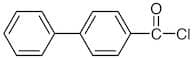
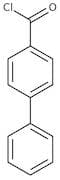
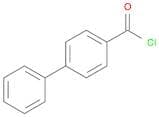
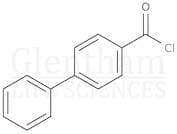
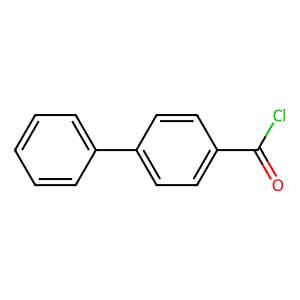
[1,1'-Biphenyl]-4-carbonylchlorid, auch bekannt als 4-Biphenylcarbonylchlorid, ist eine organische Verbindung, die durch das Vorhandensein einer Biphenylstruktur mit einer Carbonylchlorid-Funktionalgruppe in der Para-Position gekennzeichnet ist. Diese Verbindung erscheint typischerweise als farblose bis blassgelbe Flüssigkeit oder Feststoff, abhängig von Temperatur und Reinheit. Sie ist bekannt für ihre Reaktivität, insbesondere aufgrund der Anwesenheit der Acylchlorid-Funktionalgruppe, die sie zu einem nützlichen Zwischenprodukt in der organischen Synthese macht, insbesondere bei der Herstellung verschiedener Arzneimittel und Agrochemikalien. Die Verbindung ist im Allgemeinen empfindlich gegenüber Feuchtigkeit und kann hydrolysieren, um die entsprechende Carbonsäure zu bilden. Es ist wichtig, diese Substanz mit Vorsicht zu behandeln, da sie ätzend sein kann und bei Kontakt mit Haut oder Schleimhäuten Reizungen verursachen kann. Angemessene Sicherheitsmaßnahmen, einschließlich der Verwendung von persönlicher Schutzausrüstung und der Arbeit in einem gut belüfteten Bereich oder einer Abzugshaube, sind unerlässlich, wenn man mit diesem Chemikalien arbeitet.
Formel:C13H9ClO
InChl:InChI=1S/C13H9ClO/c14-13(15)12-8-6-11(7-9-12)10-4-2-1-3-5-10/h1-9H
InChI Key:InChIKey=JPVUWCPKMYXOKW-UHFFFAOYSA-N
SMILES:C(Cl)(=O)C1=CC=C(C=C1)C2=CC=CC=C2
Synonyme:- (1R)-1-(4-tert-butylphenyl)ethanamine
- 4-(Phen-4-yl)benzoyl chloride
- 4-Biphenylylformyl chloride
- 4-Phenylbenzoyl chloride
- Biphenyl-4-Carbonyl Chloride
- Biphenyl-4-carboxylchloride
- Bisphenyl-4-carbony chloride
- Diphenyl-4-carboxylic acid chloride
- [1,1′-Biphenyl]-4-carbonyl chloride
- p-Biphenylcarbonyl chloride
- p-Phenylbenzoyl chloride
- Weitere Synonyme anzeigen
Sortieren nach
Reinheit (%)
0
100
|
0
|
50
|
90
|
95
|
100
7 Produkte gefunden.
4-Phenylbenzoyl Chloride
CAS:Formel:C13H9ClOReinheit:>98.0%(GC)(T)Farbe und Form:White to Almost white powder to crystalMolekulargewicht:216.66Biphenyl-4-carbonyl chloride, 98%
CAS:Biphenyl-4-carbonyl chloride was used in the preparation of a novel thiourea compound, N-(6-methyl pyridin-2-yl-carbamothioyl)biphenyl-4-carboxamide. It was also used in the preparation of 5-CF3-oxazole analog, 2-{4-[2-(2-biphenyl-4-yl-5-trifluoromethyl-oxazol-4-yl)-ethoxy]-phenoxy}-2-methyl-propionFormel:C13H9ClOReinheit:98%Farbe und Form:White to cream or pale yellow to yellow or pale cream with grey, Crystals or powder or crystalline powder or lumpy powderMolekulargewicht:216.664-Biphenylcarbonyl chloride
CAS:Formel:C13H9ClOReinheit:98%Farbe und Form:SolidMolekulargewicht:216.6630Biphenyl-4-carbonyl chloride
CAS:Formel:C13H9ClOReinheit:≥ 97.0%Farbe und Form:White to yellow or beige, powder or solidMolekulargewicht:216.66Biphenyl-4-carbonyl chloride
CAS:Biphenyl-4-carbonyl chlorideFormel:C13H9ClOReinheit:93%Farbe und Form: white crystalline solidMolekulargewicht:216.66g/mol4-Biphenylcarbonyl chloride
CAS:Formel:C13H9ClOReinheit:98%Farbe und Form:SolidMolekulargewicht:216.664-Phenylbenzoyl chloride
CAS:4-Phenylbenzoyl chloride is a primary amino compound that has been studied extensively in the context of biological studies and as an electroluminescent device. It is also used to study the effects of alkylation on biological systems. 4-Phenylbenzoyl chloride has been shown to be cytotoxic against monocytic cell lines, with a mechanism of action that involves its ability to react with DNA, forming adducts that interfere with DNA replication. In addition, it also reacts with amines in human tissue samples, which may lead to carcinogenic effects. This compound is also effective against protozoan parasites and Leishmania species, although not thiosemicarbazide.
Formel:C13H9ClOReinheit:Min. 95%Farbe und Form:PowderMolekulargewicht:216.66 g/mol