CAS 141-86-6
:2,6-Diaminopyridin
Beschreibung:
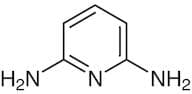
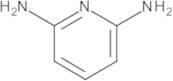
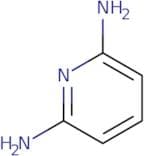
2,6-Diaminopyridin ist eine organische Verbindung, die durch ihren Pyridinring gekennzeichnet ist, der an den Positionen 2 und 6 mit zwei Aminogruppen substituiert ist. Sie erscheint als weißes bis hellgelbes kristallines Feststoff und ist in Wasser und verschiedenen organischen Lösungsmitteln löslich. Diese Verbindung hat eine chemische Formel von C5H7N3 und ein Molekulargewicht von etwa 111,13 g/mol. 2,6-Diaminopyridin ist bekannt für seine Rolle als Baustein in der organischen Synthese und wird in der Produktion von Arzneimitteln, Agrochemikalien und Farbstoffen verwendet. Sie zeigt basische Eigenschaften aufgrund der Anwesenheit von Aminogruppen, die an Wasserstoffbrückenbindungen und Protonierungsreaktionen teilnehmen können. Darüber hinaus wurde sie auf ihre potenziellen therapeutischen Anwendungen untersucht, insbesondere bei der Behandlung bestimmter neurologischer Störungen. Es ist jedoch wichtig, diese Verbindung mit Vorsicht zu behandeln, da sie bei Exposition gesundheitliche Risiken darstellen kann. Angemessene Sicherheitsmaßnahmen sollten beim Arbeiten mit 2,6-Diaminopyridin in Laborumgebungen beachtet werden.
Formel:C5H7N3
InChl:InChI=1S/C5H7N3/c6-4-2-1-3-5(7)8-4/h1-3H,(H4,6,7,8)
InChI Key:InChIKey=VHNQIURBCCNWDN-UHFFFAOYSA-N
SMILES:NC=1N=C(N)C=CC1
Synonyme:- 2,6-Dap
- 2,6-Diamino Pyridine
- 2,6-Diaminopyridin
- 2,6-Diaminopyridinium
- 2,6-Pyridinediamine
- DAP
- DAP (amine)
- Nsc 1921
- Nsc 403346
- Piridina-2,6-Diildiamina
- Pyridin-2,6-diyldiamin
- Pyridine, 2,6-Diamino-
- Pyridine-2,6-Diamine
- Pyridine-2,6-Diyldiamine
- Weitere Synonyme anzeigen
Sortieren nach
Reinheit (%)
0
100
|
0
|
50
|
90
|
95
|
100
10 Produkte.
2,6-Diaminopyridine
CAS:Formel:C5H7N3Reinheit:>98.0%(GC)(T)Farbe und Form:White to Gray to Brown powder to crystalMolekulargewicht:109.132,6-Diaminopyridine, 98%
CAS:2,6-Diaminopyridine, used as a pharmaceutical intermediate and a hair dye coupler in oxidation/permanent formulations. This Thermo Scientific Chemicals brand product was originally part of the Alfa Aesar product portfolio. Some documentation and label information may refer to the legacy brand. TheFormel:C5H7N3Reinheit:98%Farbe und Form:White to cream or pale brown to brown, Crystals or powder or crystalline powder or flakesMolekulargewicht:109.132,6-Diaminopyridine
CAS:Formel:C5H7N3Reinheit:≥ 98.0%Farbe und Form:White to off-white, dark grey or dark yellow-brown powder, crystals or flakesMolekulargewicht:109.132,6-Diaminopyridine
CAS:Kontrolliertes ProduktFormel:C5H7N3Farbe und Form:NeatMolekulargewicht:109.13Pyridine-2,6-diamine
CAS:Pyridine-2,6-diamine
Formel:C5H7N3Reinheit:≥95%Farbe und Form: very dark grey/very dark brown crystalsMolekulargewicht:109.13g/mol2,6-Diaminopyridine
CAS:Kontrolliertes ProduktFormel:C5H7N3Farbe und Form:Off-WhiteMolekulargewicht:109.132,6-Diaminopyridine
CAS:Formel:C5H7N3Reinheit:98%Farbe und Form:Powder or Crystalline Powder or FlakesMolekulargewicht:109.1322,6-Diaminopyridine
CAS:2,6-Diaminopyridine is a heterocyclic compound that is used in analytical chemistry as an indicator for the presence of protonated amines. It is prepared by coupling 2,6-diamino-pyridine with 1,3-benzodioxole-5-carboxylic acid. The nitrogen atoms are electron withdrawing groups and form hydrogen bonding interactions with the protonated amine. This type of interaction leads to a phase transition temperature of about 115°C and a high value for electrochemical impedance spectroscopy (EIS) measurements. The reaction mechanism involves the formation of a protonated amine from 2,6-diaminopyridine and 1,3-benzodioxole-5-carboxylic acid followed by proton transfer to yield the corresponding pyridinium salt.
Formel:C5H7N3Reinheit:Min. 95%Farbe und Form:Beige To Brown SolidMolekulargewicht:109.13 g/mol