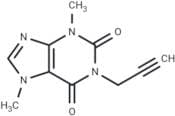
CAS 14114-46-6
:3,7-Dimethyl-1-propargylxanthin
Beschreibung:
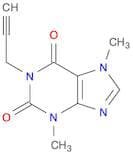
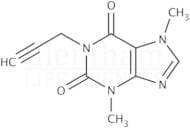
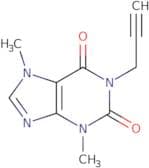
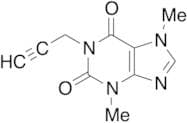
3,7-Dimethyl-1-propargylxanthin, mit der CAS-Nummer 14114-46-6, ist ein Xanthinderivat, das strukturelle Modifikationen aufweist, die für diese Klasse von Verbindungen typisch sind. Es verfügt über ein Xanthin-Rückgrat, das durch eine fusionierte bicyclische Struktur mit Stickstoffatomen gekennzeichnet ist. Das Vorhandensein von zwei Methylgruppen an den Positionen 3 und 7 sowie einer Propargylgruppe an der Position 1 trägt zu seinen einzigartigen chemischen Eigenschaften und biologischen Aktivitäten bei. Diese Verbindung ist bekannt für ihr Potenzial als Phosphodiesterase-Hemmer, der die zellulären Signalwege beeinflussen kann, indem er die Spiegel von cyclischen Nukleotiden erhöht. Infolgedessen könnte es Auswirkungen auf verschiedene therapeutische Bereiche haben, einschließlich kardiovaskulärer und neurologischer Störungen. Die Löslichkeit und Stabilität von 3,7-Dimethyl-1-propargylxanthin können je nach Lösungsmittel und Bedingungen variieren, was für seine Anwendung in der Forschung und potenziellen medizinischen Nutzung wichtig ist. Insgesamt machen seine strukturellen Eigenschaften und biologische Aktivität es zu einer interessanten Verbindung in pharmakologischen Studien.
Formel:C10H10N4O2
InChl:InChI=1S/C10H10N4O2/c1-4-5-14-9(15)7-8(11-6-12(7)2)13(3)10(14)16/h1,6H,5H2,2-3H3
InChI Key:InChIKey=IORPOFJLSIHJOG-UHFFFAOYSA-N
SMILES:O=C1C2=C(N(C)C(=O)N1CC#C)N=CN2C
Synonyme:- 1H-Purine-2,6-dione, 3,7-dihydro-3,7-dimethyl-1-(2-propynyl)-
- 3,7-Dihydro-3,7-dimethyl-1-(2-propyn-1-yl)-1H-purine-2,6-dione
- 3,7-Dimethyl-1-propargylxanthine
- 1H-Purine-2,6-dione, 3,7-dihydro-3,7-dimethyl-1-(2-propyn-1-yl)-
- Theobromine, 1-(2-propynyl)-
Sortieren nach
Reinheit (%)
0
100
|
0
|
50
|
90
|
95
|
100
6 Produkte.
3,7-Dimethyl-1-Propargylxanthine
CAS:Formel:C10H10N4O2Reinheit:98%Farbe und Form:SolidMolekulargewicht:218.21203,7-Dimethyl-1-propargylxanthine
CAS:Kontrolliertes Produkt3,7-Dimethyl-1-propargylxanthine is a cyclase inhibitor that has been shown to have pharmacological effects. It has been shown to be effective in vivo models of Parkinson's disease and has reduced locomotor activity. This drug also inhibits the production of adenosine and dopamine, leading to neuronal death. The 3,7-dimethyl-1-propargylxanthine shows high selectivity for adenosine A3 receptors and is an antagonist at these receptors. It prevents mitochondrial membrane potential from decreasing, which may be due to inhibition of the production of reactive oxygen species by mitochondria. 3,7-Dimethyl-1-propargylxanthine also inhibits platelet aggregation by blocking the activation of phospholipase C and enhances platelet aggregation by inhibiting phosphodiesterase activity.Formel:C10H10N4O2Reinheit:Min. 95%Farbe und Form:PowderMolekulargewicht:218.21 g/mol3,7-Dimethyl-1-propargylxanthine
CAS:Kontrolliertes ProduktApplications A selective A2 adenosine receptor antagonist. Pharmacology: Ki vs [3H]NECA at A2 receptors in rat striatal membranes: 11± 3 uM; Ki vs [3H]CHA at A1 receptors in rat cerebral cortical membranes: 45 ± 4 uM.
References Alfinito, P., et al.: J. Neurosci., 23, 10982 (2003), Golembiowska, K., et al.: Neuropharmacol., 47, 414 (2004), Solinas, M., et al.: Psychopharmacol., 179, 576 (2005), Panjehpour, M., et al.: Oncol. Res., 16, 575 (2007),Formel:C10H10N4O2Farbe und Form:NeatMolekulargewicht:218.21DMPX
CAS:DMPX (3,7-Dimethyl-1-propargylxanthine) is a caffeine-like compound capable of crossing the blood-brain barrier. It serves as an A2-selective adenosine receptor (AR) antagonist, effectively and selectively blocking the hypothermia and behavioral inhibition induced by A2 adenosine receptor agonists, such as NECA. DMPX is utilized in research on diseases like Parkinson's disease.Formel:C10H10N4O2Farbe und Form:SolidMolekulargewicht:218.212