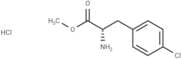
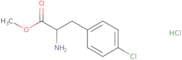
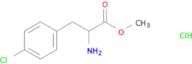
CAS 14173-40-1
:Phenylalanin, 4-chlor-, Methylester, Hydrochlorid (1:1)
Beschreibung:
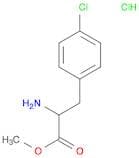
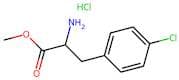
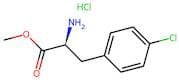
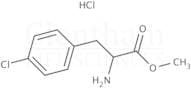
Phenylalanin, 4-chlor-, Methylester, Hydrochlorid (1:1) ist eine chemische Verbindung, die durch ihre Struktur gekennzeichnet ist, die ein modifiziertes Phenylalanin-Rückgrat mit einem Chloratom in der Para-Position und einer methylesterfunktionellen Gruppe umfasst. Diese Verbindung tritt typischerweise als Hydrochloridsalz auf, was ihre Löslichkeit in Wasser verbessert und ihre Stabilität und Reaktivität beeinflussen kann. Die Anwesenheit des Chlor-Substituenten kann die biologische Aktivität der Verbindung und ihre Wechselwirkung mit Enzymen oder Rezeptoren beeinflussen. Als Derivat einer Aminosäure kann es eine Rolle in verschiedenen biochemischen Prozessen spielen, einschließlich der Proteinsynthese und der Stoffwechselwege. Die methylesterform deutet auf potenzielle Anwendungen in der medizinischen Chemie hin, wo sie als Prodrug oder als Baustein für komplexere Moleküle dienen kann. Sicherheits- und Handhabungsvorkehrungen sollten beachtet werden, wie bei vielen chemischen Substanzen, aufgrund möglicher Toxizität oder Reaktivität. Insgesamt ist diese Verbindung sowohl in der Forschung als auch im pharmazeutischen Kontext von Interesse, insbesondere in Studien zum Aminosäurestoffwechsel und zur Arzneimittelentwicklung.
Formel:C10H12ClNO2·ClH
InChl:InChI=1S/C10H12ClNO2.ClH/c1-14-10(13)9(12)6-7-2-4-8(11)5-3-7;/h2-5,9H,6,12H2,1H3;1H
InChI Key:InChIKey=GCBCWTWQAFLKJG-UHFFFAOYSA-N
SMILES:C(C(C(OC)=O)N)C1=CC=C(Cl)C=C1.Cl
Synonyme:- (2R)-3-(4-chlorophenyl)-1-methoxy-1-oxopropan-2-aminium
- (2S)-3-(4-chlorophenyl)-1-methoxy-1-oxopropan-2-aminium
- 3-(4-Chlorophenyl)-1-Methoxy-1-Oxopropan-2-Aminium Chloride
- 4-Chloro-DL-Phe-OMe・HCl
- 4-Chlorophenylalanine methyl ester hydrochloride
- <span class="text-smallcaps">DL</span>-(4-Chlorophenyl)alanine methyl ester hydrochloride
- <span class="text-smallcaps">DL</span>-(p-Chlorophenyl)alanine methyl ester hydrochloride
- <span class="text-smallcaps">DL</span>-Phenylalanine, 4-chloro-, methyl ester, hydrochloride
- Alanine, 3-(p-chlorophenyl)-, methyl ester, hydrochloride, <span class="text-smallcaps">DL</span>-
- Alanine, 3-(p-chlorophenyl)-, methyl ester, hydrochloride, DL-
- DL-3-(p-Chlorophenyl)alanine methyl ester hydrochloride
- DL-4-chlorophenylalanine methyl ester hydrochloride
- DL-Pcpa methyl ester hydrochloride
- DL-Phenylalanine, 4-chloro-, methyl ester, hydrochloride
- DL-p-Chlorophenylalanine methyl ester hydrochloride
- H-DL-Phe(4-Cl)-OMe・HCl
- Methyl 4-Chlorophenylalaninate
- Phenylalanine, 4-chloro-, methyl ester, hydrochloride
- Phenylalanine, 4-chloro-, methyl ester, hydrochloride (1:1)
- p-Chlorophenylalanine methyl ester hydrochloride
- Methyl 4-chloro-3-phenyl-DL-alaninate hydrochloride
- Weitere Synonyme anzeigen
Sortieren nach
Reinheit (%)
0
100
|
0
|
50
|
90
|
95
|
100
7 Produkte.
Phenylalanine, 4-chloro-, methyl ester, hydrochloride (1:1)
CAS:Formel:C10H13Cl2NO2Reinheit:98%Farbe und Form:SolidMolekulargewicht:250.1217Methyl 2-Amino-3-(4-Chlorophenyl)Propanoate Hydrochloride
CAS:Methyl 2-Amino-3-(4-Chlorophenyl)Propanoate HydrochlorideReinheit:98%Molekulargewicht:250.12g/molpCPA methyl ester hydrochloride
CAS:pCPA methyl ester hydrochlorideReinheit:≥98%Molekulargewicht:250.12g/molpCPA methyl ester hydrochloride
CAS:pCPA methyl ester HCl inhibits tryptophan hydroxylase, 5-HT synthesis, crosses blood-brain barrier, lowers central 5-HT.
Formel:C10H13Cl2NO2Reinheit:99.73% - 99.88%Farbe und Form:SolidMolekulargewicht:250.124-Chloro-DL-phenylalanine methyl ester hydrochloride
CAS:4-Chloro-DL-phenylalanine methyl ester hydrochloride is a dopamine receptor agonist that has been shown to have antinociceptive properties in animal models of pain. It has also been shown to inhibit the release of lactogenic hormones, which are hormones that stimulate milk production. Dopamine is a neurotransmitter that plays a role in locomotor activity and reward mechanisms. 4-Chloro-DL-phenylalanine methyl ester hydrochloride binds to the dopamine receptor, inducing activation of the G protein and subsequent phospholipase C activation. This stimulates the synthesis of inositol triphosphate (IP3) and diacylglycerol (DAG). IP3 causes an increase in intracellular calcium ions, leading to muscle contraction, while DAG activates protein kinase C (PKC), which can inhibit adenyl cyclase and thus lead to decreased cAMP levels. The 5HT2AFormel:C10H12ClNO2·HClReinheit:Min. 98 Area-%Farbe und Form:PowderMolekulargewicht:250.10 g/mol4-Chloro-DL-Phe-OMe.HCl
CAS:M03172 - 4-Chloro-DL-Phe-OMe.HCl
Formel:C10H13Cl2NO2Reinheit:98%Farbe und Form:Solid, White powderMolekulargewicht:250.12