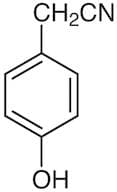
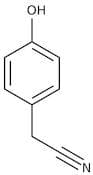
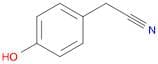
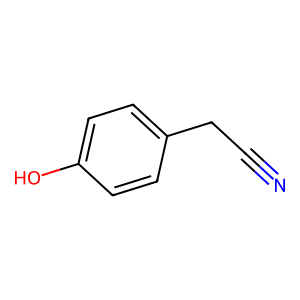
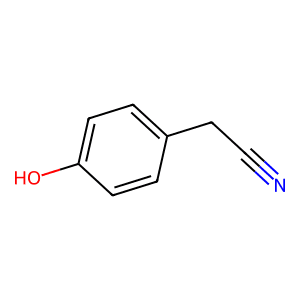
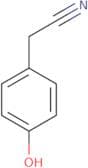
CAS 14191-95-8
:4-Hydroxybenzylcyanid
- (4-Hydroxyphenyl)acetonitrile
- (p-Hydroxyphenyl)-acetonitril
- 2-(4-Hydroxyphenyl)Acetonitrile
- 4-(Cyanomethyl)phenol
- 4-Hydroxy benzylcyaride
- 4-Hydroxy-Benzeneacetonitril
- 4-Hydroxybenzeneacetonitrile
- 4-Hydroxybenzyl
- 4-HydroxybenzylCyanide
- 4-Hydroxybenzylnitrile
- 4-Hydroxyphenylacetonitrile
- 5-[(Diaminomethylidene)Amino]-2-Oxopentanoic Acid
- Acetonitrile, (p-Hydroxyphenyl)-
- Benzeneacetonitrile, 4-hydroxy-
- NSC 76080
- P-Hydroxybenzyl cyanide
- PARA-HydroxyphenylAcetonitrile
- PHPAcn
- p-Hydroxybenzacetonitrile
- p-Hydroxyphenylacetonitrile
- Weitere Synonyme anzeigen
4-Hydroxybenzyl Cyanide
CAS:Formel:C8H7NOReinheit:>99.0%(GC)Farbe und Form:White to Yellow to Orange powder to crystalMolekulargewicht:133.154-Hydroxyphenylacetonitrile, 97%
CAS:This Thermo Scientific Chemicals brand product was originally part of the Alfa Aesar product portfolio. Some documentation and label information may refer to the legacy brand. The original Alfa Aesar product / item code or SKU reference has not changed as a part of the brand transition to Thermo SciFormel:C8H7NOReinheit:97%Farbe und Form:Cream to dark cream or yellow, Crystals or powder or crystalline powder or fused/lumpy solidMolekulargewicht:133.15Benzeneacetonitrile, 4-hydroxy-
CAS:Formel:C8H7NOReinheit:98%Farbe und Form:SolidMolekulargewicht:133.14734-Hydroxybenzyl cyanide
CAS:4-Hydroxybenzyl cyanide (4-Hydroxyphenylacetonitrile) shows strong antioxidative activity.Formel:C8H7NOReinheit:97.01% - 99.89%Farbe und Form:Light Brown SolidMolekulargewicht:133.154-Hydroxyphenylacetonitrile
CAS:Formel:C8H7NOReinheit:≥ 98.0%Farbe und Form:White to off-white or light yellow powderMolekulargewicht:133.154-Hydroxyphenylacetonitrile
CAS:4-HydroxyphenylacetonitrileFormel:C8H7NOReinheit:98%Farbe und Form: brown to dark brown crystalline solidMolekulargewicht:133.15g/mol4-Hydroxyphenylacetonitrile
CAS:4-Hydroxyphenylacetonitrile (HPA) is a chemical compound that belongs to the group of nitriles. It is a precursor to the pigment sinalbin, which is found in corynebacterium and related bacteria. HPA has been shown to have an apoptotic effect on human cells, which may be due to its ability to inhibit protein synthesis and induce DNA fragmentation. The synthetic pathway for HPA starts with the conversion of L-phenylalanine into 4-hydroxyphenylpyruvic acid by a wild-type strain or bacterial strain. The 4-hydroxyphenylpyruvic acid is then converted into 4-hydroxybenzaldehyde through polymerase chain reactions or expression plasmids in corynebacterium glutamicum. This molecule can then be transformed into HPA by hydrolysis with hydrochloric acid or enzymatic activity. HPA has also been shown to stimulate
Formel:C8H7NOReinheit:Min. 95%Farbe und Form:PowderMolekulargewicht:133.15 g/mol4-Hydroxyphenylacetonitrile
CAS:Kontrolliertes ProduktApplications 4-Hydroxyphenylacetonitrile (cas# 14191-95-8) is a compound useful in organic synthesis.
Formel:C8H7NOFarbe und Form:NeatMolekulargewicht:133.154-Hydroxybenzyl cyanide
CAS:4-Hydroxybenzyl cyanide (4-Hydroxyphenylacetonitrile) shows strong antioxidative activity.
Formel:C8H7NOReinheit:98.13%Farbe und Form:Light Brown SolidMolekulargewicht:133.15