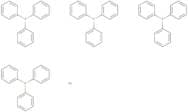
CAS 14221-02-4
:Tetrakis(triphenylphosphin)platin
Beschreibung:
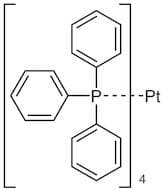
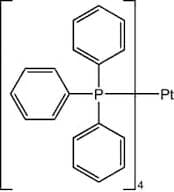
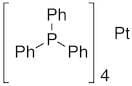
Tetrakis(triphenylphosphin)platin, mit der CAS-Nummer 14221-02-4, ist eine Koordinationsverbindung, die Platin als zentrales Metallatom aufweist, das an vier Triphenylphosphin-Liganden koordiniert ist. Dieser Komplex ist typischerweise durch seine quadratisch-planare Geometrie gekennzeichnet, die für Platin(II)-Komplexe üblich ist. Die Anwesenheit der voluminösen Triphenylphosphin-Liganden verleiht eine signifikante sterische Hinderung, die die Reaktivität und Stabilität der Verbindung beeinflusst. Tetrakis(triphenylphosphin)platin wird häufig in verschiedenen Anwendungen eingesetzt, einschließlich Katalyse, organischer Synthese und als Vorläufer bei der Herstellung anderer Platin-Komplexe. Es zeigt eine bemerkenswerte Löslichkeit in organischen Lösungsmitteln, was es für Reaktionen in nicht-wässrigen Umgebungen geeignet macht. Darüber hinaus kann die Verbindung interessante elektronische Eigenschaften aufweisen, die sich aus den Wechselwirkungen zwischen dem Platin-Zentrum und den Phosphin-Liganden ergeben, was ihr Verhalten in katalytischen Prozessen beeinflussen kann. Insgesamt ist Tetrakis(triphenylphosphin)platin eine wichtige Verbindung in der Koordinationschemie und der organometallischen Chemie mit vielfältigen Anwendungen in Forschung und Industrie.
Formel:C72H60P4Pt
InChl:InChI=1S/4C18H15P.Pt/c4*1-4-10-16(11-5-1)19(17-12-6-2-7-13-17)18-14-8-3-9-15-18;/h4*1-15H;
InChI Key:InChIKey=SYKXNRFLNZUGAJ-UHFFFAOYSA-N
SMILES:[Pt]([P](C1=CC=CC=C1)(C2=CC=CC=C2)C3=CC=CC=C3)([P](C4=CC=CC=C4)(C5=CC=CC=C5)C6=CC=CC=C6)([P](C7=CC=CC=C7)(C8=CC=CC=C8)C9=CC=CC=C9)[P](C%10=CC=CC=C%10)(C%11=CC=CC=C%11)C%12=CC=CC=C%12
Synonyme:- (T-4)-Tetrakis(triphenylphosphine)platinum
- Platinum tetra(triphenylphosphine)
- Platinum, tetrakis(triphenylphosphine)-
- Platinum, tetrakis(triphenylphosphine)-, (T-4)-
- Platinum-Triphenylphosphane (1:4)
- Tetrakis(triphenylphosphine)platinum
Sortieren nach
Reinheit (%)
0
100
|
0
|
50
|
90
|
95
|
100
7 Produkte.
Tetrakis(triphenylphosphine)platinum(0)
CAS:Formel:C72H60P4PtFarbe und Form:Light yellow to Brown powder to crystalMolekulargewicht:1,244.25Tetrakis(triphenylphosphine)platinum(0), Pt 15.2% min
CAS:Hydrosilation and oxidationFormel:C72H60P4PtMolekulargewicht:1244.25Tetrakis(triphenylphosphine)platinum(0), 98%
CAS:Tetrakis(triphenylphosphine)platinum(0), 98%
Formel:Pt(C6H5)3PReinheit:98%Farbe und Form:yellow xtl.Molekulargewicht:1244.21Platinum, tetrakis(triphenylphosphine)-, (T-4)-
CAS:Formel:C72H60P4PtReinheit:98%Farbe und Form:SolidMolekulargewicht:1244.2198Tetrakis(triphenylphosphine)platinum
CAS:Tetrakis(triphenylphosphine)platinum
Reinheit:98%Molekulargewicht:1244.22g/molTetrakis(triphenylphosphine)platinum(0)
CAS:Tetrakis(triphenylphosphine)platinum(0) is a compound that belongs to the group of organometallic complexes. It is a multinuclear compound, which means it contains more than one metal atom. Tetrakis(triphenylphosphine)platinum(0) has been used as an oxidizing agent in organic chemistry and as a catalyst for chemical reactions. Tetrakis(triphenylphosphine)platinum(0) is chemically stable and insoluble in water, making it useful for reactions that require protection from water or other protic solvents. Tetrakis(triphenylphosphine)platinum(0) has been shown to react with chloride to form chloroplatinates, with ester compounds to form platinum esters, and with carbon-carbon double bonds to form platinum carbonyls.Formel:C72H60P4PtFarbe und Form:PowderMolekulargewicht:1,244.23 g/molTetrakis(Triphenylphosphine)platinum(0)
CAS:Formel:C72H60P4PtReinheit:95%Farbe und Form:Solid, PowderMolekulargewicht:1244.251