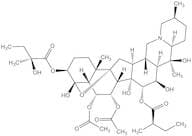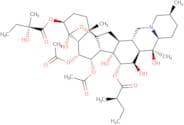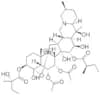
CAS 143-57-7
:Protoveratrin
Beschreibung:
Protoveratrin ist ein komplexes Alkaloid, das aus der Pflanzen-Gattung Veratrum, insbesondere aus Arten wie Veratrum album und Veratrum viride, gewonnen wird. Es ist bekannt für seine starken pharmakologischen Wirkungen, hauptsächlich als kardiovaskuläres Mittel. Protoveratrin zeigt sowohl vasodilatatorische als auch blutdrucksenkende Eigenschaften, was es nützlich bei der Behandlung von Bluthochdruck macht. Die Substanz wirkt, indem sie Natriumkanäle blockiert und die Bewegung von Calciumionen beeinflusst, was die Muskelkontraktion und den Gefäßtonus beeinflusst. Es wird typischerweise in Form eines weißen bis off-white kristallinen Pulvers gefunden und ist in Alkohol löslich und leicht in Wasser löslich. Aufgrund seiner biologischen Aktivität kann Protoveratrin signifikante Nebenwirkungen verursachen, einschließlich Übelkeit, Erbrechen und kardiovaskulären Störungen, was eine sorgfältige Dosierung und Überwachung bei therapeutischer Anwendung erforderlich macht. Seine Verwendung hat zugunsten moderner blutdrucksenkender Mittel abgenommen, bleibt jedoch von Interesse in der pharmakologischen Forschung aufgrund seiner einzigartigen Wirkmechanismen. Wie bei vielen Alkaloiden sind Sicherheits- und Toxizitätsprofile kritische Überlegungen bei seiner Anwendung.
Formel:C41H63NO14
InChl:InChI=1/C41H63NO14/c1-10-20(4)34(46)55-33-28(45)27-23(18-42-17-19(3)12-13-25(42)38(27,9)49)24-16-39-32(40(24,33)50)30(53-22(6)44)29(52-21(5)43)31-36(39,7)15-14-26(41(31,51)56-39)54-35(47)37(8,48)11-2/h19-20,23-33,45,48-51H,10-18H2,1-9H3/t19-,20+,23-,24?,25-,26-,27+,28+,29-,30+,31-,32+,33-,36-,37?,38+,39-,40-,41-/m0/s1
InChI Key:InChIKey=HYTGGNIMZXFORS-MGYKWWNKSA-N
SMILES:C[C@@]12[C@]34[C@]([C@@]5(O)[C@@](C3)([C@]6([C@]([C@@H](O)[C@@H]5OC([C@@H](CC)C)=O)([C@](C)(O)[C@]7(N(C6)C[C@@H](C)CC7)[H])[H])[H])[H])([C@H](OC(C)=O)[C@H](OC(C)=O)[C@@]1([C@](O)(O4)[C@@H](OC([C@@](CC)(C)O)=O)CC2)[H])[H]
Synonyme:- (3beta(S),4alpha,6alpha,7alpha,15alpha(R),16beta)-4,9-Epoxycevane-3,4,6,7,14,15,16,20-octol 6,7-diacetate 3-(2-hydroxy-2-methylbutyrate) 15-(2-methylbutyrate)
- (3beta,4alpha,6alpha,7alpha,9beta,12xi,15alpha,16beta)-6,7-bis(acetyloxy)-4,14,16,20-tetrahydroxy-15-{[(2R)-2-methylbutanoyl]oxy}-4,9-epoxycevan-3-yl 2-hydroxy-2-methylbutanoate
- (3beta,4alpha,6alpha,7alpha,9beta,15alpha,16beta)-6,7-bis(acetyloxy)-4,14,16,20-tetrahydroxy-15-{[(2R)-2-methylbutanoyl]oxy}-4,9-epoxycevan-3-yl (2S)-2-hydroxy-2-methylbutanoate
- (3beta,4alpha,6alpha,7alpha,9xi,15alpha,16beta)-6,7-bis(acetyloxy)-4,14,16,20-tetrahydroxy-15-{[(2R)-2-methylbutanoyl]oxy}-4,9-epoxycevan-3-yl (2S)-2-hydroxy-2-methylbutanoate
- (4Beta,5Xi,7Beta,8Xi,10Alpha,12Xi,13Xi,14Beta,15Beta,16Alpha,17Xi,20Beta,22Xi,25Xi)-6,7-Bis(Acetyloxy)-4,14,16,20-Tetrahydroxy-15-[(2-Methylbutanoyl)Oxy]-4,9-Epoxycevan-3-Yl 2-Hydroxy-2-Methylbutanoate
- 2H-4,16a-Epoxybenzo[7,8]fluoreno[2,1-b]quinolizine, cevane-3,4,6,7,14,15,16,20-octol deriv.
- Brn 0077415
- Cevane-3,4,6,7,14,15,16,20-octol, 4,9-epoxy-, 6,7-diacetate 3-(2-hydroxy-2-methylbutanoate) 15-(2-methylbutanoate), (3beta(S),4alpha,6alpha,7alpha,15alpha(R),16beta)- (9CI)
- Cevane-3,4,6,7,14,15,16,20-octol, 4,9-epoxy-, 6,7-diacetate 3-(2-hydroxy-2-methylbutanoate) 15-(2-methylbutanoate), [3β(S),4α,6α,7α,15α(R),16β]-
- Cevane-3,4,6,7,14,15,16,20-octol, 4,9-epoxy-, 6,7-diacetate 3-[(2S)-2-hydroxy-2-methylbutanoate] 15-[(2R)-2-methylbutanoate], (3β,4α,6α,7α,15α,16β)-
- Cevane-3-beta,4-beta,6-alpha,7-alpha,14,15-alpha-16-beta,20-octol, 4,9-epoxy-, 6,7-diacetate 3-((+)-2-hydroxy-2-methylbutyrate) 15-((-)-2-methylbutyrate)
- Cevane-3beta,4beta,6alpha,7alpha,14,15alpha,16beta,20-octol, 4,9-epoxy-, 6,7-diacetate 3-((+)-2-hydroxy-2-methylbutyrate) 15-((-)-2-methylbutyrate) (8CI)
- Cevane-3β,4β,6α,7α,14,15α,16β,20-octol, 4,9-epoxy-, 6,7-diacetate 3-((+)-2-hydroxy-2-methylbutyrate) 15-((-)-2-methylbutyrate)
- Nsc 23865
- Nsc 7526
- Protalba
- Protofecaterine A
- Protoveratrin
- Protoveratrine A
- Protoverine 3-[(+)-(2S)-2-hydroxy-2-methylbutyrate] 6,7-diacetate 15-[(-)-(2R)-2-methylbutyrate]
- Protoverine, 6,7-diacetate 3-(2-hydroxy-2-methylbutyrate) 15-(2-methylbutyrate)
- Puroverine
- Unii-Xp343X1Hju
- Protoveratrine
- 4-21-00-06845 (Beilstein Handbook Reference)
- Pro-AMid
- PROTOPINE HCL(FUMARINE HCL)(RG)(CALL)
- 4α,9-Epoxycevane-3β,4,6α,7α,14,15α,16β,20-octol 6,7-diacetate 3-[(S)-2-hydroxy-2-methylbutanoate]15-[(R)-2-methylbutanoate]
- Cevane-3,4,6,7,14,15,16,20-octol, 4,9-epoxy-, 6,7-diacetate 3-(2-hydroxy-2-methylbutanoate) 15-(2-methylbutanoate), [3.beta.(S),4.alpha.,6.alpha.,7.alpha.,15.alpha.(R),16.beta.]-
- HYTGGNIMZXFORS-MGYKWWNKSA-N
- Puroverin
- PROTOVERATRINE A (RG)
- 6,7-diacetate3-((+)-2-hydroxy-2-methylbutyrate)15-((-)-2-methylbutyrate)
- Weitere Synonyme anzeigen
Sortieren nach
Reinheit (%)
0
100
|
0
|
50
|
90
|
95
|
100
2 Produkte.
Protoveratrine a
CAS:Natural alkaloidFormel:C41H63NO14Reinheit:≥ 90.0 % (HPLC)Farbe und Form:PowderMolekulargewicht:793.95Protoveratrine
CAS:Protoveratrine is a potent alkaloid compound, which is derived from the roots and rhizomes of plants in the Veratrum genus, also known as false hellebores. It operates by interfering with sodium ion channels in the nervous and cardiovascular systems, leading to prolonged depolarization, thereby affecting normal cellular excitability and signal transmission.Formel:C41H63NO14Reinheit:Min. 95%Farbe und Form:PowderMolekulargewicht:793.94 g/mol