CAS 14323-36-5
:Kaliumtetracyanoplatinat(II)-trihydrat
Beschreibung:
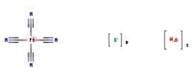
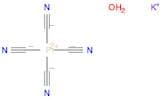
Kaliumtetracyanoplatinat(II)-trihydrat, mit der CAS-Nummer 14323-36-5, ist eine anorganische Verbindung, die durch ihre komplexe Struktur gekennzeichnet ist, die ein Platinzentrum umfasst, das an vier Cyanidliganden koordiniert ist und durch Kaliumkationen ausgeglichen wird. Diese Verbindung erscheint typischerweise als kristalliner Feststoff und ist bekannt für ihre auffällige blaue Farbe, die das Ergebnis der elektronischen Übergänge innerhalb des Platin-Komplexes ist. Sie ist in Wasser löslich, und die Anwesenheit von drei Wassermolekülen in ihrer trihydratisierten Form trägt zu ihrer Stabilität und Löslichkeit bei. Kaliumtetracianoplatinat(II) wird häufig in verschiedenen Anwendungen eingesetzt, einschließlich der analytischen Chemie und als Vorläufer in der Synthese anderer platinahaltiger Verbindungen. Ihre einzigartigen Eigenschaften machen sie in der Forschung wertvoll, insbesondere in Studien zur Koordinationschemie und Katalyse. Aufgrund der Anwesenheit von Cyanid muss sie jedoch mit Vorsicht behandelt werden, da Cyanid hochgiftig ist. Insgesamt veranschaulicht diese Verbindung das faszinierende Zusammenspiel zwischen Metallkoordination und Ligandenchemie.
Formel:C4H6K2N4O3Pt
InChl:InChI=1/4CN.2K.3H2O.Pt/c4*1-2;;;;;;/h;;;;;;3*1H2;/q;;;;2*+1;;;;-2/rC4N4Pt.2K.3H2O/c5-1-9(2-6,3-7)4-8;;;;;/h;;;3*1H2/q-2;2*+1;;;
InChI Key:InChIKey=JQTYQMMCROYLPI-UHFFFAOYSA-N
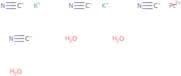
SMILES:[Pt+2]([C-]#N)([C-]#N)([C-]#N)[C-]#N.[K+].O
Synonyme:- Dipotassium Tetracyanoplatinum Trihydrate
- Dipotassium tetracyanoplatinate trihydrate
- Dipotassium tetracyanoplatinate(2-) trihydrate
- Platinate(2-), tetracyano-, dipotassium, trihydrate
- Platinate(2-), tetrakis(cyano-C)-, dipotassium, trihydrate, (SP-4-1)-
- Platinate(2-), tetrakis(cyano-κC)-, dipotassium, trihydrate, (SP-4-1)-
- Platinate(2-), tetrakis(cyano-κC)-, potassium, hydrate (1:2:3), (SP-4-1)-
- PotasAV23284
- Potassium tetracyanoplatinate(2-) trihydrate
- Potassium tetracyanoplatinate(II) hydrate
- POTASSIUM TETRACYANOPLATINATE(II) TRIHYDRATE
- Potassium tetracyanoplatinite
- POTASSIUM TETRACYANOPLATINATE9(II) TRIHYDRATE
- Potassium tetracyanoplatinate
- PotassiumTetracyanoplatinum(Ii)
- PLATINUM POTASSIUM CYANIDE
- POTASSIUM CYANOPLATINITE
- Potassium tetracyanoplatinate(II) trihydrate, 99.9% (metals basis), Pt 45.2%
- POTASSIUM TETRACYANOPLATINATE(II)
- Weitere Synonyme anzeigen
Sortieren nach
Reinheit (%)
0
100
|
0
|
50
|
90
|
95
|
100
4 Produkte.
Potassium tetracyanoplatinate(II) trihydrate, 99.9% (metals basis), Pt 44.9% min
CAS:Potassium tetracyanoplatinate(II) trihydrate is used in the preparation other salts like Krogmann's salt, that are highly conducting, one dimensional materials. This Thermo Scientific Chemicals brand product was originally part of the Alfa Aesar product portfolio. Some documentation and label inforFormel:C4H6K2N4O3PtReinheit:99.9%Farbe und Form:White to pale yellow, CrystallineMolekulargewicht:431.40Potassium tetracyanoplatinate(II) trihydrate
CAS:Formel:C4H2KN4OPtReinheit:99.9%Molekulargewicht:356.2612Potassium tetracyanoplatinate(II)trihydrate
CAS:Kontrolliertes ProduktPotassium tetracyanoplatinate(II)trihydrate (KTP) is a nanomaterial that is made of metal ions, such as ruthenium and copper, and organic molecules. It has the ability to absorb electrons from water, which are then transferred to carbon sources. This process can be used to remove proton in the water, thereby creating an acidic solution. The KTP particles have been shown to produce cavitation when exposed to ultrasound waves or other high-frequency sound waves. Cavitation occurs when bubbles form and rapidly collapse within a liquid. The resulting shockwaves can break down the cell membrane of microorganisms.Formel:C4H6K2N4O3PtReinheit:Min. 95%Molekulargewicht:431.4 g/mol