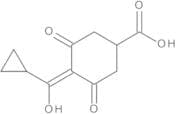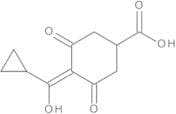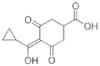
CAS 143294-89-7
:trinexapac
- 4-(Cyclopropylhydroxymethylene)-3,5-dioxocyclohexanecarboxylic acid
- Cimetacarb
- Cyclohexanecarboxylic acid, 4-(cyclopropylhydroxymethylene)-3,5-dioxo-
- Trinexapac (Free Acid)
- Trinexapac Standard
- Trinexapac
Trinexapac (free acid)
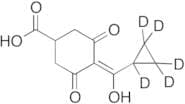
CAS:Kontrolliertes ProduktFormel:C11H12O5Farbe und Form:NeatMolekulargewicht:224.21Trinexapac-d5
CAS:Kontrolliertes ProduktApplications Trinexapac-d5, is the labeled analogue of Trinexapac (T886315), a plant growth regulator that studies have shown to have the enzymic activity of histone lysine demethylases and histone modifications during the neural stem/progenitor cell differentiation
References Vavilala, D. et al.: Toxicology Reports, Vol.1, P: 1152-1161 (2014);Formel:C11D5H7O5Farbe und Form:NeatMolekulargewicht:229.241Trinexapac
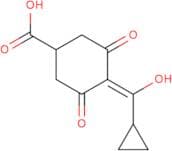
CAS:Trinexapac is a fungicide that belongs to the group of systemic, acylated triazoles. It is used for protecting perennial ryegrass against diseases caused by fungi. Trinexapac has been shown to inhibit fatty acid synthesis and cause an accumulation of monocarboxylic acids in plant tissue. This effect is due to its ability to inhibit the enzyme acylation reaction, which converts acetyl-CoA into fatty acids. Trinexapac also inhibits the production of ethylene and other essential oils in plants, as well as inhibiting sporulation in mollusks. Trinexapac is applied as a liquid or granular formulation and can be detected using analytical methods such as liquid chromatography or gas chromatography.
Formel:C11H12O5Reinheit:Min. 95%Farbe und Form:PowderMolekulargewicht:224.21 g/mol