CymitQuimica logo

CAS 143537-62-6

:

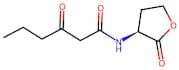
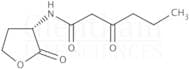
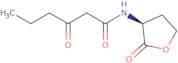
N-(B-Ketocapronyl)-L-homoserinlacton

Beschreibung:
N-(B-Ketocapronyl)-L-homoserinlacton, identifiziert durch seine CAS-Nummer 143537-62-6, ist eine chemische Verbindung, die zur Klasse der Homoserinlactone gehört, die für ihre Rolle in der bakteriellen Quorum-Sensing bekannt sind. Diese Verbindung weist eine Lactonstruktur auf, die ein zyklischer Ester ist, der aus der Reaktion eines Alkohols und einer Carbonsäure entsteht. Ihre molekulare Struktur umfasst eine Ketongruppe und ein Homoserin-Moiety, was zu ihrer biologischen Aktivität beiträgt. Die Anwesenheit der B-Ketocaproygruppe deutet darauf hin, dass sie an verschiedenen biochemischen Wegen teilnehmen könnte, was potenziell die mikrobielle Kommunikation und das Verhalten beeinflusst. Diese Verbindung ist von Interesse in der Mikrobiologie und Biochemie aufgrund ihrer Implikationen bei der Regulierung der Genexpression und der Virulenz bestimmter Bakterien. Darüber hinaus könnte ihre einzigartige Struktur potenzielle Anwendungen in der synthetischen Biologie und der Entwicklung neuer antimikrobieller Mittel bieten. Wie viele Homoserinlactone kann sie je nach Umweltbedingungen unterschiedliche Stabilitäts- und Reaktivitätsgrade aufweisen.
Formel:C10H15NO4
InChl:InChI=1/C10H15NO4/c1-2-3-7(12)6-9(13)11-8-4-5-15-10(8)14/h8H,2-6H2,1H3,(H,11,13)/t8-/m0/s1
SMILES:CCCC(=O)CC(=N[C@H]1CCOC1=O)O
Synonyme:
  • N-(Beta-Ketocaproyl)-Dl-Homoserine Lactone
  • 3-oxo-N-[(3S)-2-oxotetrahydrofuran-3-yl]hexanamide
Sortieren nach

Reinheit (%)
0
100
|
0
|
50
|
90
|
95
|
100
7 Produkte.
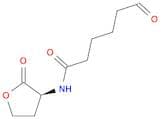
  • (S)-6-Oxo-N-(2-oxotetrahydrofuran-3-yl)hexanamide

    CAS:
    Formel:C10H15NO4
    Reinheit:98%
    Farbe und Form:Solid
    Molekulargewicht:213.2304

    Ref: IN-DA007JZ3

    1g
    657,00€
    2mg
    34,00€
    10mg
    65,00€
    50mg
    108,00€
    100mg
    165,00€
    250mg
    201,00€
  • N-(β-Ketocaproyl)-L-hoMoserine lactone

    CAS:
    N-(β-Ketocaproyl)-L-hoMoserine lactone
    Reinheit:≥98%
    Molekulargewicht:213.23g/mol

    Ref: 54-BUP11131

    10mg
    63,00€
    25mg
    122,00€
    50mg
    199,00€
    100mg
    299,00€
    200mg
    437,00€
  • N-(β-Ketocaproyl)-L-homoserine lactone

    CAS:
    Formel:C10H15NO4
    Reinheit:≥ 98.0%
    Farbe und Form:White solid
    Molekulargewicht:213.23

    Ref: 7W-GM4380

    10mg
    158,00€
    50mg
    475,00€
  • N-(β-Ketocaproyl)-L-hoMoserine lactone

    CAS:
    N-(beta-Ketocaproyl)-L-hoMoserine lactone (N-(Ketocaproyl)-L-homoserine lactone) is a component of quorum regulatory sensing and an autoinducer of P.
    Formel:C10H15NO4
    Reinheit:99.76%
    Farbe und Form:Solid
    Molekulargewicht:213.23
  • (S)-3-Oxo-N-(2-oxotetrahydrofuran-3-yl)hexanamide

    CAS:
    Reinheit:98%
    Farbe und Form:Solid
    Molekulargewicht:213.2330017

    Ref: 10-F869766

    1g
    566,00€
    50mg
    91,00€
    100mg
    151,00€
    250mg
    247,00€
  • N-(Ketocaproyl)-L-homoserine lactone

    CAS:
    <p>N-(Ketocaproyl)-L-homoserine lactone is a fatty acid analog of the bacterial signaling molecule homoserine lactone and a potent inducer of cell lysis. The synthesis of this analog has been demonstrated in vitro with Escherichia coli, Bacillus subtilis, and Streptococcus pneumoniae. It is active against human pathogens including Helicobacter pylori and Staphylococcus aureus as well as mammalian tissue. N-(Ketocaproyl)-L-homoserine lactone induces cell lysis by binding to the DNA polymerase to inhibit its activity and terminate DNA synthesis. This inhibition leads to an accumulation of unprocessed RNA, which induces apoptosis in bacterial cells.</p>
    Formel:C10H15NO4
    Reinheit:Min. 98 Area-%
    Farbe und Form:White Powder
    Molekulargewicht:213.23 g/mol

    Ref: 3D-FK24799

    1g
    883,00€
    2g
    1.280,00€
    100mg
    255,00€
    250mg
    477,00€
    500mg
    598,00€
  • N-(Ketocaproyl)-L-homoserine Lactone

    Kontrolliertes Produkt
    CAS:
    <p>Applications An autoinducer of P. fischeri luciferase. A specific genetic regulator that is unrelated to at least one of the enzyme systems that it induces, and it acts after excretion and accumulation in the extracellular medium.<br>References Eberhard, A., et al.: Biochemistry, 20, 2444 (1981)<br></p>
    Formel:C10H15NO4
    Farbe und Form:Neat
    Molekulargewicht:213.23

    Ref: TR-K180750

    25mg
    136,00€
    100mg
    224,00€
    500mg
    927,00€