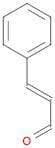
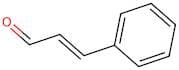
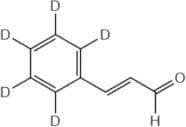
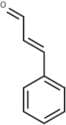
CAS 14371-10-9
:Zimtaldehyd
Beschreibung:
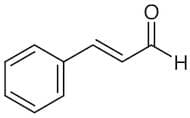
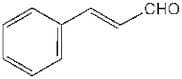
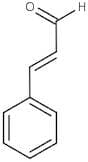
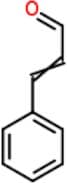
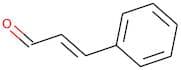
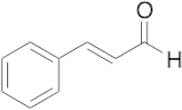
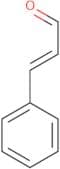
Zimtaldehyd, mit der CAS-Nummer 14371-10-9, ist eine organische Verbindung, die als Hauptbestandteil des Zimtöls dient und zu seinem charakteristischen Geschmack und Aroma beiträgt. Es wird als Aldehyd klassifiziert, spezifisch als Phenylpropanoid, und hat die chemische Formel C9H8O. Zimtaldehyd ist bei Raumtemperatur eine farblose bis blassgelbe Flüssigkeit, die einen süßen, würzigen Duft hat, der an Zimt erinnert. Es ist in organischen Lösungsmitteln wie Ethanol und Ether löslich, hat jedoch eine begrenzte Löslichkeit in Wasser. Die Verbindung ist bekannt für ihre antimikrobiellen und antimykotischen Eigenschaften, was sie nützlich für die Lebensmittelkonservierung und als natürliches Aromastoff macht. Darüber hinaus wurde Zimtaldehyd auf seine potenziellen gesundheitlichen Vorteile untersucht, einschließlich entzündungshemmender und antioxidativer Wirkungen. Es kann jedoch die Haut und Schleimhäute reizen, was Vorsicht beim Umgang erfordert. Insgesamt ist Zimtaldehyd eine vielseitige Verbindung mit Anwendungen in Lebensmitteln, Kosmetika und Pharmazeutika, die ihre Bedeutung sowohl in der Industrie als auch in der Forschung widerspiegelt.
Formel:C9H8O
InChl:InChI=1/C9H8O/c10-8-4-7-9-5-2-1-3-6-9/h1-8H/b7-4-
InChI Key:InChIKey=KJPRLNWUNMBNBZ-QPJJXVBHSA-N
SMILES:C(=C/C=O)\C1=CC=CC=C1
Synonyme:- (2E)-3-Phenyl-2-propenal
- (2E)-3-phenylprop-2-enal
- (2Z)-3-phenylprop-2-enal
- (E)-3-Phenylacrolein
- (E)-3-Phenylprop-2-en-1-al
- (E)-3-Phenylprop-2-enal
- (E)-3-Phenylprop-2-enone
- (E)-3-Phenylpropenal
- (E)-Cinnamaldehyde
- 2-Phenylprop-2-Enal
- 2-Propenal, 3-phenyl-, (2E)-
- 2-Propenal, 3-phenyl-, (E)-
- 3-Phenyl-2-propenal
- 3-Phenylprop-2-Enal
- Cinnam Aldehyde
- Cinnamaldehyde, (E)-
- Cinnamic aldehyde
- Cinnamyl Aldehyde
- E-Cinnamyl aldehyde
- Natural Cinnamyl Aldehyde
- Zimtaldehyd
- trans-3-Phenyl-2-propenal
- trans-3-Phenylpropenal
- trans-Benzenepropenal
- trans-Cinnamaldehyde
- trans-Cinnamic aldehyde
- trans-Cinnamylaldehyde
- Synthetic Cinnamaldehyde
- STYRONE
- TRANS-PHENYLACRYLALDEHYDE
- LABOTEST-BB LT00939010
- 3-PHENYLPROPENAL
- TRANS-ALPHA CINNAMALDEHYDE
- (e)-2-propena
- AKOS B004060
- TRANS-3-PHENYL-2-PROPEN-1-AL
- CINNAMALDEHYDE, TRANS-
- AKOS BBS-00003207
- FEMA 2286
- TRANS-PHENYLACROLEIN
- TRANS-CINNAMAL
- Weitere Synonyme anzeigen
Sortieren nach
Reinheit (%)
0
100
|
0
|
50
|
90
|
95
|
100
13 Produkte.
trans-Cinnamaldehyde
CAS:Formel:C9H8OReinheit:>98.0%(GC)Farbe und Form:Colorless to Light orange to Yellow clear liquidMolekulargewicht:132.16trans-Cinnamaldehyde, 98+%
CAS:trans-Cinnamaldehyde is used in the flavor and perfume industry. It is also used in medicine. It reacts with glutathione to get an adduct 1'-(glutathion-S-yl)-dihydrocinnamaldehyde. It is used to prepare cinnamylidene-bisacetamide by reacting with acetamide. Further, it inhibits xanthine oxidase. ThFormel:C9H8OReinheit:98+%Farbe und Form:Clear colorless to yellow, LiquidMolekulargewicht:132.16trans-Cinnamaldehyde
CAS:trans-Cinnamaldehyde analytical standard provided with chromatographic purity, to be used as reference material for qualitative determination.Formel:C9H8OReinheit:(GC) ≥95%Farbe und Form:LiquidMolekulargewicht:132.16Cinnamaldehyde
CAS:Cyclic aldehydes without other oxygen function not elsewhere specified or includedFormel:C9H8OFarbe und Form:Yellow Light Yellow LiquidMolekulargewicht:132.057512-Propenal, 3-phenyl-, (2E)-
CAS:Formel:C9H8OReinheit:96%Farbe und Form:LiquidMolekulargewicht:132.1592trans-Cinnamaldehyde
CAS:Formel:C9H8OReinheit:95%Farbe und Form:Liquid, ClearMolekulargewicht:132.162trans-Cinnamaldehyde
CAS:Trans-Cinnamaldehyde (Phenylacrolein) exhibits anti-inflammatory activities and antidepressant-like effects in stressed mid-aged rats as a COX-2 inhibitor.Formel:C9H8OReinheit:98.07%Molekulargewicht:132.16trans-Cinnamaldehyde
CAS:Applications trans-Cinnamaldehyde is an aromatic aldehyde that is derived from Cinnamomi cortex, the dried bark of the Cinnamomum cassia tree. trans-Cinnamaldehyde is a known cause of allergic contact dermatitis (ACD) in humans and is a major component of cinnamon oil. trans-Cinnamaldehyde also exhibits cytotoxic effects on human leukemia cells.
References Hayashi, K., et al.: Antivir. Res., 74, 1 (2007); He, Z., et al.: J. Agr. Food Chem., 53, 2424 (2005); Peters, M. & Caldwell, J.: Food Chem. Toxicol., 32, 869 (1994); Smith, C., et al.: Toxicol. Appl. Pharm., 168, 189 (2000); Zhang, J., et al.: Acta. Pharm. Sinic., 31, 861 (2010)Formel:C9H8OFarbe und Form:NeatMolekulargewicht:132.16trans-Cinnamaldehyde
CAS:Cinnamaldehyde is a natural compound that has shown to have antiviral and antimicrobial properties. It has been shown to inhibit the toll-like receptor, which is a protein on the surface of cells that detects bacteria and other microorganisms. Cinnamaldehyde is also able to inhibit c. glabrata growth in vitro at concentrations between 10 and 100 μM, as well as copper-mediated cell death in hl-60 cells. Cinnamaldehyde has been shown to cause neuronal death by interfering with cellular physiology. This compound can be used in the treatment of infectious diseases because it inhibits bacterial dna gyrase, dna topoisomerase, and rna synthesis.Formel:C9H8OReinheit:Min. 95%Farbe und Form:PowderMolekulargewicht:132.16 g/mol