CAS 144-62-7
:Oxalsäure
Beschreibung:
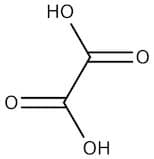
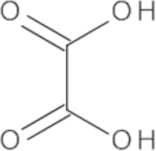
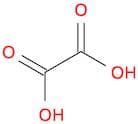
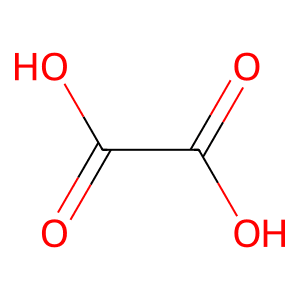
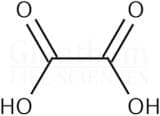
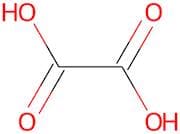
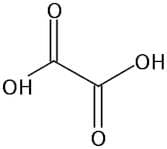
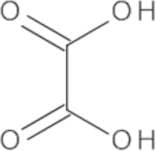
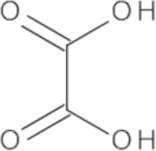
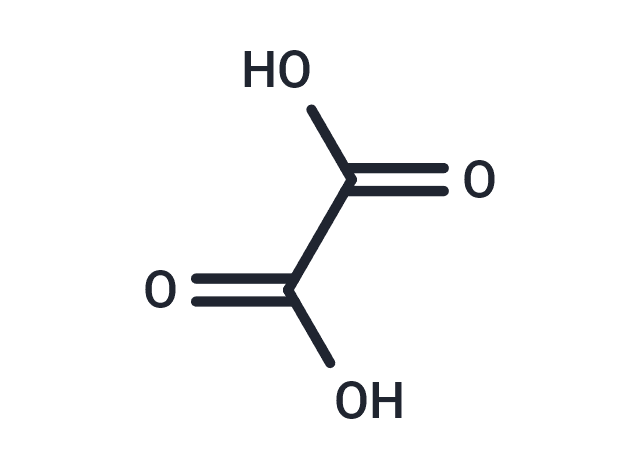
Oxalsäure, mit der CAS-Nummer 144-62-7, ist eine farblose, kristalline organische Verbindung, die als Dicarbonsäure klassifiziert wird. Sie hat eine chemische Formel von C2H2O4 und ist bekannt für ihre starken sauren Eigenschaften, da sie signifikant saurer ist als viele andere Carbonsäuren. Oxalsäure ist hoch wasserlöslich und kann verschiedene Salze bilden, die als Oxalate bekannt sind, wenn sie mit Basen reagiert. Sie kommt natürlich in vielen Pflanzen vor, darunter Rhabarber und Spinat, und wird häufig in verschiedenen industriellen Anwendungen eingesetzt, wie z.B. bei der Metallreinigung, dem Bleichen und als Reduktionsmittel in chemischen Reaktionen. Neben ihren industriellen Anwendungen wird Oxalsäure auch in Laboren für analytische Zwecke verwendet. Es ist jedoch wichtig, Oxalsäure mit Vorsicht zu behandeln, da es giftig und ätzend sein kann und Gesundheitsrisiken bei Einnahme oder Hautkontakt birgt. Ihre Fähigkeit, Metallionen zu chelatisieren, macht sie in verschiedenen chemischen Prozessen wertvoll, aber Sicherheitsvorkehrungen sind aufgrund ihrer potenziellen Gefahren unerlässlich.
Formel:C2H2O4
InChl:InChI=1S/C2H2O4/c3-1(4)2(5)6/h(H,3,4)(H,5,6)
InChI Key:InChIKey=MUBZPKHOEPUJKR-UHFFFAOYSA-N
SMILES:C(C(O)=O)(O)=O
Synonyme:- ACIDO OSSALICO (s)
- Acide oxalique
- Acide(S) Oxalique(S)
- Acido Ossalico
- Acido Oxalico
- Aktisal
- Anhydrous Oxalic Acid
- Aquisal
- ÁCido(S) OxáLico(S)
- DeerClean
- Ethanedioate
- Ethanedioic Acid
- Ethanedioic acid, conjugate acid (1:2)
- Ethanedionic acid
- Nsc 132055
- Nsc 151956
- Nsc 62774
- Nsc 76990
- OA
- OXAALZUUR (s)
- OXALSÄURE(n)
- Oxaalzuur
- Oxagel
- Oxalic Acid (Crystal) C.P. (1LB/BT)
- Oxalic acid anhydrous
- Oxalsaeure
- Oxalsaure
- Refined Oxalic Acid
- Ultraplast Activate S 52
- シュウ酸
- Weitere Synonyme anzeigen
Sortieren nach
Reinheit (%)
0
100
|
0
|
50
|
90
|
95
|
100
17 Produkte.
Oxalic acid, anhydrous, 98%
CAS:Oxalic acid is used as reducing agent for photographic films, as mordant in dyeing process, as bleaching agent for removal of rust through complex formation, and as grinding agent during polishing of marble. It is used in waste water treatment to remove calcium. The conjugate base of oxalic acid aFormel:C2H2O4Reinheit:98%Farbe und Form:White to pale cream, Crystals or powder or crystalline powderMolekulargewicht:90.03Oxalic acid, anhydrous
CAS:Formel:C2H2O4Reinheit:98.0 - 102.0 %Farbe und Form:White crystalline powderMolekulargewicht:90.04Oxalic acid
CAS:Oxalic acid (Ethanedioic acid) is a strong dicarboxylic acid occurring in many plants and vegetables, produced in the body by metabolism of glyoxylic acid.Formel:C2H2O4Reinheit:98.51% - 99.39%Farbe und Form:White Solid CrystallineMolekulargewicht:90.03Oxalic Acid
CAS:Applications An impurity of oxaliplatin which is a coordination complex that is used in cancer chemotherapy.A reducing agent and its conjugate base, known as oxalate (C2O42−), is a useful chelating agent for metal cations.
References Wheate, N., et al.: Dalton Trans., 39, 8113 (2010),Formel:C2H2O4Farbe und Form:White To Off-WhiteMolekulargewicht:90.03Oxalic acid
CAS:Oxalic acid is an organic compound that is a dicarboxylic acid. It is found in many plants, including the leaves of rhubarb and spinach. Oxalic acid exists in two forms: the anhydrous form (known as calcium oxalate) and the hydrated form (known as calcium oxalate dihydrate). The detection sensitivity of this compound can be increased by using a matrix effect. When light emission is detected, it can be used to detect oxalic acid in a solution. Sodium citrate has been shown to increase the sensitivity of the reaction solution for detecting oxalic acid. This reaction creates a particle with sodium carbonate that can be measured by kinetic data.Formel:C2H2O4Reinheit:Min. 95%Farbe und Form:White Off-White PowderMolekulargewicht:90.03 g/molRef: 4Z-A-129036
Ausgelaufenes produkt