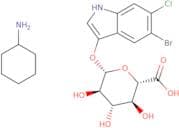
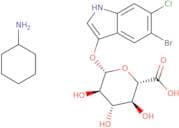
CAS 144110-43-0
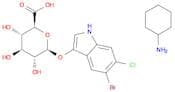
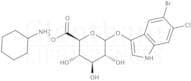
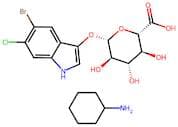
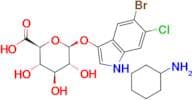
:Cyclohexylammoniumsalz von 5-Brom-6-chlor-3-indolyl-D-glucuronid
- Magenta(Tm)-Beta-D-Glucuronide Cyclohexylammonium Salt
- Magenta(Tm)-Beta-D-Glca Chx
- Magentar-Beta-D-Glucuronide, Cyclohexylammonium Salt
- Magenta-Beta-D-Glca
- Magenta-Beta-D-Glucuronide Chx-Salt
- Magenta Glca Cyclohexylammonium Salt
- Magenta-Glucuro Cha Salt
- Magenta Glucuronide
- cyclohexanamine - 5-bromo-6-chloro-1H-indol-3-yl beta-D-glucopyranosiduronic acid (1:1)
- (2S,3S,4S,5R,6S)-6-[(5-bromo-6-chloro-1H-indol-3-yl)oxy]-3,4,5-trihydroxytetrahydro-2H-pyran-2-carboxylate (non-preferred name)
5-Bromo-6-chloro-3-indolyl β-D-Glucuronide Cyclohexylammonium Salt [for Biochemical Research]
CAS:Formel:C14H13BrClNO7·C6H13NReinheit:>98.0%(HPLC)Farbe und Form:White to Orange to Green powder to crystalMolekulargewicht:521.795-Bromo-6-chloro-3-indolyl-d-glucuronide cyclohexylammonium salt
CAS:Formel:C20H26BrClN2O7Reinheit:98%Molekulargewicht:521.78665-Bromo-6-chloro-3-indolyl b-D-glucuronide cyclohexylammonium salt
CAS:Formel:C14H13BrClNO7·C6H13NReinheit:≥ 98%Farbe und Form:White to off-white crystalline powderMolekulargewicht:521.795-Bromo-6-chloro-3-indolyl-β-D-glucuronide cyclohexyl ammonium salt (1:1)
CAS:5-Bromo-6-chloro-3-indolyl-β-D-glucuronide cyclohexyl ammonium salt (1:1)Formel:C14H13BrClNO7·C6H13NReinheit:>98%Farbe und Form: white powderMolekulargewicht:521.79g/mol5-Bromo-6-chloro-3-indolyl β-D-glucuronide cyclohexylammonium salt
CAS:M04074 - 5-Bromo-6-chloro-3-indolyl beta-D-glucuronide cyclohexylammonium salt
Formel:C20H26BrClN2O7Reinheit:99%Farbe und Form:Solid, Beige powderMolekulargewicht:521.795-Bromo-6-chloro-3-indoxyl-beta-D-glucuronic acid, cyclohexylammonium salt
CAS:Chromogenic substrate for β-D-glucuronidase (GUS) yielding a magenta precipitate. It is used fordetection of GUS+ bacterial colonies as analternative to 5-bromo-4-chloro-3-indoxyl-β-D-glucuronide (X-GlcA).
Formel:C20H26BrClN2O7Reinheit:Min. 99 Area-%Molekulargewicht:521.80 g/mol5-Bromo-6-Chloro-3-Indolyl-ß-D-Glucuronide Cyclohexylammonium Salt extrapure, 98%
CAS:Formel:C14H13BrClNO7·C6H13NReinheit:min. 99%Farbe und Form:White, Crystalline powderMolekulargewicht:521.795-Bromo-6-chloro-3-indolyl b-D-glucuronide cyclohexylammonium salt
CAS:5-Bromo-6-chloro-3-indolyl b-D-glucuronide cyclohexylammonium salt is a magenta enzyme substrate commonly used in biochemical assays. This compound is a derivative of indole, containing bromine and chlorine atoms at positions 5 and 6, respectively. The glucuronide moiety is attached to the indolyl ring, and the cyclohexylammonium cation serves as a counterion to balance the charge. This substrate is often utilized in the detection and quantification of β-glucuronidase activity, an enzyme involved in the metabolism of glucuronides. Upon cleavage by β-glucuronidase, the substrate produces a magenta-colored product, allowing for easy visualization and measurement of enzyme activity.
Formel:C14H13BrClNO7·C6H13NReinheit:Min. 98 Area-%Farbe und Form:PowderMolekulargewicht:521.79 g/molRef: 3D-EB03300
Ausgelaufenes produkt
![5-Bromo-6-chloro-3-indolyl β-D-Glucuronide Cyclohexylammonium Salt [for Biochemical Research]](/_next/image/?url=https%3A%2Fstatic.cymitquimica.com%2Fproducts%2F3B%2Fthumb%2FB4128.jpg&w=3840&q=75)