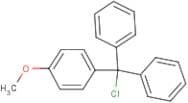
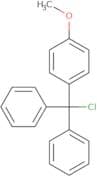
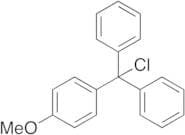
CAS 14470-28-1
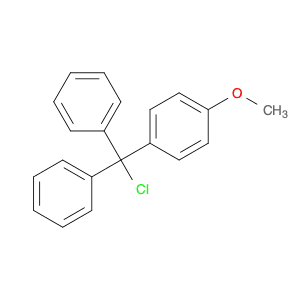
:4-Methoxytritylchlorid
Beschreibung:
4-Methoxytritylchlorid, mit der CAS-Nummer 14470-28-1, ist eine organische Verbindung, die häufig in der organischen Synthese verwendet wird, insbesondere im Bereich der Nukleinsäurechemie. Sie ist gekennzeichnet durch das Vorhandensein einer Methoxygruppe (-OCH3), die an eine Tritylgruppe gebunden ist, die eine voluminöse, stabile Schutzgruppe für Hydroxylfunktionen darstellt. Diese Verbindung erscheint typischerweise als weißer bis off-white fester Stoff und ist in organischen Lösungsmitteln wie Dichlormethan und Chloroform löslich. Ihre Reaktivität wird hauptsächlich auf das Vorhandensein der Chloridfunktion zurückgeführt, die an nucleophilen Substitutionsreaktionen teilnehmen kann. 4-Methoxytritylchlorid wird häufig verwendet, um Hydroxylgruppen bei der Synthese von Oligonukleotiden zu schützen, was selektive Reaktionen ohne Störungen durch andere funktionelle Gruppen ermöglicht. Sicherheitsvorkehrungen sollten beim Umgang mit dieser Verbindung getroffen werden, da sie reizend sein kann und geeignete Lagerbedingungen erforderlich sind, um ihre Stabilität zu gewährleisten.
Formel:C20H17ClO
InChl:InChI=1S/C20H17ClO/c1-22-19-14-12-18(13-15-19)20(21,16-8-4-2-5-9-16)17-10-6-3-7-11-17/h2-15H,1H3
InChI Key:InChIKey=OBOHMJWDFPBPKD-UHFFFAOYSA-N
SMILES:C(Cl)(C1=CC=C(OC)C=C1)(C2=CC=CC=C2)C3=CC=CC=C3
Synonyme:- (p-Anisyl)diphenylmethyl chloride
- 1-(Chlorodiphenylmethyl)-4-Methoxybenzene
- 4-Anisyl(chloro)diphenylmethane
- 4-Methoxytriphenylchloromethane
- 4-Methoxytrityl chloride
- 4-Monomethoxytrityl chloride
- Anisole, p-(chlorodiphenylmethyl)-
- Benzene, 1-(chlorodiphenylmethyl)-4-methoxy-
- MMTCl
- Mmt-Cl
- Mono-p-methoxytrityl chloride
- NSC 54121
- [(Chloro)(4-methoxyphenyl)methylene]dibenzene
- p-(Chlorodiphenylmethyl)anisole
- p-Anisylchlorodiphenylmethane
- Weitere Synonyme anzeigen
Sortieren nach
Reinheit (%)
0
100
|
0
|
50
|
90
|
95
|
100
8 Produkte.
4-Methoxytrityl Chloride [Hydroxyl Protecting Agent]
CAS:Formel:C20H17ClOReinheit:>98.0%(T)(HPLC)Farbe und Form:White to Light yellow to Light orange powder to crystalMolekulargewicht:308.814-Methoxytrityl chloride, 97%
CAS:It is used as selective protecting reagent that is used for primary hydroxyl groups. This Thermo Scientific Chemicals brand product was originally part of the Alfa Aesar product portfolio. Some documentation and label information may refer to the legacy brand. The original Alfa Aesar product / itemFormel:C20H17ClOReinheit:97%Farbe und Form:Crystals or powder or crystalline powder, White to cream to pale orange or pinkMolekulargewicht:308.81Benzene, 1-(chlorodiphenylmethyl)-4-methoxy-
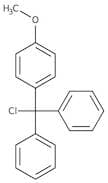
CAS:Formel:C20H17ClOReinheit:95%Farbe und Form:SolidMolekulargewicht:308.80141-[Chloro(diphenyl)methyl]-4-methoxybenzene
CAS:Reinheit:97.0%Farbe und Form:SolidMolekulargewicht:308.809997558593754-Methoxytrityl chloride
CAS:4-Methoxytrityl chlorideFormel:C20H17ClOReinheit:98%Farbe und Form: orange crystalsMolekulargewicht:308.80g/mol4-Anisylchlorodiphenylmethane
CAS:4-Anisylchlorodiphenylmethane is a trifluoroacetic acid derivative of diphenyl sulfoxide. It is activated by hydrochloric acid and hydrogen chloride to form the corresponding anisyl chlorodiphenylmethane chloride. This compound has a high resistance to nucleophilic attack, with a reaction solution that is resistant to nucleophiles such as water, amines, alcohols, and carboxylic acids. 4-Anisylchlorodiphenylmethane can be synthesized from uridine and acetic acid in the presence of diphenyl sulfoxide and a base. The reaction is then heated at reflux for 24 hours. 4-Anisylchlorodiphenylmethane binds to DNA as well as RNA templates in vitro and can be used for linear regression analysis of DNA sequences. It also has inhibitory effects on cell growth in culture.Formel:C20H17ClOReinheit:Min. 95%Farbe und Form:White PowderMolekulargewicht:308.8 g/mol4-Methoxytriphenylmethylchloride
CAS:Kontrolliertes ProduktApplications 4-Methoxyriphenylmethylchloride is used in the synthesis of N-sulfonyl imines.
References Khalafi-Nezhad, A. et al.: Can. J. Chem., 86, 456 (2008);Formel:C20H17ClOFarbe und Form:NeatMolekulargewicht:308.8
![4-Methoxytrityl Chloride [Hydroxyl Protecting Agent]](/_next/image/?url=https%3A%2Fstatic.cymitquimica.com%2Fproducts%2F3B%2Fthumb%2FM0790.jpg&w=3840&q=75)



![1-[Chloro(diphenyl)methyl]-4-methoxybenzene](/_next/image/?url=https%3A%2Fstatic.cymitquimica.com%2Fproducts%2F10%2Fthumb%2FF067663.jpg&w=3840&q=75)