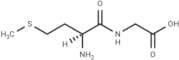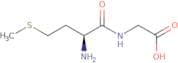
CAS 14486-03-4
:L-Methionylglycin
Beschreibung:
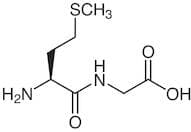
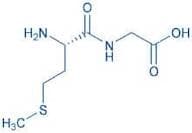
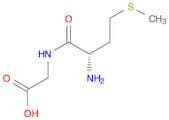
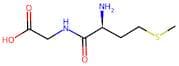
L-Methionylglycin, mit der CAS-Nummer 14486-03-4, ist ein Dipeptid, das aus den Aminosäuren L-Methionin und Glycin besteht. Es zeichnet sich durch seine Struktur aus, die ein Methionin-Rest zeigt, der durch eine Peptidbindung mit einem Glycin-Rest verbunden ist. Diese Verbindung hat typischerweise ein weißes bis off-white Aussehen und ist in Wasser löslich, was die polare Natur ihrer Aminosäurekomponenten widerspiegelt. L-Methionylglycin spielt eine Rolle in verschiedenen biologischen Prozessen, einschließlich der Proteinsynthese und des Stoffwechsels, und wird oft wegen seiner potenziellen Anwendungen in der Ernährung und Pharmazie untersucht. Als Peptid kann es spezifische biologische Aktivitäten aufweisen, einschließlich antioxidativer Eigenschaften, und kann als Baustein für größere Peptide oder Proteine dienen. Seine Stabilität und Reaktivität können von Faktoren wie pH und Temperatur beeinflusst werden, was es wichtig macht, diese Bedingungen in experimentellen Einstellungen zu berücksichtigen. Insgesamt ist L-Methionylglycin eine bedeutende Verbindung in der Biochemie und Molekularbiologie, die zu unserem Verständnis der Funktionen und Wechselwirkungen von Peptiden beiträgt.
Formel:C7H14N2O3S
InChl:InChI=1S/C7H14N2O3S/c1-13-3-2-5(8)7(12)9-4-6(10)11/h5H,2-4,8H2,1H3,(H,9,12)(H,10,11)/t5-/m0/s1
InChI Key:InChIKey=QXOHLNCNYLGICT-YFKPBYRVSA-N
SMILES:C([C@H](CCSC)N)(NCC(O)=O)=O
Synonyme:- 11: PN: WO2020046069 SEQID: 12 claimed protein
- 16: PN: WO2018144831 SEQID: 16 claimed protein
- 2-[(2S)-2-Amino-4-(methylsulfanyl)butanamido]acetic acid
- 2-[[(2S)-2-Amino-4-methylsulfanylbutanoyl]amino]acetic acid
- 205: PN: WO2008142164 SEQID: 206 claimed protein
- 21: PN: WO2011023914 SEQID: 18 unclaimed protein
- 317: PN: WO2008077945 SEQID: 323 claimed protein
- 34: PN: FR2949473 SEQID: 18 unclaimed protein
- 38: PN: US20100104568 SEQID: 206 claimed protein
- <span class="text-smallcaps">L</span>-Methionylglycine
- Glycine, <span class="text-smallcaps">L</span>-methionyl-
- Glycine, L-methionyl-
- Glycine, N-<span class="text-smallcaps">L</span>-methionyl-
- Glycine, N-L-methionyl-
- H-Met-Gly-OH
- Met-Gly
- Methionylglycine
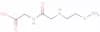
- N-[2-(methylsulfanyl)ethyl]glycylglycine
- NSC 88865
- {[(2S)-2-ammonio-4-(methylsulfanyl)butanoyl]amino}acetate
- Weitere Synonyme anzeigen
Sortieren nach
Reinheit (%)
0
100
|
0
|
50
|
90
|
95
|
100
7 Produkte.
L-Methionylglycine
CAS:Formel:C7H14N2O3SReinheit:min. 98.0 area%(HPLC)Farbe und Form:White to Almost white powder to crystalMolekulargewicht:206.26H-Met-Gly-OH
CAS:The Pt(II) dipeptide complex (Met-Gly)PtCl₂ shows in vitro toxicity against various tumor cell lines.Formel:C7H14N2O3SReinheit:> 99%Farbe und Form:White PowderMolekulargewicht:206.27(S)-2-(2-Amino-4-(methylthio)butanamido)acetic acid
CAS:Formel:C7H14N2O3SReinheit:97%Farbe und Form:SolidMolekulargewicht:206.2627(S)-2-(2-Amino-4-(Methylthio)Butanamido)Acetic Acid
CAS:(S)-2-(2-Amino-4-(Methylthio)Butanamido)Acetic AcidReinheit:98%Molekulargewicht:206.26g/molL-Methionylglycine
CAS:L-Methionylglycine is an agent of the dipeptide.Formel:C7H14N2O3SFarbe und Form:SolidMolekulargewicht:206.26H-Met-Gly-OH
CAS:H-Met-Gly-OH is a radical scavenger that has been shown to have potent antioxidant properties. It is an amide with two nitrogen atoms and can be used as a marker protein in human serum, where it binds to fatty acids and inhibits the formation of free radicals. H-Met-Gly-OH has been shown to chelate metal ions such as copper, iron, and zinc. The uptake of these metal ions by the human body may cause genotoxic effects or other toxic reactions, which can be prevented by using H-Met-Gly-OH as a chelating agent. This compound also has broad spectrum antimicrobial activity against microbes that are resistant to many antibiotics.Formel:C7H14N2O3SReinheit:Min. 95%Molekulargewicht:206.26 g/mol