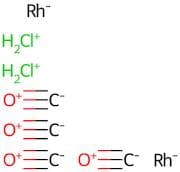
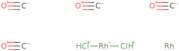
CAS 14523-22-9
:Rhodium, tetracarbonyl-di-μ-chlorodi-
Beschreibung:
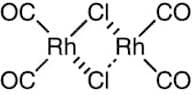
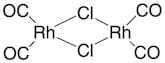
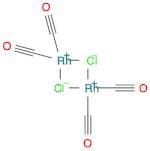
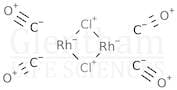
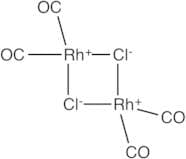
Rhodium, tetracarbonyl-di-μ-chlorodi- ist eine Koordinationsverbindung, die Rhodium als zentrales Metallatom aufweist, koordiniert von Kohlenmonoxid (CO)-Liganden und Chloridionen. Diese Verbindung zeichnet sich durch ihre einzigartige Struktur aus, bei der zwei Rhodiumzentren durch zwei Chloridionen verbunden sind und jedes Rhodiumatom zusätzlich an zwei Kohlenmonoxidliganden koordiniert ist. Die Anwesenheit von Kohlenmonoxid trägt zur Stabilität der Verbindung und ihrer Fähigkeit bei, an verschiedenen chemischen Reaktionen, einschließlich katalytischer Prozesse, teilzunehmen. Rhodiumkomplexe sind bekannt für ihre Anwendungen in der Katalyse, insbesondere in der organischen Synthese und industriellen Prozessen, aufgrund ihrer Fähigkeit, Reaktionen wie Hydrierung und Carbonylierung zu erleichtern. Die Bezeichnung Tetracarbonyl-di-μ-chlorid-di- weist auf die spezifische Anordnung der Liganden um die Rhodiumzentren hin, die die Reaktivität und Eigenschaften der Verbindung beeinflusst. Insgesamt veranschaulicht diese Verbindung die reiche Chemie der Übergangsmetallkomplexe, insbesondere derjenigen, die Rhodium betreffen, das für seine katalytischen Fähigkeiten und einzigartigen elektronischen Eigenschaften geschätzt wird.
Formel:C4Cl2O4Rh2
InChl:InChI=1S/4CO.2ClH.2Rh/c4*1-2;;;;/h;;;;2*1H;;/q;;;;;;2*+1/p-2
InChI Key:InChIKey=FGKDXBICTVUSPK-UHFFFAOYSA-L
SMILES:C(#O)[Rh+]1(C#O)[Cl-][Rh+](C#O)(C#O)[Cl-]1
Synonyme:- Bis(chlororhodiumdicarbonyl)
- Bis(dicarbonyl(μ-chloro)rhodium)
- Bis(dicarbonylchlororhodium)
- Bis(dicarbonylrhodium chloride)
- Bis(μ-chloro)bis(dicarbonylrhodium)
- Carbon Monoxide
- Chlorodicarbonylrhodium dimer
- Chlorodicarbonylrhodium(I) dimer
- Chlororhodium dicarbonyl dimer
- Di-Mu-Chloro-Bis(Dicarbonylrhodium)
- Di-My-Chloro-Tetracarbonyldirhodium
- Di-mu-chloro-tetracarbonyldirhodium
- Di-Μ-Chloro-Bis(Dicarbonylrhodium)
- Di-Μ-Cloro-Bis(Dicarbonilrodio)
- Di-μ-Chlorotetracarbonyldirhodium(I)
- Di-μ-chlor-bis(dicarbonylrhodium)
- Dicarbonylchlororhodium dimer
- Dicarbonylrhodium chloride dimer
- Dichloride
- Dichlorodirhodiumtetracarbonyl
- Dichlorotetracarbonyldirhodium
- Dirhodium tetracarbonyl dichloride
- Nsc 120116
- Rhodium carbonyl chloride
- Rhodium carbonyl chloride (Rh2(CO)4Cl2)
- Rhodium carbonyl chloride (Rh<sub>2</sub>(CO)<sub>4</sub>Cl<sub>2</sub>)
- Rhodium carbonyl chloride dimer
- Rhodium dicarbonyl chloride dimer
- Rhodium(+1) Cation
- Rhodium, tetracarbonyldi-μ-chlorodi-
- Tetracarbonyl-μ,μ'-dichlorodirhodium
- Tetracarbonyl-μ,μ'-dichlorodirhodium(I)
- Tetracarbonylbis(μ-chloro)dirhodium
- Tetracarbonyldi-μ-chlorodirhodium
- Tetracarbonyldichlorodirhodium
- [Rh(CO)2Cl]2
- tetracarbonyldi-U-chlorodirhodium(I)
- Weitere Synonyme anzeigen
Sortieren nach
Reinheit (%)
0
100
|
0
|
50
|
90
|
95
|
100
7 Produkte.
Tetracarbonyldi-^m-chlorodirhodium(I), Rh 50.1-52.9%
CAS:It is used widely as a chemical for research purposes as well as it acts as a a biochemical for proteomics research. This Thermo Scientific Chemicals brand product was originally part of the Alfa Aesar product portfolio. Some documentation and label information may refer to the legacy brand. The ori
Formel:C4Cl2O4Rh2Molekulargewicht:388.75Chlorodicarbonylrhodium(I) dimer
CAS:Chlorodicarbonylrhodium(I) dimer
Formel:RhCl(CO)2Farbe und Form:red xtl.Molekulargewicht:388.76Tetracarbonyldi-mu-chlorodirhodium(i)
CAS:Formel:C4Cl2O4Rh2Reinheit:98%Farbe und Form:SolidMolekulargewicht:388.7574Tetracarbonyl dichlorodirhodium(I)
CAS:Formel:Rh(CO)2ClFarbe und Form:Dark red to red-brown powderMolekulargewicht:388.76Rhodium(I) dicarbonyl chloride dimer
CAS:Rhodium(I) dicarbonyl chloride dimerReinheit:98%Farbe und Form:CrystalsMolekulargewicht:345.90g/molRhodium Carbonyl Chloride
CAS:Kontrolliertes ProduktApplications Rhodium Carbonyl Chloride is a reagent for rhodium-catalyzed [4+2+1] cycloaddition of in situ generated ene/yne-ene-allenes and carbon monoxide to produce [4+2+1] cycloadducts
References Tian, Z.Y., et al.: Angewandte Chemie Int. Ed.’ 57, 15544 (2018)Formel:CO·2Cl·2RhFarbe und Form:NeatMolekulargewicht:388.757Di-¼-chloro-tetracarbonyldirhodium(I)
CAS:Di-¼-chloro-tetracarbonyldirhodium(I) is a compound that has been shown to catalyze the carbonylation of various organic substrates in the presence of oxygen. In the presence of a catalytic amount of di-¼-chloro-tetracarbonyldirhodium(I), aniline was converted to 4,4'-dichlorobenzophenone with a yield of 43%. The same reaction also produced 3,3'-dichlorobenzophenone and 2,2'-dichlorobenzophenone as side products. The compound was obtained by reacting hexanes with chlorodirhodium trichloride in the presence of air. The structural analysis was performed using x-ray diffraction technique on an orange powder. It was found that the compound crystallizes in a monoclinic space group with unit cell dimensions a=7.5 ÅFormel:C4Cl2O4Rh2Reinheit:Min. 95%Molekulargewicht:388.76 g/mol