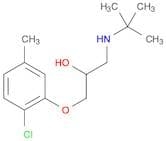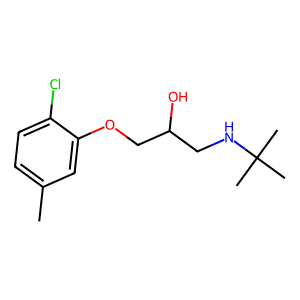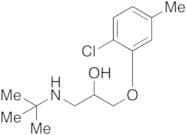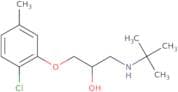
CAS 14556-46-8
:(±)-Bupranolol
Beschreibung:
(±)-Bupranolol ist ein nicht-selektiver Beta-Adrenozeptor-Antagonist, der hauptsächlich zur Behandlung von Bluthochdruck und bestimmten Arten von Herzrhythmusstörungen eingesetzt wird. Er zeichnet sich durch seine Fähigkeit aus, sowohl Beta-1- als auch Beta-2-Adrenozeptoren zu blockieren, was hilft, die Herzfrequenz und den Blutdruck zu senken. Die Verbindung ist ein racemisches Gemisch, was bedeutet, dass es gleiche Teile von zwei Enantiomeren enthält, die unterschiedliche pharmakologische Wirkungen zeigen können. Bupranolol wird typischerweise oral verabreicht und ist bekannt für seine relativ moderate Lipophilie, die es ihm ermöglicht, biologische Membranen effektiv zu durchdringen. Seine chemische Struktur umfasst eine phenolische Hydroxylgruppe und eine sekundäre Aminogruppe, die zu seiner pharmakologischen Aktivität beiträgt. Die Substanz ist auch mit potenziellen Nebenwirkungen wie Müdigkeit, Schwindel und gastrointestinalen Störungen verbunden, die bei Beta-Blockern häufig sind. Wie bei anderen Medikamenten seiner Klasse ist eine sorgfältige Überwachung unerlässlich, um die Dosierung zu steuern und unerwünschte Wirkungen zu mindern. Insgesamt spielt (±)-Bupranolol eine bedeutende Rolle in der kardiovaskulären Therapie und zeigt die Bedeutung von Beta-Blockern in der klinischen Praxis.
Formel:C14H22ClNO2
InChl:InChI=1S/C14H22ClNO2/c1-10-5-6-12(15)13(7-10)18-9-11(17)8-16-14(2,3)4/h5-7,11,16-17H,8-9H2,1-4H3
InChI Key:InChIKey=HQIRNZOQPUAHHV-UHFFFAOYSA-N
SMILES:O(CC(CNC(C)(C)C)O)C1=C(Cl)C=CC(C)=C1
Synonyme:- 1-(2-Chloro-5-methylphenoxy)-3-[(1,1-dimethylethyl)amino]-2-propanol
- 1-(Tert-Butylamino)-3-(2-Chloro-5-Methylphenoxy)Propan-2-Ol
- 1-(tert-Butylamino)-3-((6-chloro-m-tolyl)-oxy)-2-propanol
- 1-t-Butylamino-3-(2-chloro-5-methylphenoxy) -2-propanol
- 2-Propanol, 1-(2-chloro-5-methylphenoxy)-3-((1,1-dimethylethyl)amino)-
- 2-Propanol, 1-(tert-butylamino)-3-((6-chloro-m-tolyl)oxy)- (8CI)
- 2-Propanol, 1-(tert-butylamino)-3-(2-chloro-5-methylphenoxy)-
- 2-Propanol, 1-(tert-butylamino)-3-(6-chloro-m-tolyloxy)-
- 2-Propanol, 1-(tert-butylamino)-3-[(6-chloro-m-tolyl)oxy]-
- 3-(tert-Butylamino)-1-(6-chloro-m-tolyloxy)-2-propanol
- Brn 2272923
- Bupranol
- Bupranolol [INN:DCF]
- Bupranololum
- Bupranololum [INN-Latin]
- Kl 255
- Ophtorenin
- Sk&F 16805-A
- Unii-858Ygi5Pit
- Bupranolol
- Weitere Synonyme anzeigen
Sortieren nach
Reinheit (%)
0
100
|
0
|
50
|
90
|
95
|
100
6 Produkte.
Bupranolol
CAS:Bupranolol blocks β2-adrenergic receptor; treats angina, hypertension, glaucoma, arrhythmia, and prevents clots.Formel:C14H22ClNO2Reinheit:97.63%Farbe und Form:SolidMolekulargewicht:271.78Ref: TM-T8580
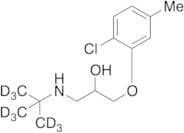
1mg52,00€5mg105,00€10mg159,00€25mg309,00€50mg440,00€100mg583,00€200mg785,00€1mL*10mM (DMSO)96,00€Bupranolol-d9
CAS:Kontrolliertes ProduktApplications Isotope labelled Bupranolol is an antagonist at the cardiostimulatory low-affinity state of b(1)-adrenoceptors and is known to treat hypertension and tachycardia.
References Zelaszczyk, D., et al.: J. Physiol. Pharmacol., 60, 51 (2009); Wachter, W., et al.: Naunyn. Schmiedebergs. Arch. Pharmacol., 313, 1 (1980);Formel:C14H13D9ClNO2Farbe und Form:NeatMolekulargewicht:280.84Bupranolol
CAS:Kontrolliertes ProduktApplications Bupranolol is an antagonist at the cardiostimulatory low-affinity state of b(1)-adrenoceptors and is known to treat hypertension and tachycardia.
References Zelaszczyk, D., et al.: J. Physiol. Pharmacol., 60, 51 (2009); Wachter, W., et al.: Naunyn. Schmiedebergs. Arch. Pharmacol., 313, 1 (1980);Formel:C14H22ClNO2Farbe und Form:NeatMolekulargewicht:271.78Bupranolol
CAS:Bupranolol is a chiral compound that has been used to study the involvement of fat cells in the development of hypertension. Bupranolol is a beta-adrenergic receptor antagonist that binds to and inhibits the activity of beta-adrenergic receptors on fat cells, which decreases the breakdown of fatty acids and lowers blood pressure. The effects of bupranolol on mice with an experimental model of urinary bladder dysfunction have been studied using monoclonal antibodies. Results show that bupranolol can relax detrusor muscle and increase urethral sphincter pressure, thereby treating urinary incontinence. The pharmacological treatment for cardiac arrhythmias such as supraventricular tachycardia, atrial fibrillation, and ventricular tachycardia includes intravenous administration of bupranolol. This drug can also be given orally or intramuscularly for other cardiovascular conditions such as angina pectoris and cardiogenicFormel:C14H22ClNO2Reinheit:Min. 95%Farbe und Form:PowderMolekulargewicht:271.78 g/mol