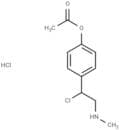
![4-[1-chloro-2-(methylamino)ethyl]phenyl acetate hydrochloride](/_next/image/?url=https%3A%2Fstatic.cymitquimica.com%2Fcas-image%2Fthumb-webp%2F217734-4-1-chloro-2-methylamino-ethyl-phenyl-acetate-hydrochloride.webp&w=3840&q=75)
CAS 14593-25-0
:4-[1-chlor-2-(methylamino)ethyl]phenylacetat hydrochlorid
Beschreibung:
4-[1-chlor-2-(methylamino)ethyl]phenylacetat hydrochlorid, mit der CAS-Nummer 14593-25-0, ist eine chemische Verbindung, die durch ihre strukturellen Merkmale gekennzeichnet ist, die eine Phenylacetat-Gruppe und eine mit einer Methylaminogruppe substituierte Chlorethylgruppe umfassen. Diese Verbindung erscheint typischerweise als weißes bis off-white kristallines Feststoff und ist in Wasser und organischen Lösungsmitteln löslich, was für viele Chloridrat-Salze üblich ist. Die Anwesenheit der Chloro- und Aminogruppen deutet auf eine potenzielle Reaktivität hin, was sie in verschiedenen chemischen Anwendungen, einschließlich der medizinischen Chemie, von Interesse macht. Ihre Chloridrat-Form zeigt an, dass es sich um ein Salz handelt, das oft seine Stabilität und Löslichkeit in biologischen Systemen verbessert. Die Verbindung kann pharmakologische Eigenschaften aufweisen, die potenziell die Neurotransmittersysteme beeinflussen, obwohl spezifische biologische Aktivitäten weitere Untersuchungen erfordern würden. Sicherheitsdaten sollten für den Umgang und die Verwendung konsultiert werden, da die Anwesenheit von Chlor- und Aminogruppen Gesundheitsrisiken darstellen kann.
Formel:C11H15Cl2NO2
InChl:InChI=1/C11H14ClNO2.ClH/c1-8(14)15-10-5-3-9(4-6-10)11(12)7-13-2;/h3-6,11,13H,7H2,1-2H3;1H
SMILES:CC(=O)Oc1ccc(cc1)C(CNC)Cl.Cl
Synonyme:- 4-[1-Chloro-2-(methylamino)ethyl]phenyl acetate hydrochloride (1:1)
- Phenol, 4-[1-chloro-2-(methylamino)ethyl]-, acetate (ester), hydrochloride (1:1)
Sortieren nach
Reinheit (%)
0
100
|
0
|
50
|
90
|
95
|
100
5 Produkte.
4-[1-Chloro-2-(methylamino)ethyl]phenyl acetate, HCl
CAS:Formel:C11H15Cl2NO2Reinheit:97%Farbe und Form:SolidMolekulargewicht:264.14834-(1-Chloro-2-(methylamino)ethyl)phenyl acetate hydrochloride
CAS:4-(1-Chloro-2-(methylamino)ethyl)phenyl acetate hydrochlorideReinheit:97%Molekulargewicht:264.15g/mol4-[1-Chloro-2-(methylamino)ethyl]phenyl acetate hydrochloride
CAS:Apigenin is a plant flavonoid that binds to nuclear receptors and has been shown to have biological effects in the test tube. Apigenin blocks the binding of ginsenoside Rf to its receptor, which may be due to its similarity in structure to glycyrrhetinic acid and phytosteroids. Apigenin also interacts with other compounds that are endogenous or exogenous. This includes glycyrrhetinic acid, phytoestrogens, and steroids.Formel:C11H14ClNO2·HClReinheit:Min. 95%Farbe und Form:PowderMolekulargewicht:264.15 g/mol4-(1-Chloro-2-(methylamino)ethyl)phenyl acetate hydrochloride
CAS:Formel:C11H15Cl2NO2Reinheit:97%Molekulargewicht:264.15Glucocorticoid receptor activator 1
CAS:Glucocorticoid Receptor Activator 1, a phenyl nitrogen-heterocyclic precursor, acts as an activator of the glucocorticoid receptor (GR). By activating GR, it downregulates the expression of pro-inflammatory genes stimulated by TNF, making it useful for inflammation research.Formel:C11H15Cl2NO2Farbe und Form:SolidMolekulargewicht:264.15
![4-[1-Chloro-2-(methylamino)ethyl]phenyl acetate, HCl](/_next/image/?url=https%3A%2Fstatic.cymitquimica.com%2Fproducts%2FIN%2Fthumb%2FDA001DIT.jpg&w=3840&q=75)


![4-[1-Chloro-2-(methylamino)ethyl]phenyl acetate hydrochloride](/_next/image/?url=https%3A%2Fstatic.cymitquimica.com%2Fproducts%2F3D%2Fthumb%2FPAA59325.jpg&w=3840&q=75)